

By Jonathan StaceyPosted: Updated: 17 min read
How Much Does A Website Cost In Thailand
What a website costs in Thailand depends on its scope, which means the number and type of pages, the design rounds, the languages, the connected systems, who writes the content and the care after launch. Only the domain and platform plans have listed prices. Across 146 Primal client websites in one week, about 6 in 10 Google clicks came from phones, so the phone layout is part of the price.
Key Takeaways
- THNIC, which runs the .th domains, lists 800 baht a year before value added tax (VAT) to register or renew a .co.th domain, while design and development are priced from the scope in each quote.
- We found no survey of website prices in Thailand that states its method and sample, so the price ranges on other pages are each company's own prices.
- In one week of Google Search Console data from 146 Primal client websites, 107 got more than half their clicks from phones, so every page design needs a phone layout.
- Across 78 Primal client websites with an article section, the home page got about 9% of its clicks from searches without the brand name, against about 60% for product and service pages, so the number of service pages is part of the price.
- Before you sign, make the quote say whose name the domain, hosting account, code and content are in, and what you get back when the contract ends.
What Sets The Cost Of A Website In Thailand
How much a website costs in Thailand depends on 8 parts of the scope. The first four are the number and type of pages, the design rounds, the languages and the systems the site connects to. The other four are the content and photos, the platform, the team and the care after launch. So two websites that look alike can cost very different amounts, because their quotes cover different work.
Only two parts have listed prices, the domain and the platform plan. We found no survey of website prices in Thailand that states its method and how many people it asked. The price ranges on other pages are each company’s own prices, and most give no source. On Clutch’s Thailand web design list, read 2026-10-22, most listed firms set a minimum project size between 1,000 and 5,000 US dollars. Clutch is a directory of agencies, and each firm enters this figure itself as the smallest project it accepts. The fair way to compare is line by line, on the scope in each quote.
The phone layout is part of that scope. We looked at one week of Google Search Console data from 146 Primal client websites. On the median site, about 6 in 10 Google clicks came from phones. On 107 of the 146 sites, phones brought more than half the clicks.
The chart groups the 146 websites by the share of their clicks that came from phones.
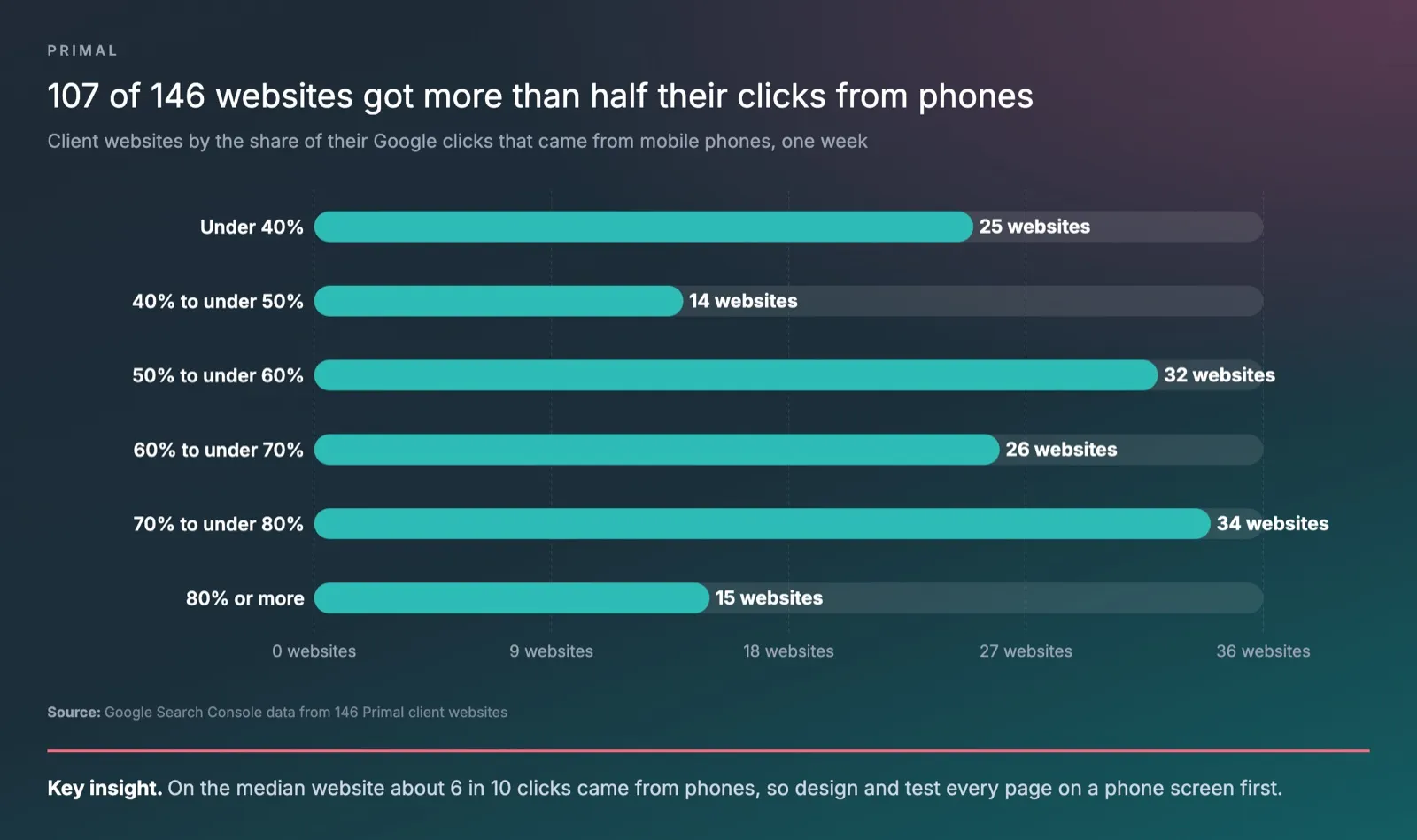
Only 39 sites got more of their clicks from computers and tablets. A good quote says how each page is designed and tested on a phone, and which pages new customers will find in search.
Which Costs Make Up The Price Of A Website
The costs of a website fall into two groups. You pay the first group once, while the site is made, for the sitemap, the design, the development, the content and the set-up of each system. You pay the second group every year or month, for the domain, the hosting or platform plan, the plugins or apps that renew, and the care of the site.
What A Domain Costs
THNIC’s .co.th page lists 800 baht a year to register or renew a .co.th domain, before value added tax (VAT), and THNIC’s price page gives 856 baht a year with VAT. THNIC runs the .th domains. A domain is the site’s address, such as yourbrand.co.th or yourbrand.com, and you renew it every year.
A .co.th domain needs one document, such as a company registration, a VAT registration or a trademark registration. The domain name has to match the company, shop or trademark name in that document. Register it in your own company’s name, because the name on the record holds the rights to the domain.
What Hosting And Platform Plans Cost
Hosting and platform plans are paid every month or every year. Hosting is the server that stores the site’s files and sends each page to visitors. A WordPress site you install yourself needs its own hosting, while a hosted platform includes it in the plan.
These are the listed prices we read on each platform’s pricing page from Thailand on 2026-10-22.
- WordPress.com lists its Personal plan at 130 baht a month billed yearly, or 300 baht paying monthly, before tax. Yearly plans include a domain for the first year.
- Shopify lists its Basic plan at 22 US dollars a month paying yearly, or 25 US dollars paying monthly. Its pricing page shows only US dollars from Thailand, so the plan is billed in dollars. The plan includes hosting and a Secure Sockets Layer (SSL) certificate, which encrypts the connection. Shopify adds a 2% fee when you use an outside payment provider.
- Squarespace lists its Basic plan at 350 baht a month paying yearly, or 500 baht paying monthly.
These prices pay for the system only. They do not cover the design, the content or the people who make the site. Platforms change prices and run promotions often, so open the pricing page again on the day you decide.
What The Sitemap And Design Cover
A sitemap is the list of every page and the order of the menus. It sets the price of nearly every line, because the number of pages multiplies the design, the development and the content. Agree the sitemap before you accept the final quote.
Design usually includes a set number of revision rounds, and rounds beyond that cost extra. The quote should state the number of rounds. It should also say whether you will review a phone design and a desktop design, or only one of them.
What Development Covers
Development turns each design into working pages in a content management system (CMS), such as WordPress. Pages of the same kind, such as product pages or articles, share one template. The first page of a template takes the most time. Each later page that reuses it takes less. So a 30-page site with only 4 page types can cost less than a 15-page site where every page is different.
Who Writes The Content And Supplies The Photos
Content is two jobs. One is writing it, and the other is loading it into the site, such as each product, article and image. A quote should list the two jobs apart and say who writes and who finds the photos. Photography is usually not part of the website price. If you write the content yourself, put the date you will send it into the plan, because the launch date depends on it.
What A Second Language Adds
A website in Thai and English needs a separate page for each language. Google’s page on multilingual sites recommends a different web address, or uniform resource locator (URL), for each language version, rather than cookies or browser settings. It also asks you to use hreflang annotations, so search results link to the right language, and not to send visitors to another language automatically.
A second language adds a second set of pages, the content in that language and the language switch. Content translated from the other language costs less. But people search with different words in each language, so content written new from the searches in that language matches what people type. Ask the quote to say whether the second language is a translation or new writing.
Which Systems The Website Connects To
Each system the site sends data to is its own set-up and test. A quote should list them one by one.
- A contact form that sends to email or to a customer relationship management (CRM) system, such as HubSpot
- A LINE Official Account button, and tracking of how often people tap it
- A booking system for appointments or rooms
- A payment gateway for an online shop, which you apply for with the payment provider and which charges its own fees
- Tracking in Google Analytics 4, such as form sends and phone taps
- A cookie consent banner and a privacy policy page
Online shops come in two kinds that cost different amounts. The first shows the products and lets customers order on LINE. The second takes payment on the site, which adds a cart, a checkout page and payment tests.
What Care After Launch Covers
Care after launch covers updates to the CMS, the theme and the plugins, backups, and fixes when the site stops working. A good care plan applies each update to a staging copy of the site first and checks the main pages before the live site changes. Ask whether the plan covers content edits, and whether server work, such as a server software upgrade, is included or charged apart.
Three costs renew every year. They are the domain, the hosting or platform plan, and any plugins or apps with a yearly licence. Ask the team that makes your site for this list with the due dates.
How A Template, A New Design And A Hosted Platform Differ
There are three ways to get a site. They differ in what you pay at the start, what you pay each month and whether you can take the site elsewhere. This table compares them without any company’s prices.
| Hosted platform you set up yourself | Template set up for you | New design for every page type | |
|---|---|---|---|
| Examples | Wix, Shopify, Squarespace, WordPress.com | A ready-made theme on WordPress or Shopify, with your colours and content | Each page type designed new, then developed on the CMS you choose |
| Paid at the start | The least, because you do the work | Set-up and changes to the theme | The sitemap, the design and the development of every template |
| Paid after launch | The monthly or yearly plan for as long as the site runs | Hosting, the theme and yearly plugin licences | Hosting, plugins and care |
| Can you take it elsewhere | Hard, and the site stops when you stop paying for the plan | Yes, if the hosting account is in your name | Yes, if the contract gives you the code and files |
| Suits | A small shop, or a business with a few pages and someone to run them | A business that needs a site soon and has few page types | A business with several services, two languages or several connected systems |
| Limits | Page layout and speed only as far as the platform allows | Looks like other sites on the same theme | Takes the longest and costs the most at the start |
The same choice comes up for features a platform does not have. You can rent an add-on service each month, such as automatic translation. That costs less at the start, but it stops working when you stop paying. Or you can make the feature part of the site. That costs more at the start, but you own it, and the content in each language can differ.
What Pushes The Cost Up Or Down
The cost of a website goes up when page types, languages or connected systems are added. It goes down when pages can reuse templates and you prepare the content yourself.
These push the price up.
- Many page types that each need their own design
- More revision rounds than agreed
- Two languages with new writing in each
- A payment gateway, a booking system or data sent to a CRM
- Many products or articles to load
- An old site with many pages whose addresses all have to point to new pages
These bring the price down.
- One template for every page of the same kind
- Content and photos you write and send yourself, by the agreed dates
- A launch in stages, with the main pages that sell first and more pages and languages later
- Features the platform already has, in place of new ones
On a recent site project, I showed the client the sitemap and asked them to tell us what needed adding, because every addition means another round of revisions. Some facts on the pages, such as minimum investment amounts, also had to be confirmed by the client, because only they can say whether the figures are right. The brief itself changed when the client’s team asked to add new property listings themselves with AI in place of logging into a CMS, so I revised it to cover AI editing with a review step before anything goes live.
How To Read A Website Quote
Ask every company for a quote on the same scope, then compare the quotes line by line. A quote you can compare should state these 8 things.
- Every page, listed by page type and language
- The number of revision rounds, and whether you review phone and desktop designs
- Who writes the content, who finds the photos and how many items have to be loaded
- Every connected system, and who applies for outside services such as the payment gateway
- The CMS, and the plugins or apps that renew
- Testing before launch, the launch date and the redirects from old page addresses to new ones
- What the price leaves out, such as copywriting, photography, legal wording, hosting and care
- Whether the price includes VAT, and the payment schedule
Line 7 matters most. In our work, disputes during a project usually come from what each side assumed was in the price. A cheaper quote that leaves out line 7 cannot be compared with one that includes it.
Who Owns The Domain, Hosting, Code And Content
The domain, the hosting account, the platform account and the Google Analytics account should be in your company’s name. You should have full admin access from day one. The team that makes the site can work through user accounts you add.
The contract should also say that the content, images and code made for you are yours once you have paid in full. Paid themes and plugins carry the seller’s licence, so ask whose name each licence is in.
What Happens When The Contract Ends
When the contract ends, you should get admin access to every account and the latest copy of the site files and database. You should also get a list of renewals with their due dates. If the site sits on hosting or a platform account in the agency’s name, ask before you sign how the account will be handed over. A rented service stops working when nobody pays for it.
What A Website Has To Do After Launch
After launch, a website has to be found by new people, work well on a phone and record each enquiry. So that work belongs in the scope from the start.
People who do not know your brand yet arrive mostly through service pages and articles. We looked at 78 Primal client websites with an article section. On the median site, the home page got only about 9% of its clicks from searches without the brand name. Product and service pages got about 60%, and articles about 99%.
The chart compares the three page types in the same week.
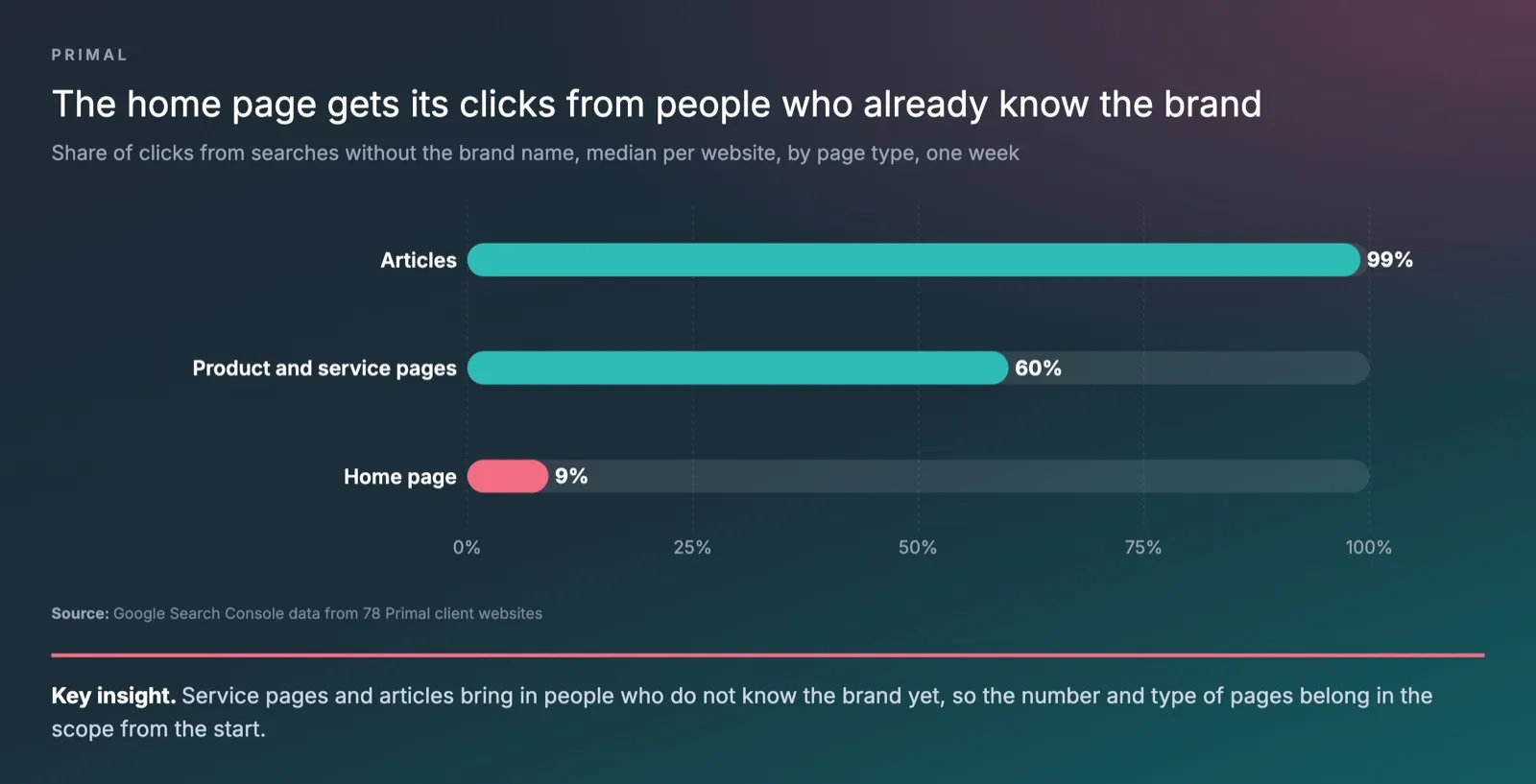
A site with only a home page, an about page and a contact page gets its clicks mostly from people who already know the brand.
Question searches follow the same pattern. We looked at 69 client websites in the same week. On the median site, articles took about 9 in 10 of the impressions from question searches. They took about 1 in 4 of the impressions from other searches without the brand name. So one service page for each service, and an article section, belong in the sitemap from day one. The steps to plan pages around searches are in our guide on how to do search engine optimisation (SEO).
Speed has its own measures. Google’s Core Web Vitals page gives three. Largest Contentful Paint (LCP) measures loading and should happen within 2.5 seconds. Interaction to Next Paint (INP) measures how fast the page responds and should be under 200 milliseconds. Cumulative Layout Shift (CLS) measures how stable the page is and should be under 0.1. Ask the team to test these on a phone before launch, and write into the quote who fixes any that fail.
Google reads the phone version first too. Google’s mobile-first indexing page says Google uses the mobile version of a site’s content for indexing and ranking. It recommends responsive design, which serves the same code on the same URL and fits the layout to the screen. It also asks that the main content on mobile match the desktop, because only the mobile content is used for indexing. Every phone design needs all of the main content of the desktop page.
Measurement starts on launch day. Set up Google Search Console and Google Analytics 4 before the site goes live. The numbers to watch in the first months are in our post on SEO key performance indicators. How to work out the share of visitors who send a form or tap LINE is in our post on conversion rate.
Will Rankings Drop When A New Site Replaces The Old One
Rankings may go up and down for a while, as Google recrawls the new site. Google’s guide to site migrations with URL changes recommends a permanent server-side redirect from each old URL to its new URL. The redirects follow a map of old to new URLs that you prepare, and a 301 redirect or a 308 redirect does the job. It says to keep the redirects for as long as possible, generally at least 1 year.
For a medium-sized site, the same page gives a few weeks or more. That is how long Google can take to start showing the new URLs in place of the old ones. It also says 301 and other permanent redirects do not lose PageRank, the value that links pass to a page.
The map from old pages to new pages is a line in the quote, and the number of old pages sets its size. Each old address should point to the new page that matches it, not to the home page. On Primal’s new site, every old address, including 1,071 old blog posts, redirects with a 301 to the closest new page.
Mark McDowell, Primal’s founder and chief executive officer, covers this in the video below.
In this video from his channel, Mark McDowell explains redirects for old pages and the temporary drop in rankings. He also covers what to keep doing while a site changes its address.
How Primal Prices A Website
Primal prices a website from a page list the client has confirmed. We do not publish prices on our site, because each project’s price depends on that list. These are the steps.
- Review the current site before pricing it, to see the platform, the number of pages and any pages that no other page links to
- Draw up the sitemap, marking each current page to keep, cut or rewrite, with a new address for every page that is cut
- Add the service pages the business sells but has no page for
- Ask the client to confirm the sitemap, and only then price it
- Estimate the hours page by page, for desktop and for mobile, with fewer hours for a page that reuses another page’s template
- Price the design and the copywriting as separate lines, and price content loading by the number of items
- Include the work that often drops out of quotes, which is the review at the start, the testing, and the launch with the handover
A second language, a second market or a second brand is a further phase in the quote. Payment gateways and paid plugins are outside services the client renews. We state what the price leaves out, such as copywriting when it is not bought, photography, legal wording, hosting and care. Care after launch is a separate monthly plan. Full website projects have a minimum project size, and landing pages for ads come in two forms, from a template or with a new design.
The site you are reading was planned the same way. It runs on Astro, has 2 languages and has about 75 pages in each language before articles and case pages. Every service page uses the same set of blocks. The Thai pages are written new from the words Thai people search for, and each Thai and English pair is linked with hreflang.
A Scope Example For A Website In Two Languages
This example is made up. A business-to-business (B2B) company has 6 services. It wants a site in Thai and English and has an old site of 40 pages. The table shows page numbers only, with no prices.
| Page type | Templates | Thai pages | English pages |
|---|---|---|---|
| Home page | 1 | 1 | 1 |
| Service pages | 1 | 6 | 6 |
| About the company and the team | 1 | 2 | 2 |
| Article index and articles | 2 | 11 | 11 |
| Contact page with a form and a LINE button | 1 | 1 | 1 |
| Privacy policy, terms and 404 page | 1 | 3 | 3 |
| Total | 7 | 24 | 24 |
The article rows are 1 index page and the first 10 articles. The site has 48 pages but only 7 templates. So the design is priced on 7 templates. The development is priced on full time for the first page of each template and less time for each page that reuses one.
The quote for this example covers 5 more pieces of work. The English content is written new from English searches. The form sends to the CRM, and LINE taps are tracked. There is a cookie banner, and a map from the 40 old pages to new ones. If the company leaves out English at first, the content and loading work falls by half, but the number of templates stays the same.
If you want us to plan the sitemap and the scope from your current site, see Primal’s web design service. The team in our Bangkok office sends you the sitemap to confirm before we price the work.
Frequently Asked Questions About Website Cost
Customers Often Ask Us How Long A New Website Takes
Most new websites and landing pages take us about a week once the content and the brief are complete. We now make sites with artificial intelligence (AI) tools, so the time depends on how fast designs and pages are approved and how complete the brief is, not on developer hours. A complete brief gives the page list, the content, the photos and the brand details, so the site can be finished without waiting for missing parts. The work runs in 4 stages, which are the kick-off, design approval, development and launch, and a check after launch that nothing is broken.
Customers Often Ask Us Whether The Fee Is One-Off Or Monthly
A new website is a one-off project fee, apart from any monthly SEO or advertising fee. When a site comes with SEO, the monthly SEO work often starts a little before launch. That way the new pages have their search terms and content from day one. The domain, the hosting and the care plan are ongoing costs paid apart.
Customers Often Ask Us Whether The Price Includes Care After Launch
Our website price does not include care after launch. It covers the design, the development and the fixing of bugs before handover. Care is a separate monthly plan that covers updates to the CMS and plugins, backups and testing of the site. If your own team can run the site, you do not need the plan.
Customers Often Ask Us Whether The Domain Must Be Registered And Renewed With Us
No. The domain should sit with a domain registrar in your company’s name. You renew it each year and own it for as long as you keep renewing. We work on the domain through access you give us, for example to point it at the new site.
Customers Often Ask Us Whether An Existing WordPress Site Lowers The Cost
Not by much. For a new site we write new code and carry the old content across, and we do not keep working on the old code. What does save work is old content that can be reused once it is adjusted to the searches, and a sitemap you confirm quickly. If you only want a new look for the current site, that is a different scope, and the current design can be kept as a base.
Customers Often Ask Us Whether A Website Made For SEO Needs A Lot Of Text
Not on every page. The main pages can look good and use animation, as long as content pages behind them cover each topic in detail and link to them. Question searches go mostly to articles, as our data on what a website does after launch shows. Animation still has to meet the Core Web Vitals limits on a phone.
Digital Project Manager
Jonathan Stacey is the Digital Project Manager at Primal and runs web projects from brief to launch. He is a dual British and Thai citizen, has lived in Thailand for over 20 years and is fluent in English and Thai.
About The Author