

By Pimlapat PhansuathongPosted: Updated: 14 min read
SEO KPIs To Track And How To Read Them In Search Console
SEO KPIs are the few key performance indicators (KPIs) you judge search engine optimisation (SEO) on, such as clicks from searches without your brand name, rankings for an agreed keyword list and enquiries from Organic Search in Google Analytics 4 (GA4). Google Search Console is Google's no-cost service that shows how often a site appears, gets clicks and ranks in Google Search.
Key Takeaways
- In Google Search Console data from 139 Primal client websites over 28 days, the median site-wide click-through rate was about 1.6%, and half the sites sat between 1.1% and 2.4%.
- Across 117 client websites in one week, searches with the brand name got about 12 clicks per 100 impressions and other searches under 1, so set the SEO KPI on searches without the brand name.
- Of 46 client websites whose average position improved by half a place or more, 20 got fewer clicks, so read rankings on a fixed keyword list rather than the average.
- In GA4, judge SEO on key events from Organic Search, such as form sends, LINE taps, calls and orders, a channel that also holds visits from Google's AI Overviews and AI Mode.
- Measure AI search with AI impressions in Search Console and with the share of AI answers that cite your site, which was about 1 in 5 for the brand's own site across 285,098 answers about 171 brands logged last month by Elevate, Primal's AI Visibility Tracker.
What SEO KPIs Are
SEO KPIs are the few numbers a business agrees to judge its search engine optimisation (SEO) on. KPI stands for key performance indicator, a number with a target and a date. SEO gives you dozens of numbers. Only a few of them should carry a target.
Primal’s client data shows why a typical SEO report is easy to misread. A site-wide number mixes two groups of people. The first group already knows the brand and searches for it by name. The second group does not know the brand yet. In Google Search Console data from 117 client websites over one week, the first group clicked about 12 times per 100 impressions. The second group clicked less than once.
Average position misleads in the same way. When we compared two periods across 127 client websites, average position improved by half a place or more on 46 sites. Yet 20 of those 46 got fewer clicks.
So set your KPIs on clicks from searches without your brand name. Read rankings on a fixed keyword list agreed at the start. Then judge the work on the enquiries and orders that come from search.
Which SEO KPIs To Track And Where Each One Comes From
Track one KPI for each step a searcher takes, from Google finding the page to an enquiry or an order. Answers from artificial intelligence (AI), such as the AI Overviews Google shows above the results, are now a step of their own. The early numbers change fast. The late numbers change slowly, but they tell you whether SEO pays.
| Step | KPI | Where to find it |
|---|---|---|
| Google finds the page | Pages in Google’s index | Search Console, Page indexing report |
| People see the result | Impressions, split into brand and other searches | Search Console, Performance report |
| People see the result | Rankings for an agreed keyword list | A rank tracker, or Search Console filtered by query |
| People click | Clicks and click-through rate (CTR), split into brand and other searches | Search Console, Performance report |
| People visit | Sessions and engagement rate from Organic Search | Google Analytics 4 (GA4), Traffic acquisition report |
| People visit | Page speed and ease of use (Core Web Vitals) | Search Console, Core Web Vitals report |
| People get in touch or buy | Key events from Organic Search, such as forms, LINE taps, calls and orders | GA4 and your customer relationship management (CRM) system |
| AI answers | Impressions in AI Overviews and AI Mode, and citations in AI answers | Search Console’s generative AI report and an AI answer tracker |
| Other sites link to you | Sites that link to yours (backlinks) | Search Console, Links report, or a tool such as Ahrefs |
Pick one KPI from the “get in touch or buy” row to decide whether the work succeeded. For most businesses, that is the number of enquiries or orders from Organic Search. The other rows explain why that number went up or down. Core Web Vitals and backlinks follow the technical work and the link work that help the other rows rise.
Visits matter to a business only when they lead to more people knowing the brand or getting in touch. So read visit numbers next to those two.
What Is Google Search Console
Google Search Console is Google’s no-cost service for checking how a website shows up in Google Search and fixing what stops its pages from appearing. Google’s Search Console Help says a site does not need Search Console to appear in Google. But Search Console is where Google shows, from its own data, which searches show your site, how often it appears and how often people click.
Google says the service is for business owners, SEO specialists and marketers, site administrators and web developers. For SEO KPIs, the Performance report is the one you will open most. The Page indexing report shows which pages are in Google’s index. The Links report shows which sites link to yours.
What The 4 Numbers In The Performance Report Mean
Google explains each number in the Performance report on its help pages. All 4 come from Google’s results pages.
- Impressions are how often someone saw a link to your site on Google.
- Clicks are how often someone clicked a link from Google to your site.
- CTR is clicks divided by impressions.
- Average position is your site’s highest place in the results, averaged across every search it appeared in. Position 1 is the top.
An AI Overview takes one position in the results, and every link inside it gets that same position. A click from an AI Overview to your page is recorded as a click.
Know the limits before you set targets. Google’s page on why the numbers can differ says data usually takes 2 to 3 days to appear. Days follow Pacific Time in every view except the 24-hour view. The table shows at most 1,000 rows, and rare searches are left out of the table but kept in the chart total. So use the chart’s total clicks as the main number in a report.
How To Set Up Google Search Console
Start by proving you own the site. A Domain property covers every subdomain and both http and https in one place. You verify it with a record in your domain’s Domain Name System (DNS). Then work through these steps.
- Add the site as a Domain property and verify it.
- Open the Page indexing report and check that your product and service pages are indexed.
- Submit your sitemap.
- Open the Performance report and note the clicks, impressions, CTR and average position for the last 28 days. These are your starting values.
- Give your team or agency access, and keep the owner role in the business’s own account.
How Search Console Differs From GA4
Search Console records what happens on Google’s results page. GA4 records what happens on your website. So the two tools rarely show the same numbers, and they do not need to.
Search Console reports clicks from the results. GA4 reports sessions on the site, and only from browsers with JavaScript turned on. Search Console also holds back some data to protect searchers’ privacy.
In GA4, SEO visits sit in the Organic Search channel. Google’s guide to the default channel group says this channel includes visits from Google’s AI Overviews and AI Mode. Visits from ChatGPT, Gemini, Copilot and other assistants go to a separate AI Assistant channel.
Use Search Console to see what people saw and clicked on Google. Use GA4 to see what they did next. When you compare the two, check that the trend lines rise and fall together. Do not compare them day by day.
What A Good Click-Through Rate Looks Like
There is no single good CTR. In Google Search Console data from 139 Primal client websites over 28 days, the median site-wide CTR was about 1.6%. Half the sites sat between 1.1% and 2.4%.
The chart shows how many sites fell into each CTR band. Use it as a reference point when you note your own starting value.
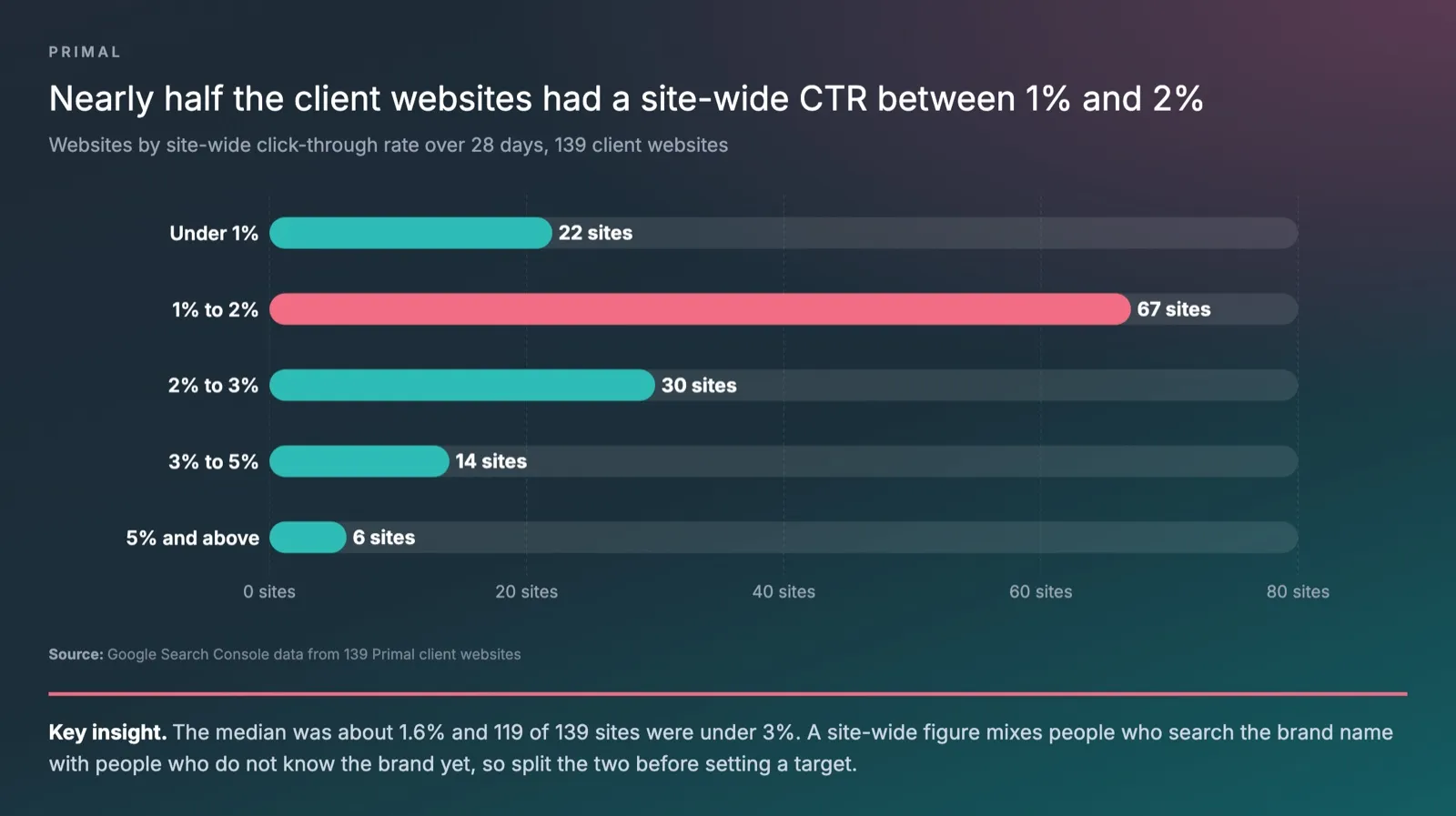
Of the 139 sites, 119 were under 3%. The range is wide because site-wide CTR depends on things that say little about the quality of the SEO work. A site that many people search for by name has a high CTR, because those people click far more often. The position of each page matters too. So does what Google shows above the links, such as an AI Overview. That is why CTR can fall even when rankings hold.
Compare each page’s CTR with its own past. Take brand searches out first, and read CTR next to position. Use other sites’ numbers as a reference point only.
Why To Split Brand Searches Before Setting SEO KPIs
Searches with your brand name measure demand you already have. Searches without it measure how many new people SEO brings to the site. The two give very different numbers, and mixed together they hide whether SEO is working.
In Search Console data from 117 Primal client websites over one week, searches with the brand name got about 12 clicks per 100 impressions. Searches without it got about 0.8. The brand-name rate was higher on all 108 sites with enough brand searches.
The chart compares the two medians.
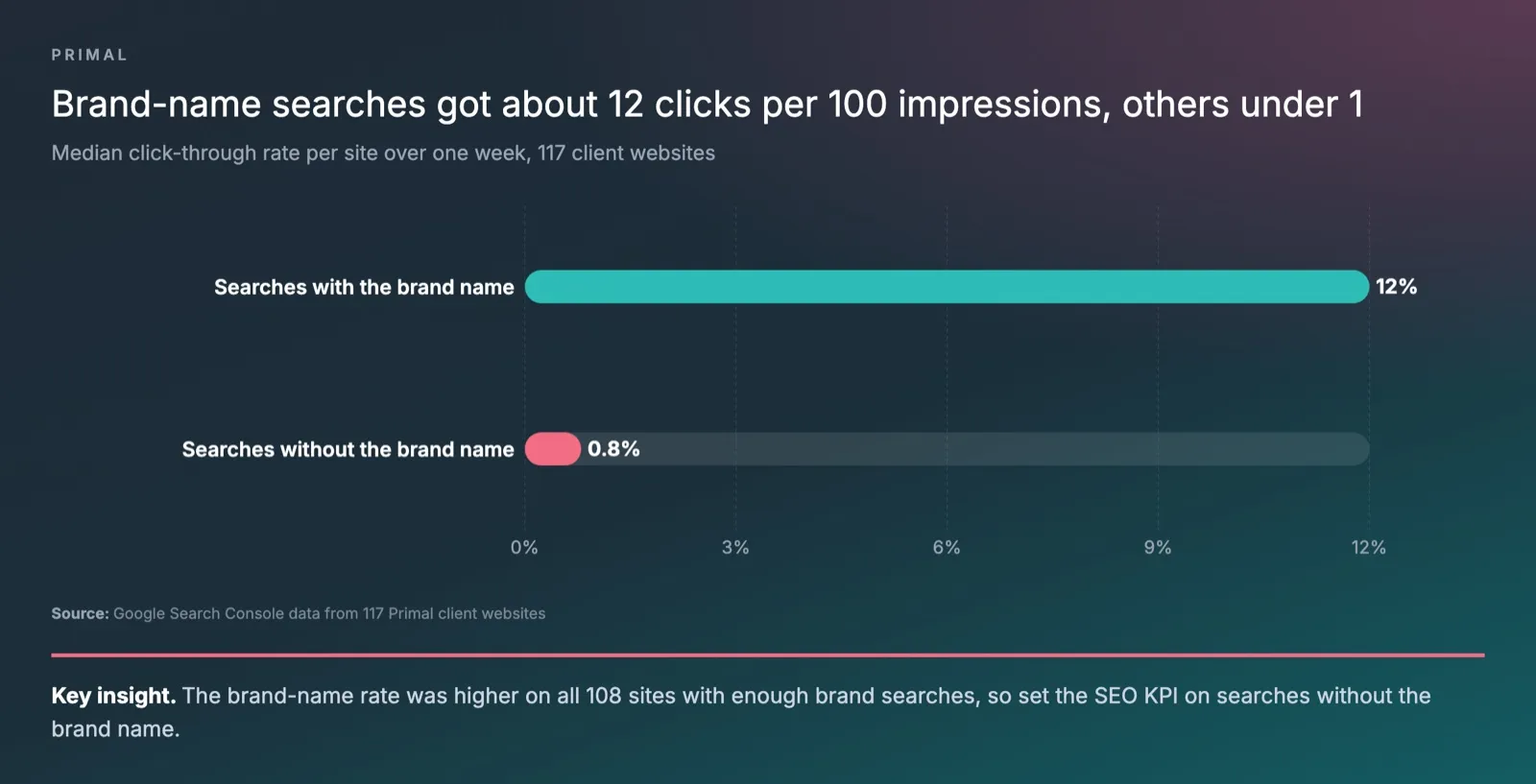
So a site’s overall CTR can fall in a month when SEO is working. As pages start to show for new searches without the brand name, more impressions come from people who click less. The share of clicks also differs a lot between sites. On half the sites, searches without the brand name brought between about 3 in 10 and 8 in 10 of all clicks. Our post on what SEO is shows this split from the same data.
Search Console has a filter for branded and non-branded queries. It is not available on sites with few impressions, and Google says some queries may be put in the wrong group. If you cannot use it, filter for queries not containing your brand name. Or use a custom regex filter that lists every spelling of the brand in Thai and English.
Once you split them, you can see which case your site is in. If most clicks come from your brand name, the site mostly serves people who already know you, and SEO brings few new people. If most clicks come from other searches but brand searches never grow, visitors may not remember the brand. Set the SEO KPI on clicks from searches without the brand name. Use brand searches to read the demand the brand already has.
Why Average Position Can Improve While Clicks Fall
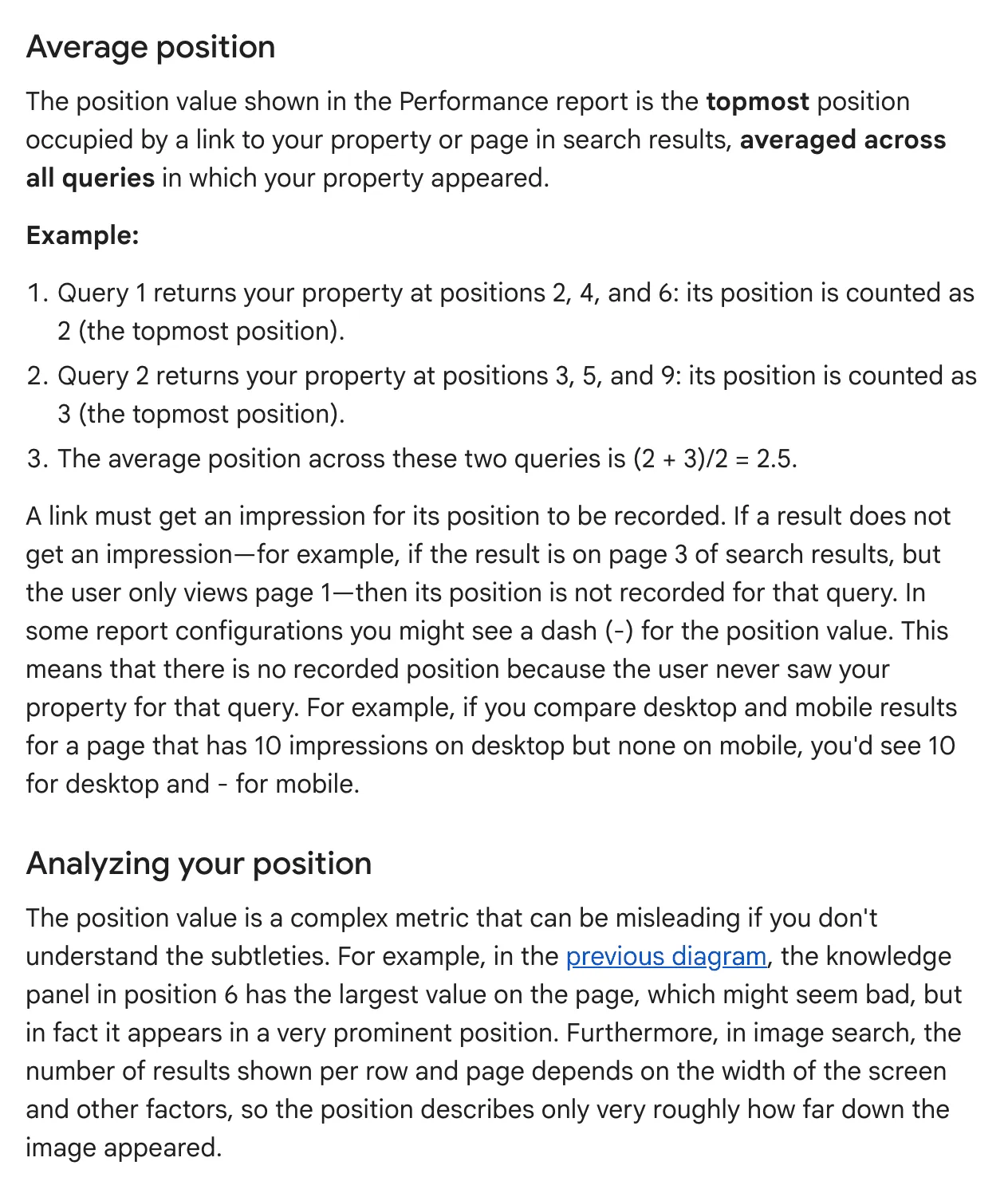
Average position can improve while clicks fall, because it averages only the searches where your site appeared. When a site drops out of searches where it ranked low, the average improves, even though impressions and clicks go down.
Google warns about this on its help page about average position. The capture shows how the average is worked out and the line that says the position value can be misleading.
Our client data shows that a better average position did not mean more clicks. We compared Search Console data from 127 Primal client websites across two 28-day periods about 3 months apart. Average position improved by half a place or more on 46 sites. Yet 20 of those 46 got fewer clicks, and 28 had fewer impressions.
The made-up example below uses the click rates from our SEO vs SEM post. Pages in positions 1 to 3 got about 31 clicks per 1,000 impressions, and pages in positions 11 to 20 got about 4.
| Period 1 | Period 2 | |
|---|---|---|
| Keyword group 1 at position 3 | 1,000 impressions, about 31 clicks | The same |
| Keyword group 2 at position 15 | 2,000 impressions, about 8 clicks | No longer shown |
| Total impressions | 3,000 | 1,000 |
| Total clicks | 39 | 31 |
| Average position | 11 | 3 |
The site did not rank higher for any search. Its average position went from 11 to 3 because keyword group 2 left the average. Its clicks fell from 39 to 31.
So read rankings on a fixed keyword list agreed at the start. At Primal we check the same keyword list every day. We report how many keywords sit in the top 3, on page 1 and in the top 100, against 30 days earlier, next to the impressions of the same pages.
How To Measure SEO In GA4 With Key Events
In GA4, the number that judges SEO is key events from the Organic Search channel. Google Analytics Help says a key event measures an action that matters to your business. Analytics used to call these conversions.
For a business in Thailand, mark the real contact and purchase actions as key events. That means form sends, taps on the LINE button, taps to call and orders. Test each one yourself before the work starts. Time on a page or a general click should not be a key event, because it raises the number when nobody got in touch.
Engagement rate helps you read the rest. GA4 treats a session as engaged when it lasts longer than 10 seconds, has a key event, or has 2 or more page or screen views. Read this rate by landing page for Organic Search visits. It shows which pages answer what searchers came for.
How To Measure AI Search As An SEO KPI
Measure AI search with two separate numbers. The first is your impressions in AI Overviews and AI Mode, from Search Console. The second is the share of AI answers that cite your website, from a tool that logs AI answers.
The generative AI performance report in Search Console shows impressions from AI Overviews and AI Mode by page, country, date and device. It does not split them by search query. It may not show for a site with few AI impressions. Clicks from those answers are already in the main Performance report.
The second number shows whether AI tools cite your site or someone else’s. Over the last month, Elevate, Primal’s AI Visibility Tracker, logged 285,098 AI answers to questions about 171 brands. The brand’s own website was cited in about 1 in 5 of the answers about it. For half the brands, the figure sat between about 8 and 35 in 100. Use that range as a reference point when you note your starting value. Our guide to measuring AI search visibility goes deeper on this number.
In this video on his YouTube channel, Mark McDowell, Primal’s Founder and Chief Executive Officer, explains how to measure whether AI tools recommend your brand.
AI numbers belong in every monthly SEO report. An AI Overview appeared on the results page for 859 of 995 keywords in Primal’s rank-tracking data for 17 client brands. People who search those keywords see an AI answer above the website links.
What Changes First In The First 3 Months Of SEO
Indexing and impressions change first, then clicks, then enquiries. Pages get indexed, and the pages you fixed gain impressions. Enquiries usually change last, because people must see a result before they click, and visit before they get in touch.
Use the first month to note the starting value of every KPI and to check that tracking works. A month 1 report should cover 4 things.
- The starting value of each KPI, from the 28 days before work began
- A test result for every key event
- The work finished, with the date each change went live
- Early signs, such as pages indexed after fixes and impressions on the fixed pages
When you compare, set the last 28 days against the 28 days before. A 28-day period always holds 4 of each weekday, while a calendar month can hold 4 or 5 Saturdays. Note long holidays such as Songkran in the report, because those weeks do not compare with normal weeks.
Mark McDowell, who founded Primal, tells owners what the first 3 months of SEO look like before the work starts. The first 2 weeks set the starting point, with tracking and a benchmark report, so every later number has something to compare against. Most of the work happens in the first 1 to 2 months, with the technical fixes and the content ready to publish, and the pace depends on how quickly changes are approved on the site. The first pages I expect to rise are the ones just off page one, where a new title and new headings can be enough. When a client asks whether results will show in the first month, my answer is no, because the rise in Google and AI answers usually starts between month 4 and month 6.
How To Set SEO KPIs You Can Judge The Work On
A KPI you can judge the work on has a number, a starting value, a target and a date. Without all four, nobody can say whether the work hit the target.
- Pick one deciding KPI, such as enquiries from Organic Search.
- Pick 3 to 5 supporting numbers, such as clicks from searches without the brand name, keywords on page 1 and impressions in AI Overviews.
- Note the starting values from the 28 days before the work begins.
- Set the target and the date from the starting value, the search volume of the agreed keywords and where the pages rank at the start.
- Agree the keyword list to check, and keep the same list for the whole contract.
If you work with an agency, the contract should state the KPI, the starting value, the target, the date and what happens if the target is missed. Then each monthly report can be checked against that agreement.
Primal runs SEO for Google’s results and for AI answers from our Bangkok office, and reports against a KPI set agreed with the client in the first month. See how we work on our SEO services page.
Frequently Asked Questions About SEO KPIs
Customers Often Ask Us What A Monthly SEO Report Should Include
A monthly report should start with the deciding KPI against its target and starting value. Then it should show clicks from searches with and without the brand name, the number of keywords in each ranking band, and the AI numbers. It should end with the work that went live that month, with dates, and the plan for next month. A report with only an average position chart cannot judge the work.
Customers Often Ask Us How To Set A Yearly Target For Search Visits
Start from your current clicks from searches without the brand name. Then look at the search volume of the agreed keyword list and where your pages rank today. Clicks from that list cannot go above the list’s total search volume. For a higher target, the plan needs new topics and new pages.
Customers Often Ask Us How A B2B Business Can Trace SEO To Closed Deals
A business-to-business (B2B) company should send each form’s lead source into its CRM. Then it can see how many Organic Search enquiries became deals. For calls and LINE messages, ask every new contact how they found you, and log the answer in the same system.
Is Bounce Rate Still An SEO KPI
Bounce rate still exists in GA4, but it should not be the deciding KPI. GA4 defines it as the share of sessions that were not engaged, the opposite of engagement rate. Both show whether a page answered the visitor. Neither shows whether anyone got in touch or bought.
What Is The Difference Between An SEO Metric And An SEO KPI
A metric is any number SEO produces, such as impressions or average position. A KPI is a metric you have chosen to judge the work on, with a target and a date. A good SEO report holds many metrics but only one deciding KPI and a few supporting numbers.
Content Writer
Pimlapat Phansuathong is a Content Writer at Primal with over 6 years of writing experience. She writes search engine optimisation (SEO) content, from search intent and keyword research to the structure of each article. She joined Primal in 2022.
About The Author