

By Mark McDowellPosted: Updated: 11 min read
33 AI Marketing Statistics On Business, Search And Ads
Artificial intelligence (AI) marketing statistics for Thailand show wide use of AI while clicks still run through Google. NECTEC found that 53.7% of the 574 Thai organisations it surveyed already use AI. StatCounter found that AI chatbots sent 0.07% of referral visits to websites in Thailand in 2026-09, against about 98% from search engines.
Key Takeaways
- In 166 Google Ads accounts Primal manages, Smart Bidding took about 3 in 4 baht of spend between 2025-10-01 and 2026-09-30, and manual bidding took under 2 baht in every 1,000.
- In 285, 098 AI answers about the categories of 171 brands, logged by Elevate, Primal's AI Visibility Tracker, between 2026-09-20 and 2026-10-19, a brand's own website was cited in only about 1 in 5.
- NECTEC surveyed 574 Thai organisations in 2026-06 and 2026-07 and found that 53.7% already use AI, but only 13.6% of the users have measured a clear gain.
- StatCounter found that AI chatbots sent 0.07% of referral visits to websites in Thailand in 2026-09, while search engines sent about 98%.
- Salesforce found that 83% of 150 marketers in Thailand have optimised, or are optimising, for AI-driven search such as Google's AI Overview.
What These AI Marketing Statistics Show
Artificial intelligence (AI) is now part of most marketing work in Thailand. Yet the clicks and the ad money still run through Google. AI now picks which brands an answer mentions. In Google Ads, Google’s own bidding system sets the price on almost every baht.
So I tell brands to rank on Google first and to get their name onto the sites AI reads. Then they should give the bidding system real conversions and measure each month.
Primal’s own data comes first on this page. Thai figures from government bodies and research firms come next. Global studies fill the gaps where Thailand has no figure. Each figure has its source, its sample and its window, and the table sums up Primal’s figures.
| Figure from Primal’s data | Sample | Window |
|---|---|---|
| Smart Bidding took about 3 in 4 baht of spend (76%) | 166 Google Ads accounts Primal manages | 2025-10-01 to 2026-09-30 |
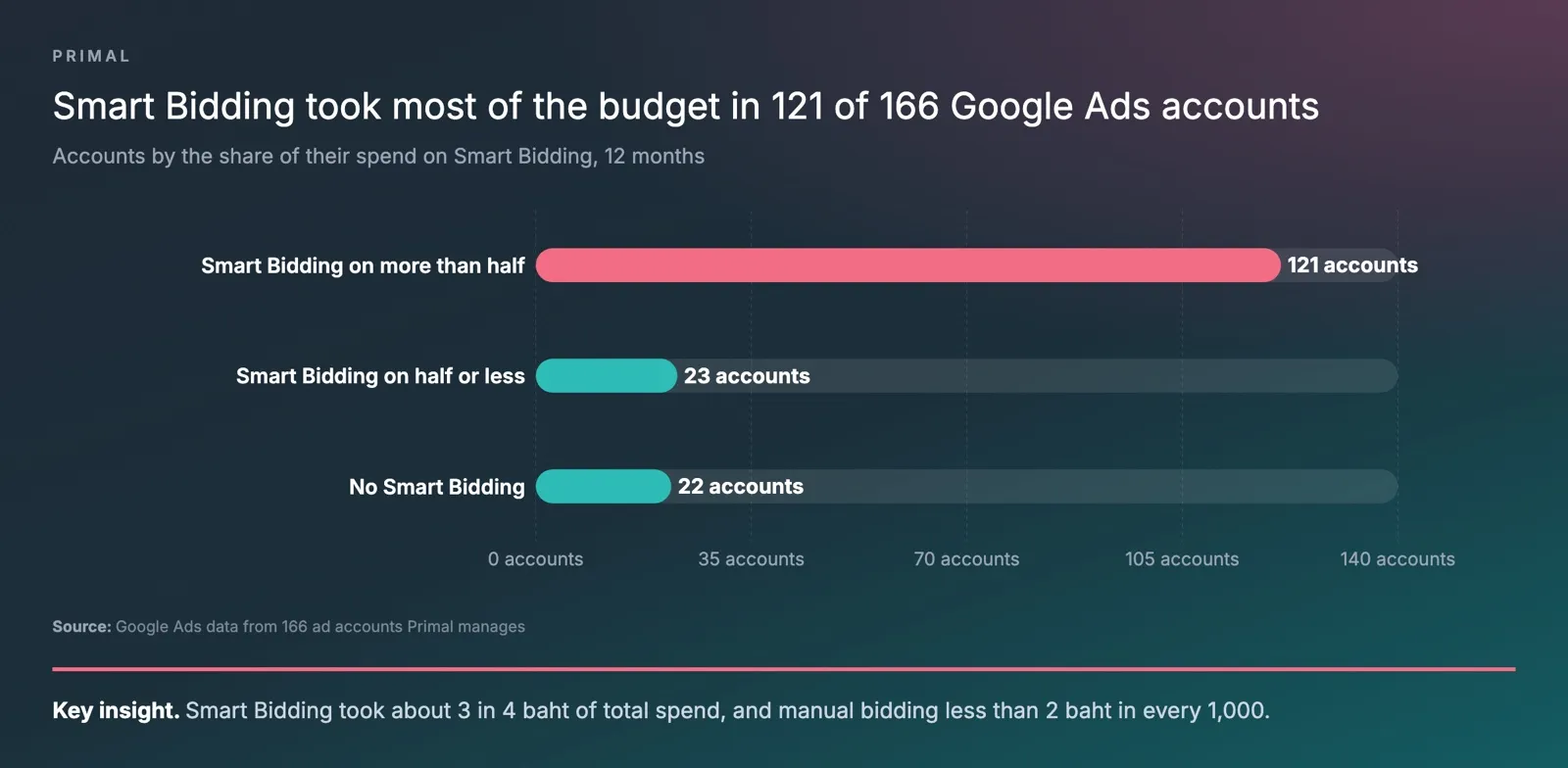
| Smart Bidding took over half the budget in 121 of 166 accounts | The same 166 accounts | 2025-10-01 to 2026-09-30 |
| Manual bidding took under 2 baht in every 1,000, in 9 accounts | The same 166 accounts | 2025-10-01 to 2026-09-30 |
| Performance Max ran in 77 of 166 accounts | The same 166 accounts | 2025-10-01 to 2026-09-30 |
| A brand’s own site was cited in about 1 in 5 AI answers | 285,098 answers, 171 brands, about 2,800 queries (Elevate, Primal’s AI Visibility Tracker) | 2026-09-20 to 2026-10-19 |
| An AI Overview showed on 859 of 995 keywords | 995 keywords in Primal’s rank-tracking data for 17 client brands | Results pages of 2026-10-20 |
| Positions 1 to 3 got almost half the clicks from about 1 in 7 impressions | 117 client websites, searches without a brand name (Google Search Console) | 2026-10-11 to 2026-10-17 |
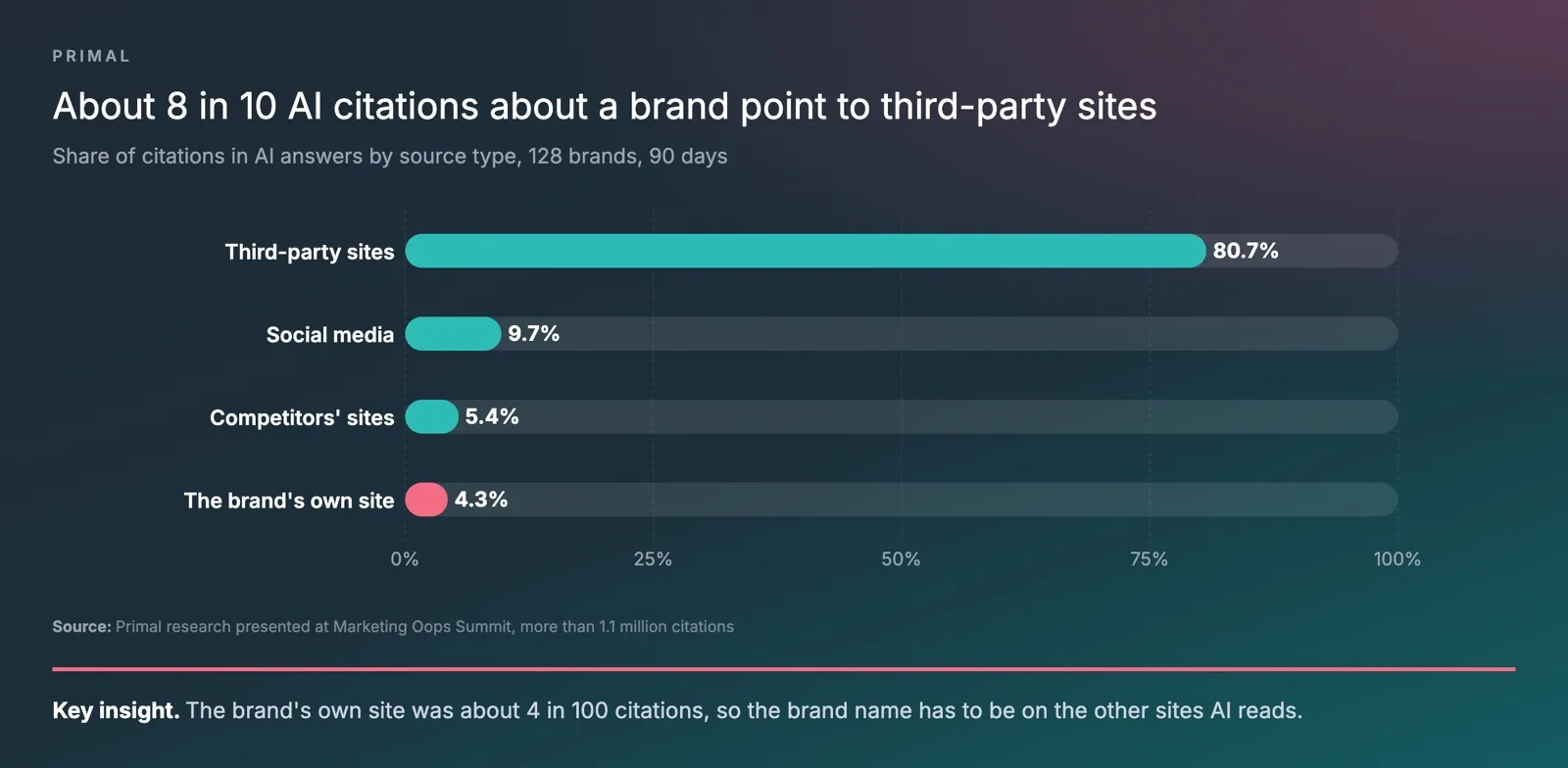
| A brand’s own site was about 4 in 100 AI citations | 128 brands, more than 1,100,000 citations (my Marketing Oops Summit study) | 90 days |
How Many Thai Businesses Use AI In Marketing
About half of the organisations in Thailand’s national AI survey already use AI. Marketing is where they use generative AI most. Very few can yet show what it gave them.
- Of the 574 public and private organisations in NECTEC’s AI Readiness Survey 2026, 53.7% already use AI. NECTEC is a Thai state research centre for electronics and computing. It ran the survey in 10 target industries in 2026-06 and 2026-07.
- The share of organisations using AI tripled from 2024 to 2026, NECTEC says.
- Of the 308 organisations in the survey that use AI, 74.7% use generative AI in marketing, selling and customer service. No other area of work was higher.
- Only 13.6% of those 308 have measured the results and found a clear gain.
- In the same survey, about 67% of large organisations use AI. About 49% of medium ones and 44% of small ones do.
- Salesforce’s State of Marketing survey asked 150 marketers in Thailand from 2025-10-08 to 2025-11-17. Of them, 79% need more personalised content than their team can make.
Most organisations in the survey have started with AI, and few can say what it gave them. So my advice is to agree on the measure before you add another AI tool.
How People In Thailand Use AI Search
People in Thailand use AI tools almost as widely as they use search engines. But when they search and then click, they still use Google for almost all of it.
- GWI, a consumer research firm, surveyed internet users aged 16 and over in the last quarter of 2025. In Thailand, 85.8% of them use AI tools each month, DataReportal’s Digital 2026 Mid-Year Global Update reports. The figure includes AI features in apps such as Canva and Microsoft Office.
- In the same survey, 87.1% of internet users in Thailand aged 16 and over use search engines each month.
- SimilarWeb’s Thailand figures for April 2026 put about 96% of Thai search and AI visits on Google’s own products. Those are Google Search, AI Overviews and Gemini.
How Much Traffic AI Sends To Websites
AI chatbots send very few visitors to websites in Thailand so far. Search engines still send almost all of them.
- AI chatbots sent 0.07% of referral visits to websites in Thailand in 2026-09, StatCounter found. Search engines sent about 98%.
- A year earlier, in 2025-09, AI chatbots sent about 1 in 1,000 of those visits.
- Among the chatbots, ChatGPT sent about 70% of those visits in 2026-09 and Gemini about 25%. That is from StatCounter’s AI chatbot figures for Thailand. Gemini’s share was about 9% in 2025-09.
These figures only measure clicks out of a chatbot. So the effect of AI on a brand sits more in the answers that mention it than in the visits it sends.
How Often Google Shows An AI Overview
Google shows an AI Overview on most of the searches brands want to rank for. Clicks from the normal results still go mostly to the top 3 positions.
- An AI Overview showed on 859 of the 995 keywords in Primal’s rank-tracking data for 17 client brands. Those were the results pages of 2026-10-20.
- A People Also Ask box showed on 646 of the same 995 keywords.
- We read Google Search Console data for 117 client websites from 2026-10-11 to 2026-10-17. On searches without a brand name, positions 1 to 3 got about 1 in 7 of the impressions. They got almost half of the clicks.
- On the median site that week, positions 1 to 3 got about 31 clicks per 1,000 impressions. Positions 4 to 10 got about 7.
- We also read 69 client websites that week. On the median site, article pages got about 9 in 10 of the impressions from question searches.
How a page gets cited in one of those answer boxes is in our post on AI Overviews.
To me, these figures are about Google. People in Thailand use AI a lot, but the AI they see most is on Google’s results page. A brand outside the top 3 positions misses most of the clicks before a chatbot comes into it.
Which Websites AI Answers Cite About A Brand
AI answers cite other websites about a brand far more often than the brand’s own site.
- Elevate, Primal’s AI Visibility Tracker, logged 285,098 AI answers from 2026-09-20 to 2026-10-19. They came from about 2,800 queries in the categories of 171 brands. A brand’s own website was cited in only about 1 in 5 of them.
- In the same data, the most-cited source was another site in the category for 77 brands. It was the brand’s own site for 50, social media for 26 and a competitor for 18. So for 121 of the 171 brands, AI cited another source more than the brand’s own site.
- Facebook was among the 15 most-cited sites for 161 of the 171 brands. YouTube was among them for 88 and Pantip for 48.
- My Marketing Oops Summit study looked at 128 brands over 90 days and more than 1,100,000 AI citations. Third-party sites got about 81% of the citations. Social media got about 10%, competitors’ sites about 5% and the brand’s own site about 4%.
The chart shows that split from my study, by type of source.
- The same study found that in many categories the 2 most-mentioned brands got 76% of the AI mentions on average.
- In the same Salesforce survey of 150 marketers in Thailand, 83% have optimised for AI search such as Google’s AI Overview, or are doing it now.
How AI picks its sources is in our guide to AI search.
My advice here is to look past your own website. Most of what AI says about a brand comes from what other sites write about it. So your brand name has to be on the news, review, forum and social pages AI reads in your category.
How AI Changed Ad Buying
Google’s AI now sets the bid on most of the money in the Google Ads accounts we manage. Manual bidding has almost gone.
Google’s help page on Smart Bidding says it uses Google AI to optimise for conversions or conversion value in every auction. Google lists 4 Smart Bidding options. Two aim for the most conversions or the most conversion value. The other two aim at a target cost per acquisition (CPA) or a target return on ad spend (ROAS).
- Across the 166 Google Ads accounts Primal manages, Smart Bidding took about 3 in 4 baht of spend from 2025-10-01 to 2026-09-30.
- Smart Bidding took more than half of the budget in 121 of those 166 accounts.
- Manual bidding took under 2 baht in every 1,000 in the same accounts. Only 9 accounts used it at all.
- Performance Max campaigns ran in 77 of the 166 accounts and took about 1 in 5 baht of their spend.
- Demand Gen campaigns ran in 26 of the same accounts.
Almost all the rest of the spend went to other automatic bidding, such as bidding for the most clicks. The chart sorts the 166 accounts by how much of their own spend went on Smart Bidding.
How the campaign types differ is in our Google Ads guide.
In these accounts, the bidding system already sets the price on almost every baht. Your team still controls the conversions you send it, the ads and the page each ad opens. If a conversion you send has no value, the system bids for it anyway.
How Marketers Plan To Spend On AI
Most marketers in Thailand are not raising their budgets for 2026. So money for AI has to come out of the budget they already have.
- The Marketing Association of Thailand (MAT) asked 126 senior marketers about 2026 before the year began. Of them, 69% will not raise their marketing budget in 2026.
- The same marketers chose AI and the Internet of Things (IoT) as the 2 leading technologies for marketing.
- Gartner’s spend survey asked 401 marketing leaders in North America, the United Kingdom and Europe from 2026-01 to 2026-03. About 15% of their marketing budgets went to AI work.
- In the same survey, marketing budgets were about 8% of company revenue, only a little up on 2025.
- In the same Salesforce survey of 150 marketers in Thailand, 52% have not yet worked out how to adapt their marketing plans to the wide use of AI.
So in 2026, money for AI comes out of budgets that already exist. The teams that can show which work pays will be the first to shift money into AI.
What These AI Statistics Mean For A Brand
The figures point to 4 jobs for a brand, in this order. Rank on Google, get onto the sites AI reads, send real conversions, then measure each month.
Rank on Google first. Search still sends almost all the visits. An AI Overview shows on most of the searches brands want. Positions 1 to 3 get almost half the clicks on searches without a brand name.
Put your brand on the sites AI reads. Check which news, review, forum and social pages AI cites in your category. Then make sure what they say about your brand is correct and the same everywhere.
Send the bidding system conversions with real value. Track only the actions that bring the business something, such as a full form, a call or a purchase. Smart Bidding bids toward the conversions it gets.
Measure every month with the same questions. Pick the questions customers ask in your category. Then check each month which brands each AI tool mentions and which pages it cites.
Some months ago I sat with the marketing head of a brand at the top of its category, with millions spent on marketing every year. We asked an AI who the top brands in his category were. His brand did not show up at all. That night changed what I talk about. In my study above, a brand’s own website is a small part of what AI cites and most of it comes from third-party pages, so the work starts everywhere else.
I explain how to measure whether AI mentions your brand in this video, which goes with the last job.
A video from my YouTube channel on how to check whether AI answers recommend your brand.
The first, second and fourth jobs are search engine optimisation (SEO) on Google, a place on the sites AI cites, and a monthly check on what AI answers say. Primal’s AI SEO service does that work for brands in Thailand.
Frequently Asked Questions About AI Marketing Statistics
Do People In Thailand Use ChatGPT Or Gemini More
ChatGPT still sends more visits, but Gemini is growing. StatCounter’s AI chatbot figures for Thailand show that ChatGPT sent about 70% of the chatbot visits to websites in 2026-09. Gemini sent about 25%, up from about 9% a year earlier.
Do Small Businesses In Thailand Use AI Less Than Large Ones
Yes. NECTEC surveyed 574 organisations, and about 67% of the large ones use AI. About 49% of medium ones and 44% of small ones do. NECTEC rates the readiness of all 3 sizes at the same “Aware” level.
Does Smart Bidding Work For Every Google Ads Account
It works once the account tracks conversions. Google says Smart Bidding needs conversion tracking switched on. It also says to judge results over a period with at least 30 conversions, such as a month or longer, or 50 for target ROAS bidding. An account with fewer conversions should fix its tracking first.
Where Do AI Statistics For Thailand Come From
The sources on this page fall into 4 groups. Business use of AI comes from NECTEC’s national survey. People’s use of AI comes from GWI’s survey in DataReportal’s report. Website visits come from StatCounter and SimilarWeb. The ad-buying and AI-answer figures come from Primal’s own data.
How To Cite The Figures On This Page
Give the source, the sample and the window, as each figure’s sentence states them. Cite Primal’s figures as Primal’s data and link to this page. For the other figures, link to the source page that this page links to.
Founder and Chief Executive Officer
Mark McDowell is the Founder and Chief Executive Officer of Primal, which he started in Bangkok in 2015. He is on the Forbes 30 Under 30 Asia 2020 list and was Campaign Asia’s Southeast Asia Young Achiever of the Year in 2018. He writes about AI search and search engine optimisation.
About The Author