

By Mark McDowellPosted: Updated: 11 min read
What Is AI Search And Where Its Answers Come From
AI search is search where an artificial intelligence (AI) system reads several web pages for you and writes a short answer with links to its sources. In Thailand people use it on Google in AI Overviews and AI Mode, and in ChatGPT, Gemini and Perplexity. The system decides which brands to mention, and it cites other websites about a brand far more often than the brand's own site.
Key Takeaways
- Google says AI Mode splits a question into subtopics and searches each one at the same time, so a page that answers one narrow question well can be cited.
- In 285, 098 AI answers about the categories of 171 brands, logged over the last month by Elevate, Primal's AI Visibility Tracker, a brand's own website was cited in only about 1 in 5.
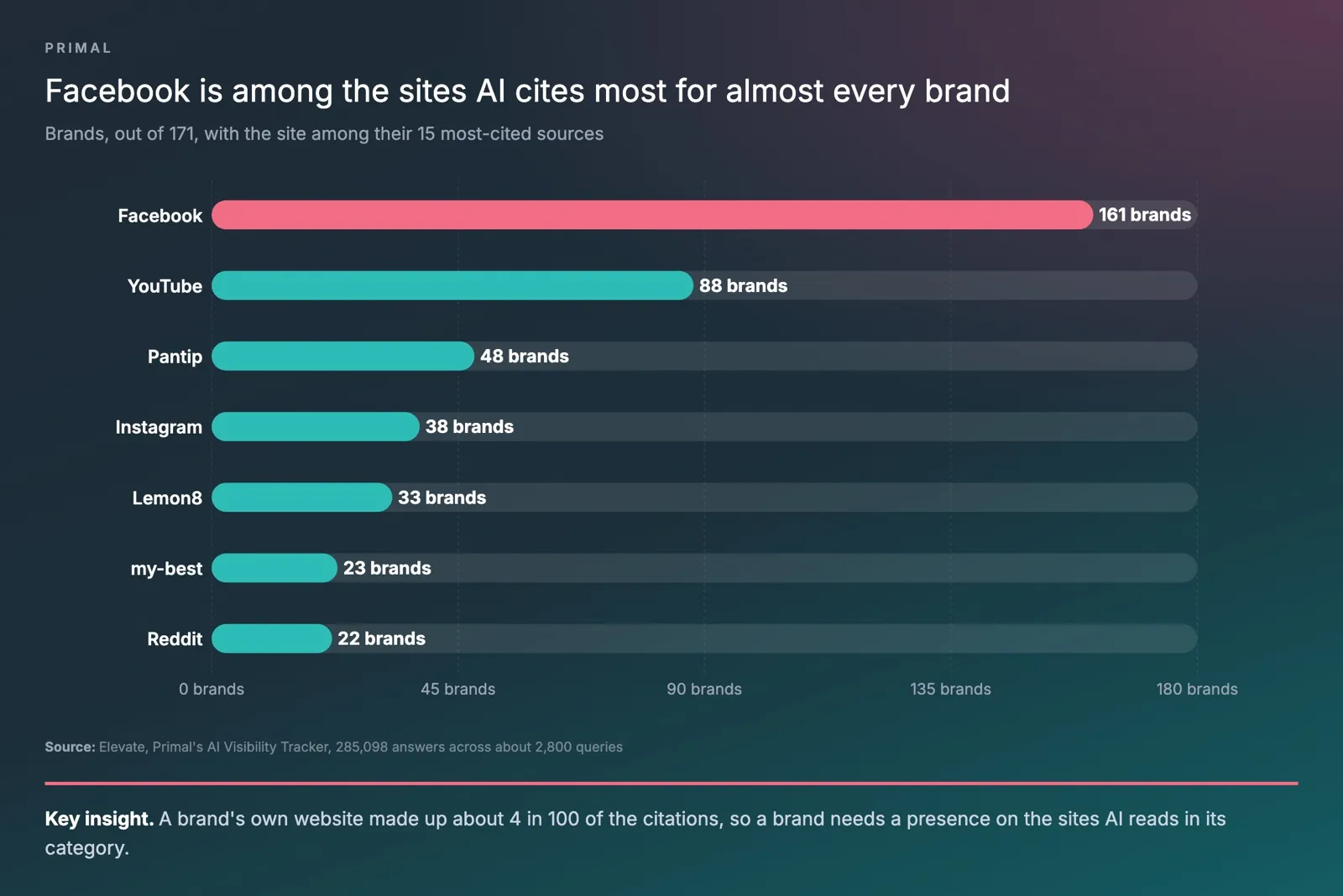
- Facebook was among the 15 most-cited sites for 161 of those 171 brands, YouTube for about half of them and Pantip for 48.
- Google says a page only has to be indexed and eligible for a snippet to appear as a link in AI Overviews or AI Mode, so search engine optimisation (SEO) is still the base of AI search.
- OpenAI says ChatGPT search leaves out sites that block its OAI-SearchBot crawler, so check that your robots.txt file lets it in.
What Is AI Search
AI search is search where an artificial intelligence (AI) system reads web pages for you and writes the answer. You ask a question in plain words. The system finds pages that match and reads them. Then it replies in a few sentences, with links to its sources.
In Thailand, most AI search happens on Google, in AI Overviews and AI Mode. The rest happens in chatbots such as ChatGPT, Gemini and Perplexity.
For a brand, AI search changes who does the choosing. On a classic results page, the buyer picks which site to open. In AI search, the system picks which brands to mention and which pages to cite. Our data shows it rarely picks the brand’s own site. Over the last month, Elevate, Primal’s AI Visibility Tracker, logged 285,098 AI answers to the questions buyers ask in the categories of 171 brands. A brand’s own website was cited in only about 1 in 5 of them.
So your brand has to appear on the pages AI reads, on your own site and on other sites in your category. I put it as “Be the Name, not the Page” on stage at Marketing Oops Summit 2026, as Marketing Oops reported. AI has to see your brand’s name again and again, across many sources.
Your pages need to answer buyer questions in their first sentences. And other sites in your category need to talk about your brand.
How AI Search Works
AI search works in four steps. It reads the question, splits it into smaller searches, finds the best pages, then writes an answer with links. Google’s AI Mode help page says AI Mode divides a question into subtopics and searches for each one at the same time. Google calls this query fan-out.
- It reads the question. The system reads the whole sentence to work out what the person wants. “Which coworking space near Asok has a meeting room for 10 people?” asks for spaces in one area with one kind of room.
- It splits the question into smaller searches. One question becomes several searches, such as the spaces near Asok, their meeting rooms, their prices and their reviews.
- It finds the best pages. Each smaller search pulls pages from the system’s index. The index is the copy of the web that the system’s crawler has saved. The system keeps the pages that answer each search clearly.
- It writes the answer. A language model writes the reply from those pages and links them as its sources. These links are called citations.
So a page does not have to rank first for the main question to be cited. Google Search Central says fan-out lets AI Overviews and AI Mode show a wider and more varied set of links than classic search. A page that clearly answers one of the smaller searches can be picked.
What LLMs And NLP Mean In AI Search
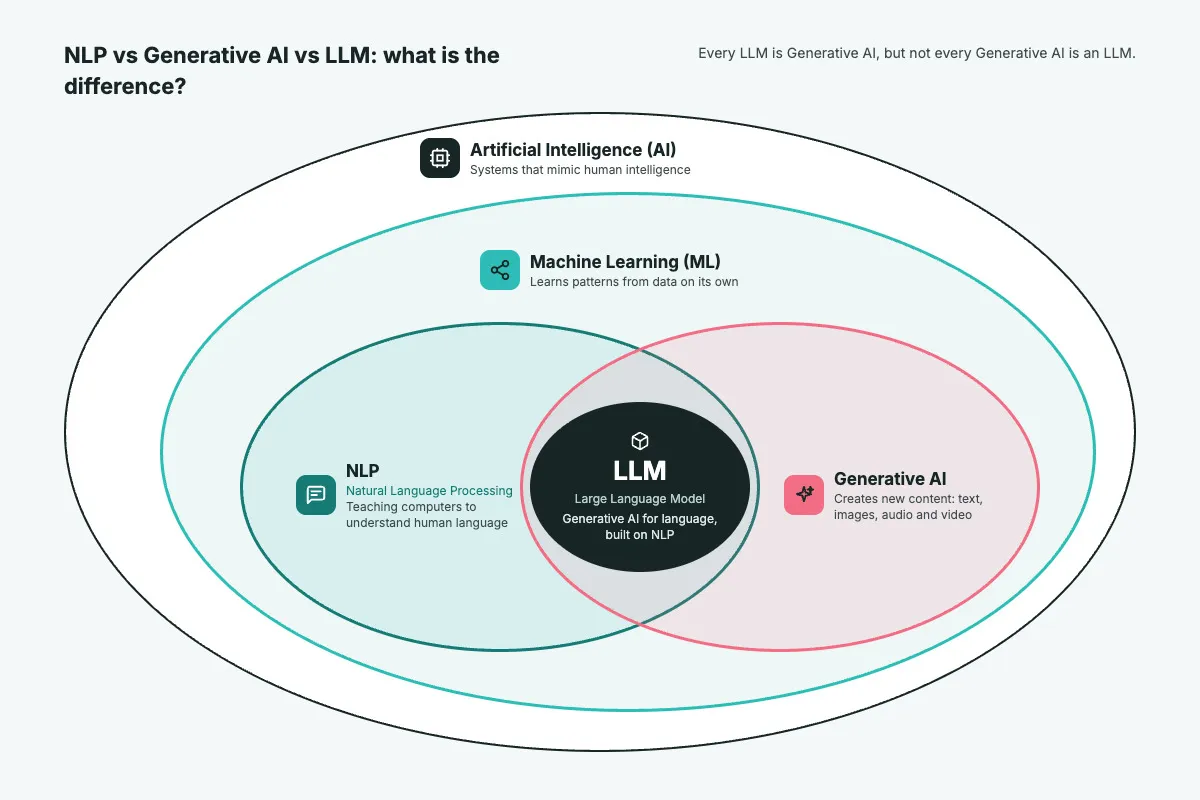
A large language model (LLM) is an AI model trained on a very large amount of text, so it can read and write language. ChatGPT runs on OpenAI’s GPT models. Gemini and Google’s AI Mode run on Google’s Gemini models.
Natural language processing (NLP) is the part of AI that lets computers work with the words people type and say. An LLM uses it to read the question and to write the answer. Generative AI is AI that makes new content, such as text, images, audio or video. An LLM is the kind of generative AI that makes text.
Primal’s diagram below shows how these terms fit together.
How AI Search Differs From Google Search
Classic search gives you a list of links to read yourself. AI search reads those pages for you and answers in its own words. It also chooses which pages to cite, which changes how a brand gets seen and how you measure it.
| Classic search | AI search | |
|---|---|---|
| What people type | Short keywords, such as “coworking Asok” | A full question, with follow-ups in the same chat |
| What comes back | 10 links a page | A written answer with a few source links |
| Who chooses | The searcher picks which site to open | The system picks which brands to mention and which pages to cite |
| When a brand is seen | Its page ranks near the top | Its name is in the answer, or its page is cited |
| How it is measured | Rankings, clicks and organic traffic | How often the brand is mentioned and cited in answers |
On Google, both kinds draw on the same index. AI Overviews and AI Mode take their links from pages Google has indexed. A page Google has not indexed cannot appear as a link in them.
Which AI Search Engines People In Thailand Use
People in Thailand use AI search in two places. The first is inside Google, through AI Overviews and AI Mode. The second is the chatbots, such as ChatGPT, Gemini, Perplexity, Claude and Microsoft Copilot.
StatCounter tracks which chatbots send visits to websites. In Thailand last month, ChatGPT sent about 7 in 10 of those visits and Gemini about 1 in 4.
| Tool | Where people use it | Where it finds pages |
|---|---|---|
| AI Overviews | At the top of some Google results pages | Pages in Google’s index |
| AI Mode | The AI Mode button in Google Search, google.com/ai and the Google app | Google’s index, through query fan-out |
| ChatGPT search | The ChatGPT app and website | Pages that OpenAI’s OAI-SearchBot crawler can reach |
| Gemini | The Gemini app and website | Google Search |
| Perplexity | The Perplexity app and website | A web search for each question, with its sources shown |
| Microsoft Copilot | Windows, Edge and Bing | Bing’s index |
If you check one place first, check AI Overviews and AI Mode, because people in Thailand already search on Google. Then check ChatGPT and Gemini.
How To Get AI Search On Google
You may already see it. AI Overviews appear on their own at the top of some Google results. For AI Mode, Google’s help page gives three ways in. Go to google.com/ai, type a question on google.com and press AI Mode, or press AI Mode on the home screen of the Google app.
Does AI Search Work In Thai
Yes, AI search works in Thai. Google’s AI Mode help page lists Thailand among its countries and Thai among its languages. ChatGPT, Gemini and Perplexity also answer questions asked in Thai.
The answers cite local sites too. In our data, Pantip was among the 15 most-cited sites for 48 of the 171 brands, and Lemon8 for 33.
Where AI Search Gets Its Sources
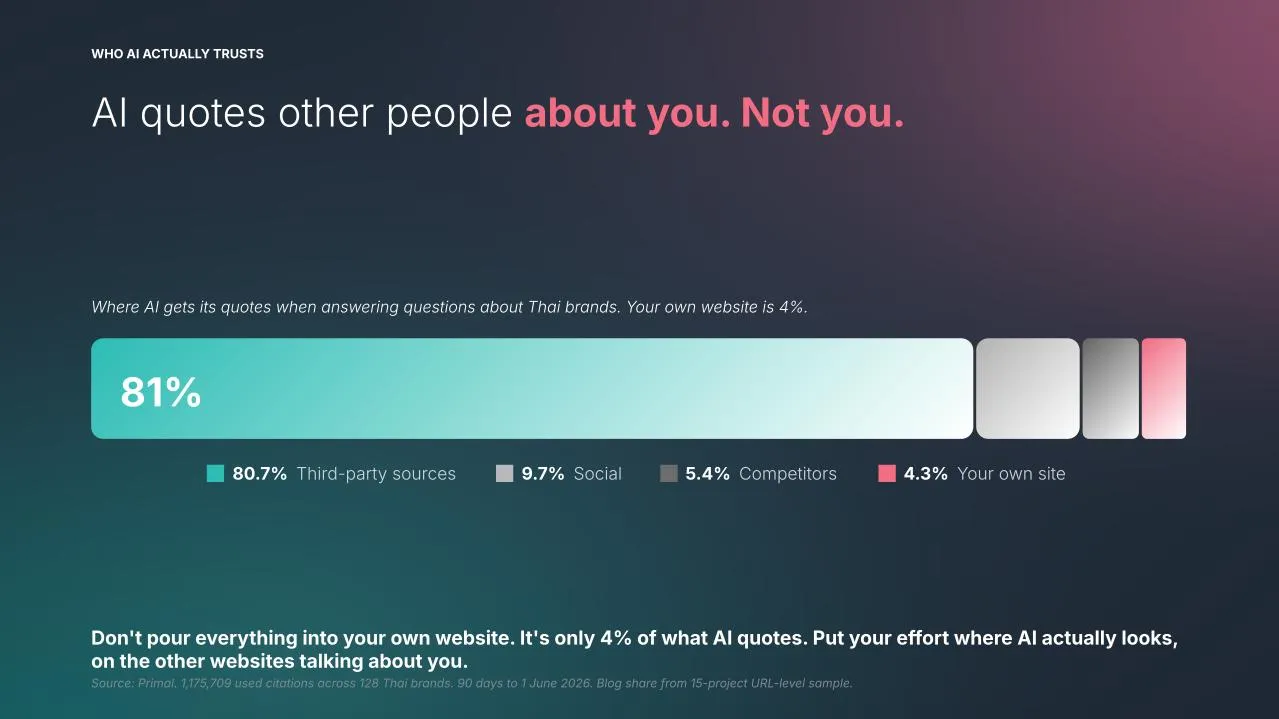
AI search cites other websites about a brand far more often than the brand’s own site. In the same 285,098 answers, a brand’s own website made up about 4 in 100 citations. That is the median across the 171 brands. Social media, review sites, community forums and other brands in the same category took most of the rest.
The chart below shows how many brands had each site among the 15 sites AI cited most for them. Facebook is on the list for almost every brand, and YouTube for about half.
This matches the study Primal presented at Marketing Oops Summit 2026. It covered 128 brands over 90 days and also found a brand’s own site at about 4% of citations.
Customers Often Ask Us Whether To Focus On Their Website Or Other Platforms
Do both, and start with the website. Your website is the one place where you set the facts yourself, such as prices, specifications, services and the areas you cover. Next, find out which sites AI cites in your category, and give your brand a presence there. That might be a Facebook page that answers customer questions, or YouTube videos that explain your product.
The slide below, from the same study, splits AI citations by the type of site they came from.
Will AI Search Replace Google And SEO
Not on current figures. In Thailand, most AI search happens inside Google. Google’s AI features take their links from the same index as normal search. So search engine optimisation (SEO) is still the base for being cited in AI Overviews and AI Mode.
Set Google against ChatGPT, and StatCounter’s figures for last month show Google sending almost every visit to websites in Thailand. ChatGPT sent about 1 visit in 2,000.
AI search changes what a brand measures. Rankings and clicks still matter. Add how often AI answers mention your brand, and which of your pages they cite.
How SEO, AEO And GEO Relate To AI Search
SEO gets a page ranked in search results. Answer engine optimisation (AEO) gets a page lifted as the answer, in a featured snippet or an AI Overview. Generative engine optimisation (GEO) gets a brand mentioned and cited in answers written by generative AI, such as ChatGPT, Gemini and AI Mode. All three need pages that search systems can reach and that answer the question clearly.
How To Get Your Brand Into AI Search Answers
A brand gets into AI search answers when its pages are indexed and answer questions clearly. It also needs its name on the other sites AI cites in its category. The work has five steps.
- Get your pages into Google’s index. Google Search Central says a page must be indexed and eligible for a snippet to be a link in AI Overviews or AI Mode. It sets no other technical requirement. Check the status in Google Search Console.
- Let AI crawlers into your site. Check that your robots.txt file does not block OpenAI’s OAI-SearchBot or the crawlers of the other platforms your buyers use. The robots.txt file sits at the root of your site and tells each crawler which pages it may read.
- Answer the question in the first sentences of each section. Write headings as the questions buyers ask, then answer in the first 1 to 3 sentences. Each smaller search can then find its answer on your page.
- Get your brand mentioned on the sites AI cites in your category. Use press coverage, articles, customer reviews and product videos on sites such as Facebook, YouTube, Pantip and the review sites in your category.
- Keep your brand facts the same everywhere. Your name, address, prices and product details should match on your website, social pages, review sites and Google Maps. An AI that reads many sources at once then finds no conflict.
Most of Thailand still goes to Google. The AI answers people see here are AI Overviews, with AI Mode next, and both pull from Google’s index. So the first step is still to rank, and to rank in Thai. We watch an English post sit still while the Thai version of the same post ranks almost immediately. Then be everywhere else, because most of what AI cites is third-party pages, not your own site.
Step 2 matters most for ChatGPT. OpenAI’s crawler documentation, captured below, says sites that opt out of OAI-SearchBot are not shown in ChatGPT search answers. It also says a robots.txt change can take about 24 hours to apply.
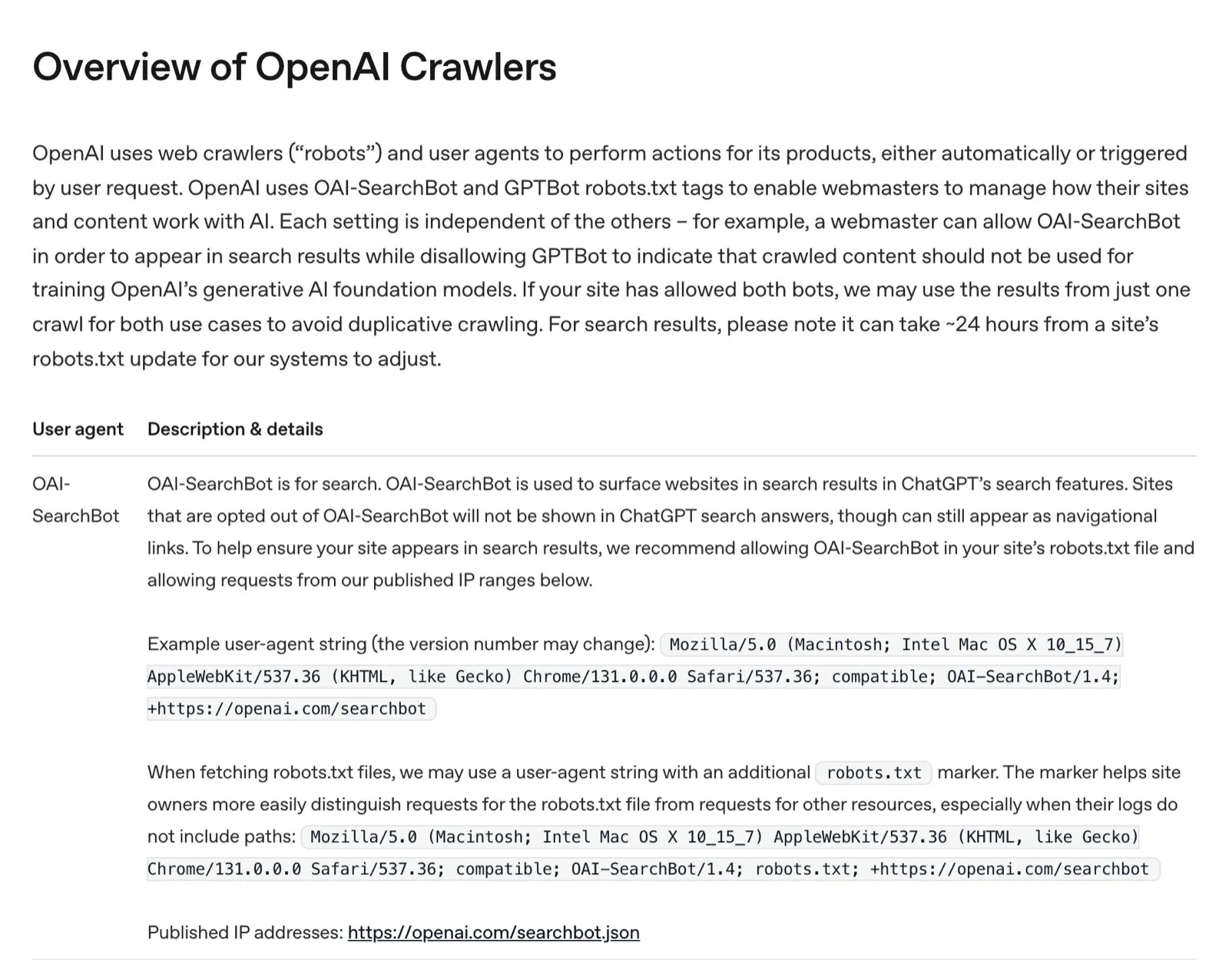
OpenAI’s page also treats GPTBot, which collects content to train its models, as a separate setting. So a brand can block GPTBot and still allow OAI-SearchBot.
The video below covers how to prepare a whole site for AI search.
A video on optimising a whole site for AI search, from Mark McDowell’s YouTube channel.
How To Check Whether AI Search Mentions Your Brand
Ask ChatGPT, Gemini and AI Mode the questions your buyers really ask, and write down what comes back. Note whether your brand is mentioned and which pages are cited. Note which brands appear in your place, and whether the prices in the answer are right. Ask the same questions every month, because answers change from day to day and from platform to platform.
On Google, Search Console has a Generative AI performance report. It shows how often links to your site appeared in AI Overviews and AI Mode, by page, and by device or country. Our guide to measuring AI search visibility covers the method in full.
If you want a team to run this every month, that is Primal’s AI SEO service. It starts by tracking your buyers’ questions in ChatGPT, Gemini, Perplexity and Google AI Overviews with Elevate, Primal’s AI Visibility Tracker. Then it plans the SEO, AEO and GEO work around what the data shows. We work from our Bangkok office, with colleagues in Kuala Lumpur and Singapore.
Frequently Asked Questions About AI Search
Customers Often Ask Us Whether They Can Tell AI To Fix Wrong Facts About A Product
Not directly, because you cannot make an AI correct its answer for every user. You fix it at the sources AI reads. Put the prices and specifications of every model, the newest included, clearly on your own pages. Then make sure the outside sites AI cites often carry the same facts.
On Google, you can also press thumbs down under an AI Mode answer to report a mistake.
Customers Often Ask Us How Long It Takes Before A Brand Appears In AI Answers
There is no fixed time. It depends on how fast the systems crawl and index new pages, and on how much other sites mention the brand. Technical fixes work fast, and OpenAI says ChatGPT search can take about 24 hours to adjust to a robots.txt change. Mentions on other sites take longer to add up, so measure with the same questions every month.
Customers Often Ask Us Whether ChatGPT, Gemini And Perplexity Each Need Separate Work
The base work is the same for every platform, with clear pages and mentions on other sites. Each platform still cites different sites, though. The study Primal presented at Marketing Oops Summit 2026 found that a brand mentioned often in Google’s AI answers can be almost absent from ChatGPT. So check each platform on its own.
Is AI Search Accurate
It can be wrong, so check anything important. Google says AI Mode does not always get it right and can misread web content or miss context. Google’s advice is to check important information in more than one place and to open the source links.
Is AI Search The Same As A Chatbot
Only when the chatbot searches the web. Without a search, a chatbot answers from what its model learned in training, up to a fixed date. AI search looks pages up as you ask and cites them. ChatGPT and Gemini search the web when a question needs it.
Founder and Chief Executive Officer
Mark McDowell is the Founder and Chief Executive Officer of Primal, which he started in Bangkok in 2015. He is on the Forbes 30 Under 30 Asia 2020 list and was Campaign Asia’s Southeast Asia Young Achiever of the Year in 2018. He writes about AI search and search engine optimisation.
About The Author