

By Mark McDowellPosted: Updated: 11 min read
First published by Sitvisut Anantnakarakul, 2021-04-20. Updated by Mark McDowell on 2026-10-21.
What Is CPAS And How Do Collaborative Ads Work
CPAS, short for Collaborative Performance Advertising Solution, is Meta's collaborative ads product. A retailer such as Shopee or Lazada shares a catalogue of a brand's products with the brand's ad account, and the brand runs Facebook and Instagram ads that send shoppers to buy in that store. The retailer's pixel reports the purchases, so the brand sees totals but not raw event data.
Key Takeaways
- CPAS uses a catalogue segment that Shopee or Lazada shares with the brand, sends shoppers to buy in the retailer's app or site, and uses the retailer's pixel to report their purchases to Meta.
- Meta says the pixel in collaborative ads belongs to the retailer, so the brand sees purchases with shared items and product-level reports, but not the retailer's Events Manager or raw event data.
- A collaborative ads account works with one retailer and can only send people to that retailer's site or app, so a brand on both Shopee and Lazada needs at least 2 ad accounts.
- Shopee offers a Meta Ads tool in its Seller Centre that sets the audiences for the store, while Lazada allows retargeting of its shoppers from the last 180 days only for stores with a Traffic Enhancement Agreement.
- In 274, 271 artificial intelligence (AI) answers about 171 brands logged over the last month by Elevate, Primal's AI Visibility Tracker, Shopee or Lazada was among the 15 most-cited sites for 13 of 25 consumer product brands and for 3 of 146 other brands.
What Is CPAS
CPAS, the Collaborative Performance Advertising Solution, is a Meta ad product for brands that sell through online stores. Meta now calls it Collaborative Ads. A retailer such as Shopee or Lazada shares a list of the brand’s products with the brand. The brand uses that list to run ads on Facebook and Instagram.
Each ad shows products from the retailer’s store. A click takes the shopper to the product page, and the shopper buys there.
CPAS exists because of the pixel. A brand cannot put its own Meta pixel on a Shopee or Lazada store page. So a normal Facebook ad that links to the store knows who clicked, but not who bought. CPAS uses the retailer’s pixel instead, so the campaign learns from real orders. The data still belongs to the retailer. The brand sees totals and product reports, not what each shopper did.
We see this in the CPAS campaigns Primal has set up on client ad accounts. The pixel field in every ad set is empty, because the purchase data comes from the retailer. Every ad with a link goes to lazada.co.th or shopee.co.th and nowhere else. So make 2 decisions before you start. First, choose between the marketplace’s own tool and your own ad account. Second, choose the report you will use as your main measure.
How CPAS Works
CPAS works in 5 steps. The retailer shares a catalogue segment. The brand accepts it in Meta’s Collaboration Centre and runs catalogue ads. Then a shopper clicks and buys in the retailer’s app or site.
In the last step, the retailer’s pixel sends product views, adds to cart and purchases back to Meta. Meta then reports them to the brand.
A catalogue segment is the part of the retailer’s catalogue that holds the brand’s products. The photo, name and price in each ad come from the retailer. The brand cannot edit the segment. It can make product sets from it, such as new arrivals or items on promotion. This diagram follows the data from the catalogue to the order.
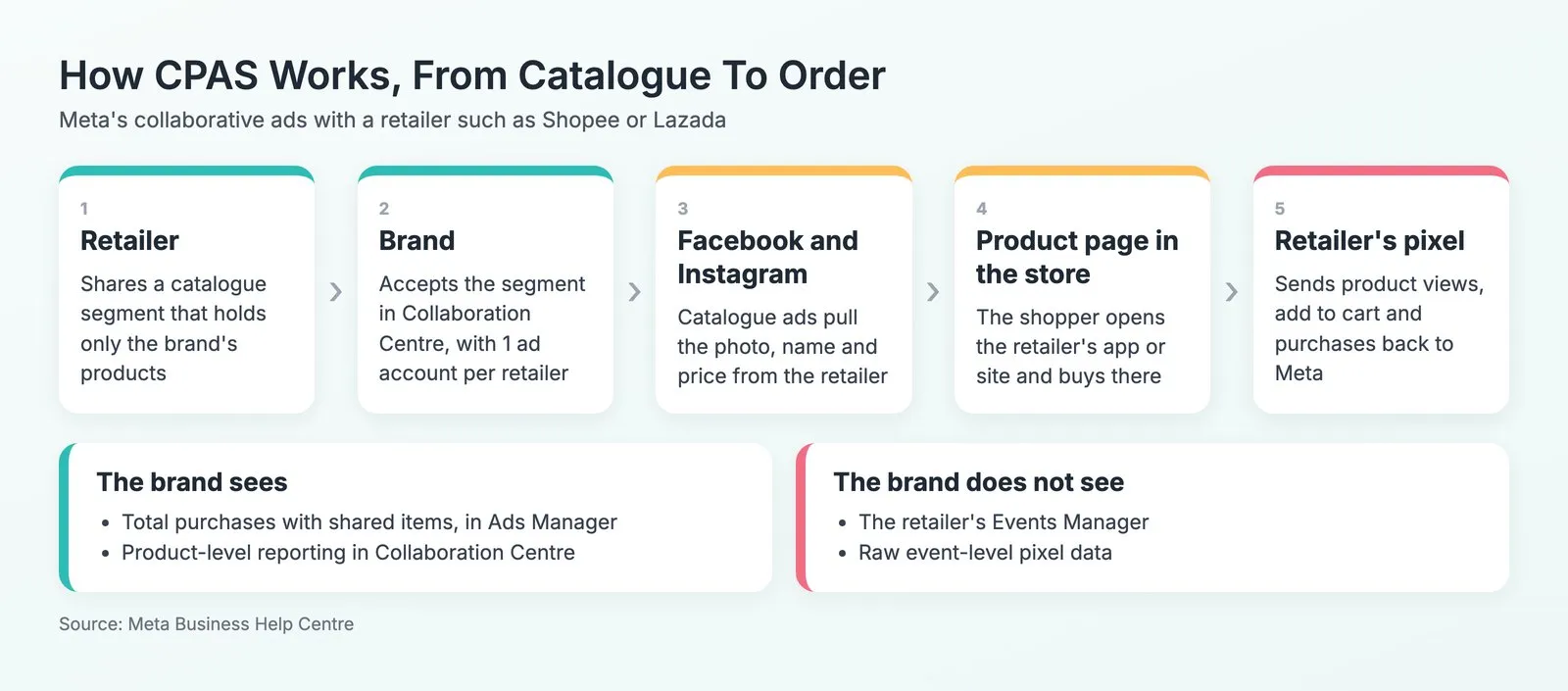
Meta’s page about collaborative ads says the segment runs Advantage+ catalogue ads. Meta used to call these dynamic ads. A campaign can aim for awareness, traffic or online sales. The brand can also show ads again to people who viewed its products in the store.
How CPAS Differs From A Normal Facebook Ad
A normal Facebook ad that links to a Shopee or Lazada store can measure clicks. CPAS can measure purchases in the store, because it uses the retailer’s pixel. So Meta can show the ads to the people most likely to buy. The table compares the two on the points a brand must choose between.
| Point | A normal Facebook ad that links to a store | CPAS |
|---|---|---|
| Product photo and price | Added by the brand, and may not match the store | Pulled from the retailer’s catalogue |
| What it measures | Clicks and visits to the link | Product views, adds to cart and purchases in the store |
| What Meta optimises for | Clicks or visits | Purchases |
| Who you can retarget | People who engaged with the ad or the Page | People who viewed your products in the retailer’s store |
| Ad account | The account the brand already uses | A separate account for each retailer |
| Where the ad can send people | Anywhere | Only that retailer’s site or app |
If you have never set up a campaign in Ads Manager, read how to run Facebook ads step by step first. CPAS uses the same campaign, ad set and ad levels.
Is CPAS The Same As Dynamic Ads
CPAS uses the same ad format as dynamic ads, now called Advantage+ catalogue ads. The difference is who owns the catalogue and the pixel. In a normal catalogue ad, the brand owns both. In CPAS, the retailer owns both and shares them with the brand.
What A Brand Can And Cannot See In CPAS
In Ads Manager, a brand sees purchases with shared items. In Collaboration Centre, it sees a report for each product. It can also follow campaign trends over time. It cannot open the retailer’s Events Manager, see raw pixel data or test events live.
Meta gives the reason on the same help page. In collaborative ads, the pixel belongs to the retail partner, not to the brand. This capture shows that part of the page.
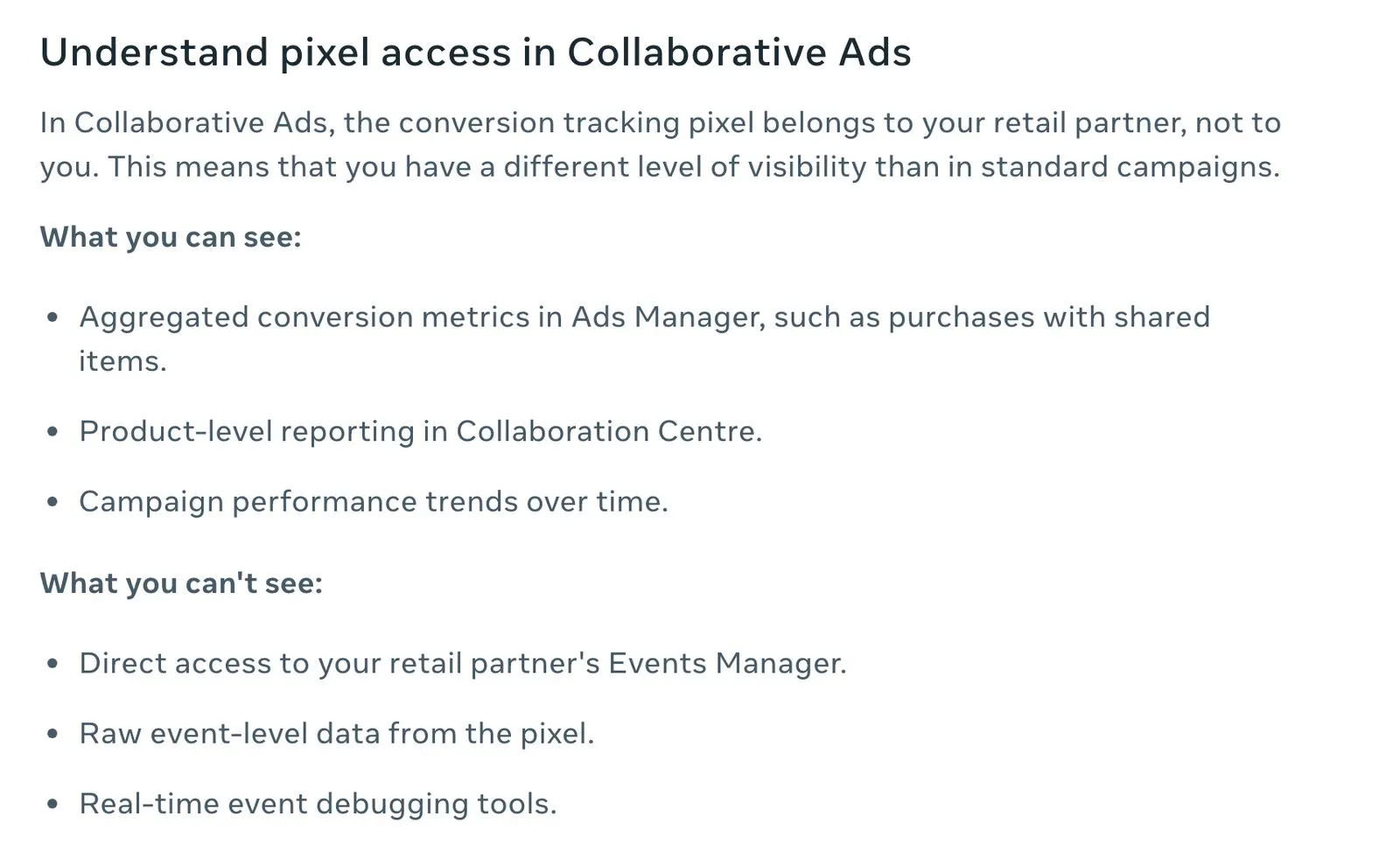
The ad account has its own conditions too. Meta’s page on collaborative ads ad accounts sets them out:
- Each ad account works with one retailer, and only with the assets that retailer shares.
- Ads can only send people to that retailer’s site or app. Meta pauses an ad that links anywhere else.
- Meta advises a new ad account for each partner. Some retailers require a new account and viewing access, so they can see your results.
- A brand cannot end the partnership by itself. The retailer has to stop sharing the catalogue segment.
Only the retailer can fix tracking problems. Its events must carry the product identifiers (IDs) and quantities Meta needs. If they do not, the brand sees an error saying the catalogue is not CPAS compliant. Meta says event IDs should match catalogue IDs at least 95% of the time.
How Shopee And Lazada Run CPAS
A Shopee store can run CPAS in 2 ways. It can use the Meta Ads tool in Shopee’s Seller Centre. Or it can take Shopee’s catalogue into the brand’s own ad account. A Lazada store asks for the catalogue in the Lazada seller back office and runs the ads from its own ad account.
The table compares Shopee’s tool with the own-account route.
| Point | Meta Ads in Shopee’s Seller Centre | The brand’s own ad account (Shopee or Lazada) |
|---|---|---|
| Account and Page | Made by Shopee’s system, not linked to the brand’s own Page | The brand’s Business Manager, Page and ad account |
| Audiences | Set automatically, and the store cannot change them | Set by the brand, plus the audiences the retailer shares |
| Ad formats | Carousel, or collection with carousel | The catalogue ad formats in Ads Manager |
| Payment | Credit topped up in Seller Centre, not refundable, kept apart from Shopee Ads credit | Billed to the brand’s ad account by Meta |
| Reports | Impressions, clicks, orders and order value within 7 days of a click, in Seller Centre | Ads Manager, and product-level reports in Collaboration Centre |
Shopee’s Meta Ads Tool In Seller Centre
Shopee’s seller guide to Meta Ads in Seller Centre is in Thai. It says any store with the off-platform ads feature can use the tool. The store must have been active for 7 days or more, and must not be on vacation mode. Meta picks 10 products from the store, based on each shopper’s interests. It shows them as carousel or collection ads on Facebook and Instagram. Shopee advises opening the account 3 weeks or more before a campaign day. It also advises running each campaign for 14 days. This route suits a store with no ads team. In return, the store gives up control of the audiences and most of the creative.
Your Own Ad Account With Shopee
The second Shopee route works the same way as CPAS with any retailer. The brand sets up a Business Manager, a Page and an ad account. Shopee sends an invitation, and the brand accepts the catalogue segment in Collaboration Centre. The brand then sets its own audiences, budget and creative.
Your Own Ad Account With Lazada
Lazada’s page on collaborative ads says retargeting with Lazada’s shopper data needs a Traffic Enhancement Agreement (TEA). Only stores with that agreement can use it. Lazada offers 2 audiences. One reaches shoppers who browsed your category or similar ones. The other reaches shoppers who visited your store, added to cart or ordered in the last 180 days. Lazada’s setup guide asks for one ad account per Lazada catalogue. It also asks for viewing access to that account. Without it, Lazada cannot share its audiences.
How To Set Up CPAS Step By Step
On the own-account route, CPAS takes 7 steps. Steps 1 to 3 happen once for each retailer. Steps 4 to 7 repeat for each campaign.
- Set up a Business Manager, a Facebook Page and a new ad account for each retailer. Use that ad account for CPAS only.
- Ask the retailer for its catalogue. On Lazada, you do this in the seller back office. You give your Business Manager ID and ad account ID.
- Accept the invitation in Meta’s Collaboration Centre. Agree to the terms. Give the retailer viewing access if it asks.
- Make product sets from the catalogue segment. Filter by brand or product name, not by ID. A set filtered by ID can change when the retailer edits its catalogue.
- Create the campaign in Ads Manager. Switch on Collaborative Ads and pick the retailer’s ad account. Then choose the online sales objective and the catalogue segment.
- Choose the goal that gets the most conversions. Track purchases for 7 days after a click and 1 day after a view. On Lazada, add Lazada’s tracking code to the ad link, or the results will not show in Lazada’s report.
- Plan the budget around campaign days such as 9.9, 11.11 and 12.12. Start early, so the campaign has time to learn.
Steps 4 and 6 follow Meta’s best practices for collaborative ads. The same page says a brand cannot add new products to its catalogue segment. If a product is missing, ask the retailer to add it. In the CPAS campaigns Primal has set up for clients, almost all used the online sales objective with the catalogue. Most of those accounts tracked purchases for 7 days after a click and 1 day after a view.
How To Measure CPAS Results
Measure CPAS on purchases with shared items and return on ad spend (ROAS) in Ads Manager. Then check them against the product-level report in Collaboration Centre. The two will not always match.
Meta’s page on collaborative ads reporting gives an example. A shopper buys 3 toothbrushes in one order. Ads Manager shows 1 purchase with shared items. The product-level report shows a quantity of 3.
The product-level report also shows every purchase from the catalogue segment. That includes products that were not in the ad’s product set. Some columns in Ads Manager stay blank, such as age, gender and placement.
Each marketplace also uses its own attribution window. Shopee’s Seller Centre tool reports order value within 7 days of a click. Lazada’s guide says its report gives each order to the last channel the shopper touched within 14 days. Meta uses 7 days after a click and 1 day after a view. Your store’s own order report includes every order from every channel.
So pick one of these as your main measure. Then compare like with like, such as one campaign day against the last one.
Meta says its system needs about 50 conversions to predict results well. It advises planning for 100 or more conversions per ad set over its life. Until then, the cost per purchase can be high and ROAS low. A store with few orders should run fewer ad sets, so each one gets enough purchase data.
When the reports disagree, our ad operations team works to a fixed check. It never adds together the revenue that two ad channels each claim on the same marketplace, because both can be counting the same orders. Where Meta’s reported purchases and the orders tracked through tagged links differ, the team writes the gap into the report as a measurement step for the brand and the team to settle together.
Which Brands CPAS Suits
CPAS suits brands that sell mainly on Shopee or Lazada. It works best with many products, stock ready to ship and enough orders for the campaign to learn. A brand that sells mainly on its own website should run catalogue ads with its own pixel. That way it keeps the full customer data.
Elevate, Primal’s AI Visibility Tracker, shows a second reason marketplace pages matter. Over the last month, it logged 274,271 answers from artificial intelligence (AI) assistants about 171 brands. For 24 of 25 consumer product brands, the answers cited Shopee or Lazada. Shopee or Lazada was among the 15 sites cited most for 13 of those brands. Among 146 other brands, such as hotels, clinics and insurers, that was true for 3. The chart shows the 2 groups as a share of brands.
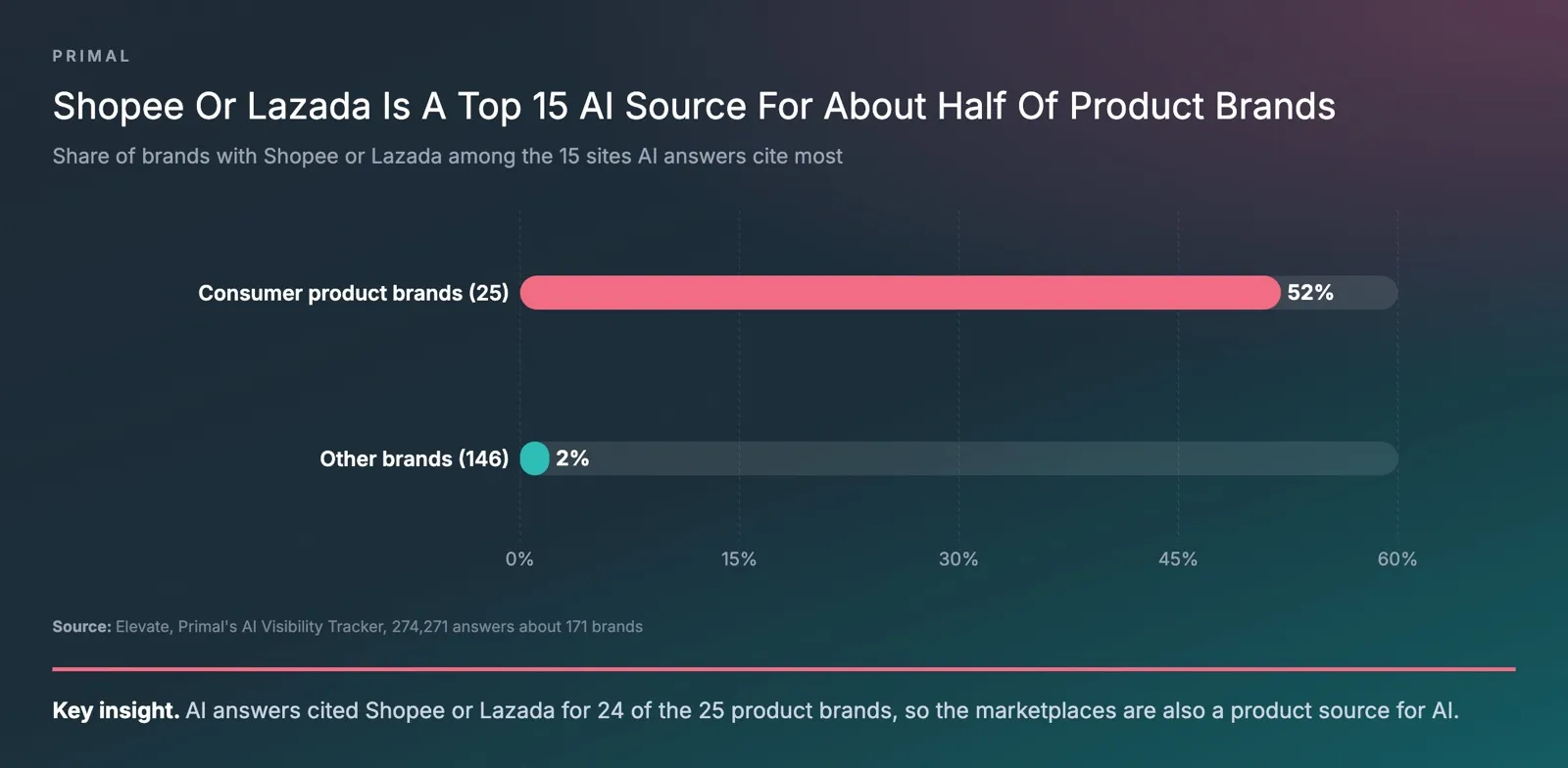
For one product brand we checked page by page, the cited pages were Shopee search pages and the marketplaces’ buying guides. So shoppers who click a CPAS ad read your product names, categories and reviews in the store, and AI assistants read them too.
The ad sends people to a product page, so the product page decides whether they buy. A page with few reviews, unclear photos or a higher price than other stores may lose them. Work on your product pages alongside the ads, as part of your ecommerce marketing.
If you want a team to plan and run CPAS on Shopee and Lazada, see Primal’s CPAS ads service. Our Bangkok office plans CPAS together with a brand’s in-app marketplace ads.
Frequently Asked Questions About CPAS
What Does CPAS Stand For
CPAS stands for Collaborative Performance Advertising Solution. Meta now calls it Collaborative Ads. Lazada’s page uses both names. In marketing, CPAS means a Meta ad that shows a retailer’s products and sends shoppers to that store.
Who Pays For CPAS Ads
On the own-account route, Meta bills the ads to the brand’s ad account, as for any campaign. On Shopee’s Seller Centre tool, the store tops up ad credit in Seller Centre.
Shopee’s FAQ for the tool says Shopee adds no fee or commission on top of the ad cost. It charges by impressions, as cost per mille (CPM), and the ads run on Facebook, Instagram and Audience Network. Shopee’s guide says each top-up includes 7% value added tax (VAT).
Is CPAS The Same As CPA
CPA and CPAS are different things. Cost per acquisition (CPA) is a metric, the ad cost of one result, such as one order. CPAS is a type of ad. A CPAS campaign tracks cost per purchase as one of its measures, next to ROAS.
How CPAS Differs From Shopee Ads And Lazada’s In-App Ads
Shopee Ads and Lazada’s in-app ads show inside the marketplace app. People see them while they shop there. CPAS ads show on Facebook and Instagram. They bring people into the store, including people who were not shopping at the time.
Shopee keeps Meta Ads credit apart from Shopee Ads credit, so one budget cannot pay for both.
Customers Often Ask Us Whether To Start With CPAS Or TikTok Ads
It depends on where the orders happen. Say your main store is on Shopee and few people search for your product yet. Then we suggest starting with CPAS to Shopee, because the campaign learns from orders in the store.
Add TikTok when the budget allows, and see our guide to TikTok marketing for that side. When you run both, read the store’s total orders next to each platform’s report.
Founder and Chief Executive Officer
Mark McDowell is the Founder and Chief Executive Officer of Primal, which he started in Bangkok in 2015. He is on the Forbes 30 Under 30 Asia 2020 list and was Campaign Asia’s Southeast Asia Young Achiever of the Year in 2018. He writes about AI search and search engine optimisation.
About The Author