

By Panlert ChampakhomPosted: Updated: 13 min read
What Is AI Visibility And How To Measure It
AI visibility is how often artificial intelligence (AI) answers name or cite your brand when people ask questions in your category. Measure it on a fixed set of questions asked again and again on each platform, and read four numbers each month, which are visibility, mentions, citations and share of voice. Google Search Console and Google Analytics 4 (GA4) show what reaches your website.
Key Takeaways
- Visibility, the share of answers that name your brand, is the number to compare month to month, because it is a share and does not depend on which competitors you track.
- In 285, 098 AI answers logged over the last month by Elevate, Primal's AI Visibility Tracker, the median brand was measured on 10 questions, and each question collected about 90 answers a month.
- In the same data, a brand's own website was cited in only about 1 in 5 answers, and for 121 of 171 brands another site was cited more often, so a report should list the other sites too.
- Search Console's generative AI performance report shows impressions in AI Overviews and AI Mode by page, country, date and device, but not the search behind each impression.
- When the question set changes, the figures start again, and the first month of the new set cannot be compared with the month before.
What Is AI Visibility
AI visibility is how often artificial intelligence (AI) answers name or cite your brand. It covers the answers people get when they ask questions in your category. Those answers come from Google’s AI Overviews and AI Mode, ChatGPT, Gemini and other assistants. The main number is the share of answers that name your brand over a period of time.
AI answers change each time someone asks. So you measure with the same set of questions, ask them many times, and read the result as a monthly figure. One search of your own shows only that one answer.
Our data shows that AI answers about a brand often cite other sites. Over the last month, Elevate, Primal’s AI Visibility Tracker, logged 285,098 AI answers to questions in the categories of 171 brands. A brand’s own website was cited in only about 1 in 5 of them. For 121 of the brands, another site was cited more often than the brand’s own. So an AI answer can name your brand while it quotes someone else’s page.
Start with the questions your buyers really ask, and measure each platform on its own. Keep mentions and citations on separate lines. Use Google’s reports only for what they record.
Which Numbers Measure AI Visibility
Four numbers measure AI visibility. They are visibility, mentions, citations and share of voice. Sentiment, the tone of the answer, is read beside them. All of them come from the answers to one question set in one period, and each one measures something different.
| Number | What it measures | Base | What it cannot tell you |
|---|---|---|---|
| Visibility | The share of answers that name the brand | All answers to the question set that month | A good total can hide a topic where the brand never appears |
| Mentions | How many answers name the brand | None, it is a raw number | It rises when you add questions or ask more often |
| Citations | The share of answers that link to the brand’s website | All answers to the question set | An answer can name you and link to someone else |
| Share of voice | The brand’s part of all brand mentions | Mentions of every brand on your competitor list | It changes when you add or drop a competitor |
| Sentiment | The tone of the answers that name the brand | Answers that name the brand | Whether the prices and services in the answer are right |
If you keep one number to compare month to month, keep visibility. It is a share, so it does not grow just because there are more answers. It also does not depend on your list of competitors. Share of voice then shows which brands take the answers that leave you out.
Customers Often Ask Us How The Visibility Number Is Worked Out And How Many Times To Ask
Visibility is the number of answers that name your brand, divided by all the answers your question set collected that month. Say a set of 20 questions collects 1,800 answers in a month. If 450 of them name your brand, visibility for that month is 25%.
Each question has to be asked many times, on every platform you measure. In the data above, each question collected about 90 answers a month, or about 3 a day. A typical brand’s monthly figure rested on about 1,100 answers.
How Brand Mentions In AI Differ From Citations
A brand mention in AI is your brand name in the text of an answer. A citation is a link to your page in the list of sources under the answer.
The gap between the two is why a report lists the sites that get cited. In our data, most brands saw other sites cited more often than their own. So the citations line should say which sites were cited most. They may be review sites, news sites, forums or the brand’s own Facebook Page.
Before you start, give your tracker every way people write your brand name. Include the Thai and English spellings, short names and common misspellings. A tracker only finds the names it is given. An answer that uses a name you left out does not show up as a mention.
Why Position In An AI Answer Is Not A Metric
Your place inside an AI answer, such as first or third, changes too much to report. In SparkToro’s study, hundreds of volunteers asked ChatGPT, Claude and Google’s AI the same questions almost 3,000 times. The chance of getting the same list of brands twice was under 1 in 100. The chance of the same order was about 1 in 1,000.
The same study found that the share of answers that name a brand is a fair measure. That holds when the share comes from many questions, each asked several times. This share is visibility, the first number in the table above.
Mark McDowell, Primal’s Founder and Chief Executive Officer, shows how to check whether AI recommends your brand in this video from his YouTube channel.
How To Set Up A Question Set To Measure AI Visibility
Your question set should hold the questions buyers ask before they choose, grouped by topic. Keep the same set for the whole period you measure. How many questions you need depends on how many topics you sell in.
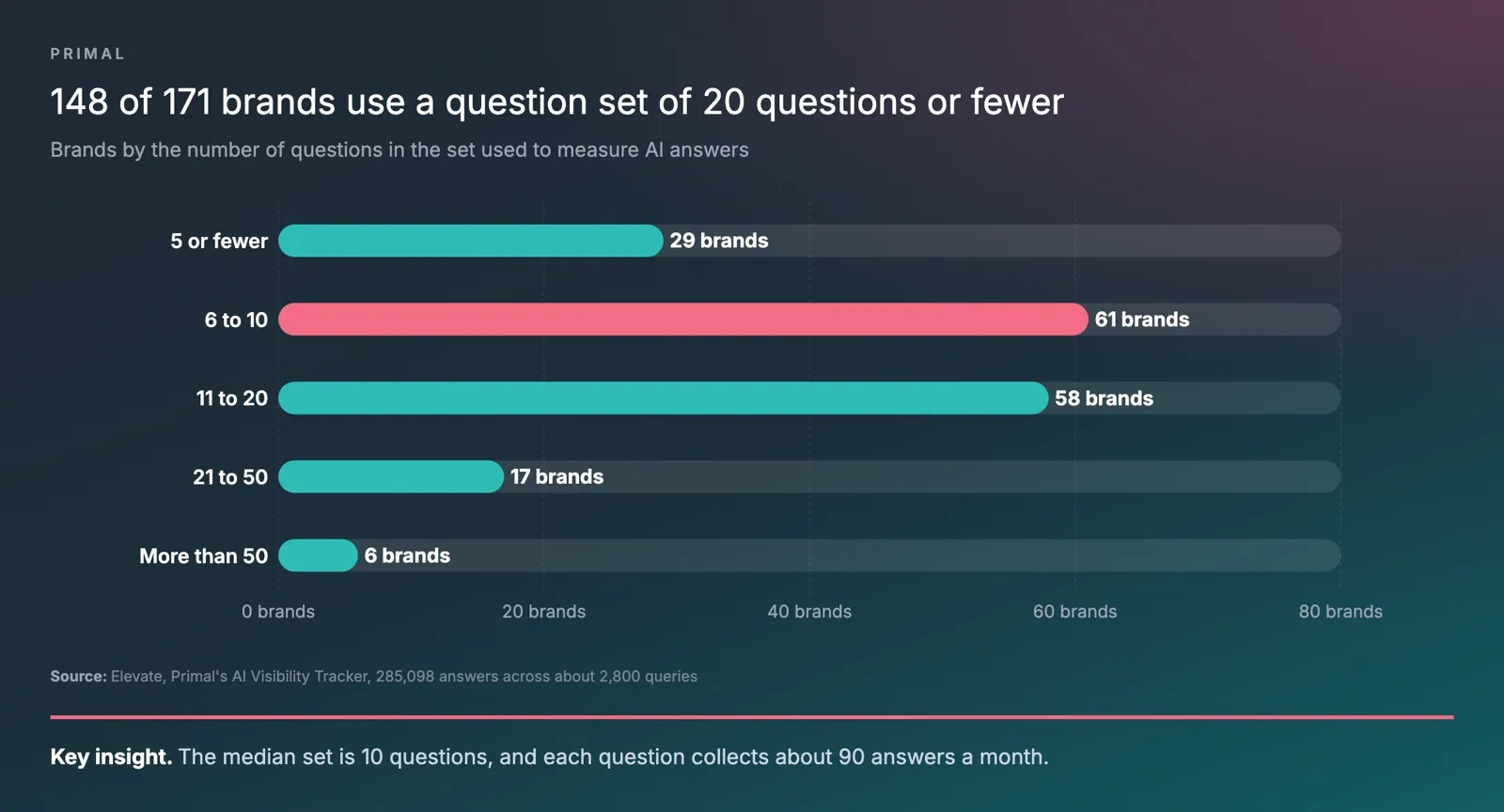
In the data from Elevate, Primal’s AI Visibility Tracker, the median brand used 10 questions. Of the 171 brands, 148 used 20 or fewer.
The chart below groups the brands by the size of their question set. Sets of 6 to 10 questions were the most common.
A small set works when each question is asked often enough. These steps set one up.
- Collect the questions customers ask your team before they buy and after. Write each one as a full sentence, the way a person types it into an AI assistant.
- Add questions from the keywords people search in your category. Use Thai and English if your buyers search in both.
- Group the questions by stage, from understanding the problem, to comparing options, to choosing a supplier.
- Leave your brand name out of most questions. Keep a few branded ones to check that the answers describe you correctly.
- Fix the list of competitors used for share of voice, and keep it for the whole period.
- Give the set a version name and a start date, and do not edit it in the middle of a month. Then you can compare the same questions before and after a change to your pages or a press campaign.
Customers Often Ask Us Whether To Track Questions With Our Brand Name Or Category Questions
Track mostly category questions. They show whether AI picks your brand when a buyer does not know your name yet. Questions that already contain your brand name show whether AI describes your products, prices and branches correctly.
Answers to branded questions usually name the brand. If you mix them into the same set, visibility looks higher than what a new buyer sees. Report the branded questions on a separate line.
Which AI Platforms To Measure
Start with Google’s AI Overviews and AI Mode, and with ChatGPT. Then add Gemini and any other assistant your customers use.
In Thailand, StatCounter’s figures show which chatbots send people to websites. ChatGPT sent about 7 in 10 of those visits, and Gemini about 1 in 4. AI Overviews and AI Mode sit inside Google Search, so their visits arrive with your Google search visits.
Measure each platform on its own line. A total across platforms hides a change on one of them. You may want to check ChatGPT by hand between reports. Our guide to ranking in ChatGPT answers has a prompt that tests whether it mentions your brand.
What Search Console’s Generative AI Report Shows
The generative AI performance report in Google Search Console shows how many times links to your site appeared in AI Overviews and AI Mode. You can see the numbers by page, country, date and device. Google’s help page for the report says it covers those two features and leaves out experiments in Search Labs.
Add this report to every monthly review. AI Overviews already appear on most results pages for the keywords we track for clients. Across 995 keywords in Primal’s rank-tracking data for 17 client brands, an AI Overview showed on 859 Google results pages.
The report shows four things.
- Impressions in AI Overviews and AI Mode by day, week or month
- The pages with the most and the fewest impressions
- The countries and devices people searched from
- Text searches apart from image searches, such as a search with a phone camera
It leaves out four things.
- The search behind an impression, because the report’s tabs are pages, countries, dates and devices only
- A split between AI Overviews and AI Mode, because the report’s one filter splits text searches from image searches
- Clicks, which Google’s page on AI features places in the main Performance report, under the Web search type
- Answers in the Gemini app or in ChatGPT
The chart in the report adds up by site. If one answer links to two of your pages, the chart records one impression, while the table by page credits both pages. So the two totals can differ. Dates are in Pacific Time, 14 or 15 hours behind Thai time, so compare monthly totals, not single days.
Google’s page on impressions, position and clicks says every link in an AI Overview shares one position. It also says a follow-up question in AI Mode is a new search. So the average position of a page in an AI Overview cannot tell you where your link sat inside the answer.
What GA4’s AI Assistant Channel Includes
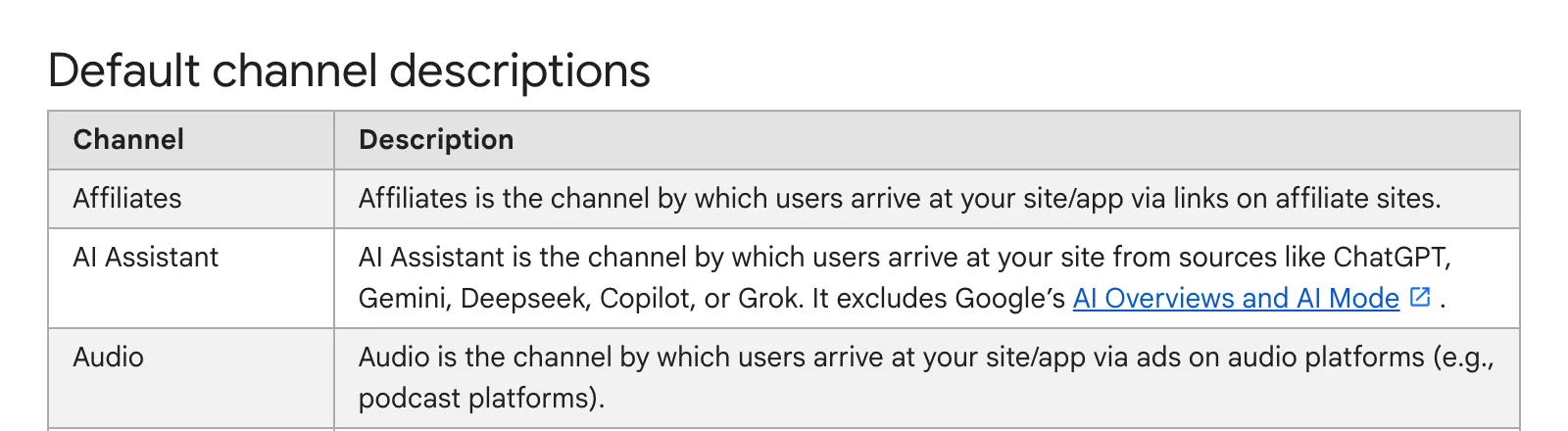
The AI Assistant channel in Google Analytics 4 (GA4) groups visits from assistants such as ChatGPT, Gemini, Deepseek, Copilot and Grok. It leaves out Google’s AI Overviews and AI Mode, which stay in Organic Search, according to Google’s help page on the default channel group. GA4 marks a visit as ai-assistant when the site that sent it is on Google’s list of AI assistants.
The capture below is from that help page. It shows the AI Assistant row between the Affiliates and Audio channels.
In the Traffic acquisition report, set the table to Session default channel group and read the AI Assistant row each month. Write down the sessions, the landing pages and the key events. A key event might be a form sent or a tap on your LINE button.
GA4 only sees people who click. An answer that names your brand without a click never reaches GA4. So GA4 figures cannot stand in for visibility.
Customers Often Ask Us Whether A Visit From ChatGPT Is Organic
A visit from ChatGPT is not organic in GA4. GA4 puts it in the AI Assistant channel, which is separate from Organic Search. Clicks from AI Overviews and AI Mode are the exception, and GA4 records them as Organic Search. If your customer relationship management (CRM) system sorts leads only as paid or organic, add an AI source so it matches GA4.
How To Track AI Assistants Missing From Google’s List
Use a custom channel group. Google’s help page on custom channel groups has an example for AI assistants.
It adds a channel with a pattern, called a regular expression. The pattern matches the sites of assistants such as ChatGPT, Gemini, Microsoft Copilot, Claude and Perplexity. You then place that channel above Referral in the list.
A custom channel group applies to your past data as well. Write the pattern so it matches each assistant’s site name in full, such as perplexity or claude. Update it when your customers start using a new assistant.
How To Read Monthly AI Visibility Figures
Compare months on the same question set, one platform at a time, and read the shares before the raw numbers. When the question set changes, start again from that month. The table below is a made-up example of one brand over 6 months, not any brand’s data. Set A collects 1,800 answers a month and set B collects 2,700, at about 90 answers per question.
| Month (made-up example) | Question set | Mentions | Visibility | Citations | Search Console impressions |
|---|---|---|---|---|---|
| Month 1 | Set A, 20 questions | 396 | 22% | 8% | 4,100 |
| Month 2 | Set A, 20 questions | 450 | 25% | 8% | 4,600 |
| Month 3 | Set A, 20 questions | 486 | 27% | 9% | 4,500 |
| Month 4 | Set B, 30 questions | 513 | 19% | 7% | 4,900 |
| Month 5 | Set B, 30 questions | 567 | 21% | 10% | 5,600 |
| Month 6 | Set B, 30 questions | 648 | 24% | 13% | 6,300 |
Read the table in this order.
- Months 1 to 3 use the same set, and visibility rises from 22% to 27%. That change comes from the AI answers.
- In month 4, visibility falls to 19% while mentions rise. Both changed because the question set grew, so month 4 is the starting point for set B.
- Compare months 4 to 6 with each other. Visibility rises from 19% to 24%.
- In months 1 to 3, visibility rose but citations hardly changed. AI mentioned the brand more often but still quoted other pages. Open the list of cited sites and see what those pages answer that yours do not.
- Search Console impressions cover the whole site and do not depend on the question set, so all 6 months can be compared.
The chart below shows visibility for the same example. The pink bar marks the month the new question set started.
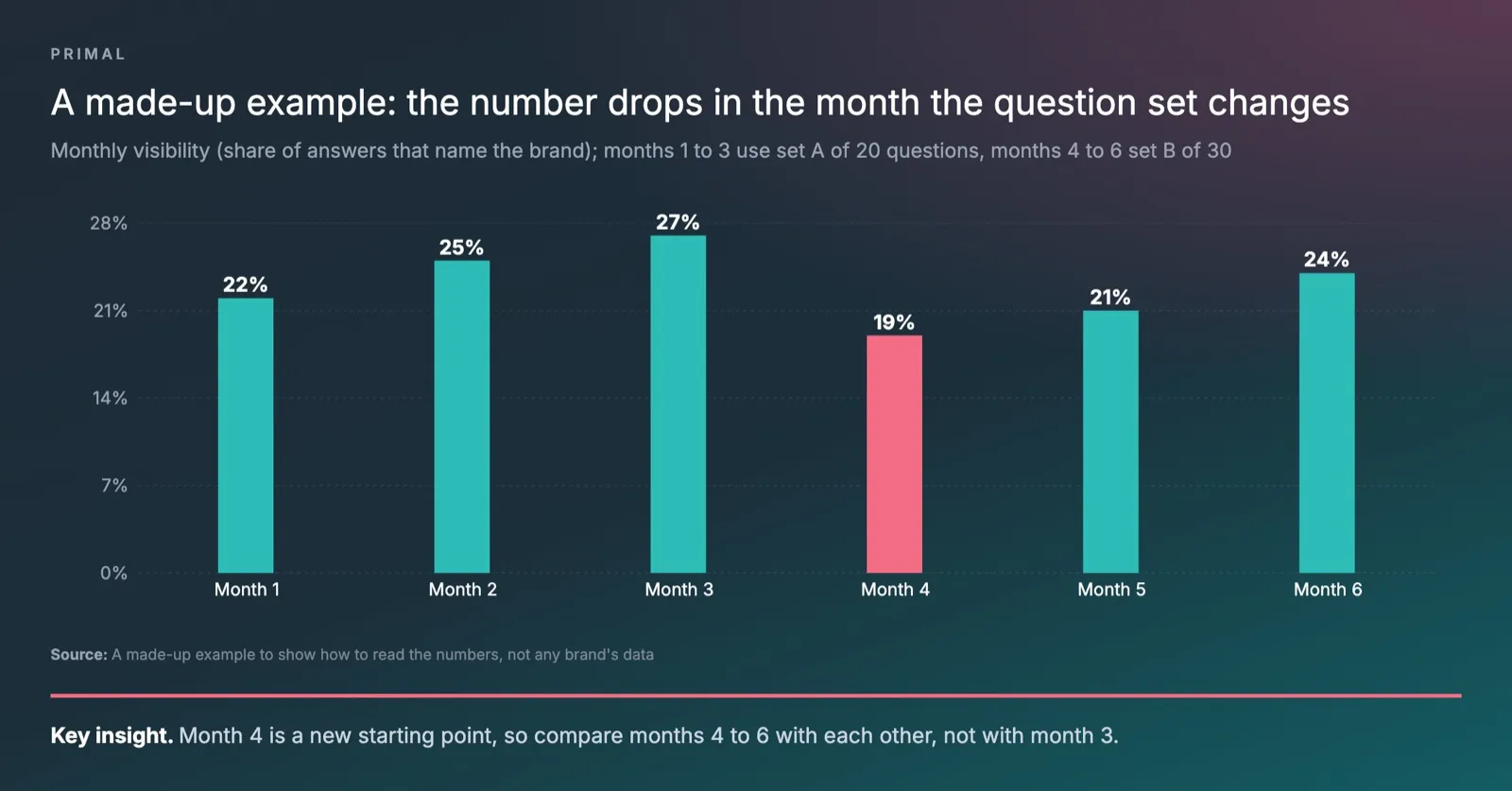
Note in the report the months when you changed pages or ran public relations (PR) work. Say month 5 in the example was the month the pages changed. Then the rise in citations is the result to keep watching on the same question set.
Mark McDowell, who founded Primal, has been asked by brands what a monthly report should hold. Our reports measure a brand’s AI visibility against its competitors, together with its keywords on page 1 of Google. They also show AI sessions next to organic sessions, AI conversions next to organic conversions, and which platforms send the most traffic. So a change in visibility in one month can be read next to the visits and conversions from the same month.
Customers Often Ask Us Whether Adding Questions Will Lift The Number
Adding questions can lift the number or lower it. It depends on whether the new questions cover topics where AI already names your brand.
So you cannot compare a new set with the old one. The first month of the new set is a new starting point. To compare across the change, ask the old set beside the new one for at least 1 month.
What A Monthly AI Visibility Report Should Include
A monthly AI visibility report fits on one page. It has 6 lines, each from one source, and each line sits beside last month’s figure.
| Line | Source | What to write down |
|---|---|---|
| Visibility by platform and topic | Your answer tracker, fixed question set | This month, last month and the version of the question set |
| Share of voice | The same tracker, with your competitor list | Your share, and which competitors gained |
| Citations | The same tracker | The share of answers that link to your site, and the other sites cited most |
| Impressions in AI Overviews and AI Mode | Search Console, generative AI report | The total, and the pages with the most impressions |
| Visits from AI assistants | GA4, AI Assistant channel | Sessions, landing pages and key events |
| Work done that month | The team that runs the website | Pages changed, PR published, and the dates |
Beyond the numbers, read about 10 real answers each month. Check that the prices, branches and services in them are right. A wrong fact in an answer is fixed on your own page or on the site the AI cites. Some search engine optimisation (SEO) numbers belong in the same report, such as clicks on searches without your brand name. Our guide to SEO key performance indicators (KPIs) covers them.
For a team that measures and improves this every month, see Primal’s AI SEO service. It uses Elevate, Primal’s AI Visibility Tracker, to follow the answers to your customers’ questions in AI Overviews, AI Mode, ChatGPT and Gemini. We use a report like the one above to plan the work on your pages and on the other sites AI cites. Our team works from offices in Bangkok, Kuala Lumpur and Singapore.
Frequently Asked Questions About AI Visibility
Can You Measure AI Visibility Without A Paid Tool
You can measure part of it. Search Console and GA4 cost nothing. They show how often AI Overviews and AI Mode showed your site, and how many visits AI assistants sent you.
Asking questions yourself and noting the answers gives you examples. It does not give you a share you can compare month to month, because each question needs dozens of runs a month.
Customers Often Ask Us Whether Being Mentioned Brings Visits To The Website
Some of it does. An answer that names your brand without a link makes people aware of the name but sends no visit.
People who click from ChatGPT or Gemini show up in the AI Assistant channel in GA4. People who remember the name and search for it on Google later arrive through search. So read your branded search clicks in Search Console beside visibility each month.
What Is A Good AI Visibility Figure
No single figure fits every category. The number depends on how many brands AI can choose from and on the questions you track. Use your own first month as the reference, and use share of voice to compare with competitors on the same questions.
For citations, our data gives a reference point. Half the brands had their own website cited in between about 8 and 35 of every 100 answers.
Does Bing Report AI Citations
Bing reports them in the AI Performance report in Bing Webmaster Tools. Bing’s announcement says it shows how often Microsoft Copilot, AI summaries in Bing and some partner services cite your pages. It also shows which pages they cite, and a sample of the phrases the AI searched with.
In the StatCounter figures above, Copilot sent under 1 in 100 of the visits from AI chatbots in Thailand. So treat this report as an extra line.
Senior SEO Specialist
Panlert Champakhom has worked in search engine optimisation (SEO) since 2018 and is a Senior SEO Specialist in Primal’s technical team. His work covers technical SEO, keyword research, on-page and content optimisation, and internal linking. His current focus is AI search, helping brands earn citations in Google AI Overviews, ChatGPT, Perplexity and Gemini.
About The Author