

By Mark McDowellPosted: Updated: 13 min read
ChatGPT SEO And How To Rank In ChatGPT Answers
ChatGPT SEO is the work of getting your brand mentioned and your pages cited when ChatGPT answers a question. OpenAI says a site has to let its OAI-SearchBot crawler in to appear in ChatGPT search answers, and that a place in the results is not guaranteed. So the job has two halves, a page ChatGPT can reach that answers clearly, and a brand name that appears on the other sites AI reads.
Key Takeaways
- In 285, 098 AI answers about the categories of 171 brands, logged over the last month by Elevate, Primal's AI Visibility Tracker, the most-cited source was another site for 121 brands and the brand's own website for only 50.
- OpenAI says ChatGPT search rewrites a question into targeted searches and sends them to the search providers it works with, and Microsoft, which runs Bing, is on its list.
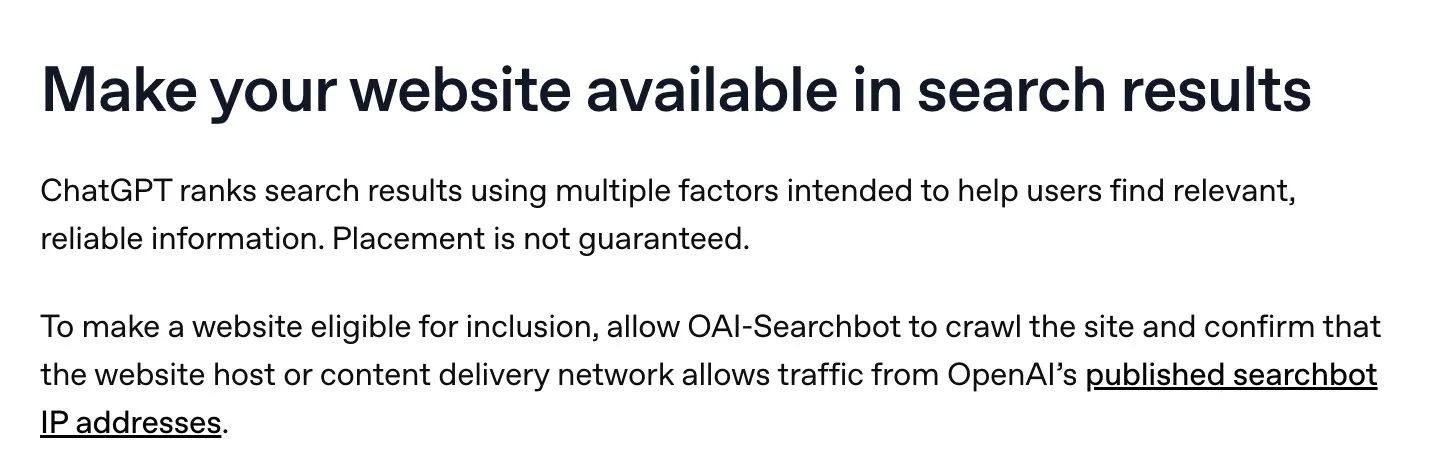
- OpenAI says a site becomes eligible for ChatGPT search when it allows OAI-SearchBot and its host or content delivery network lets in traffic from the crawler addresses OpenAI publishes.
- Blocking GPTBot tells OpenAI not to use your content to train its models, and it does not remove your site from ChatGPT search, because OpenAI treats the two crawlers as separate settings.
- Primal's study for Marketing Oops Summit 2026 found that a brand that stands out in Google's AI may barely appear in ChatGPT, so ChatGPT needs checks of its own.
What Is ChatGPT SEO
ChatGPT SEO is search engine optimisation (SEO) for ChatGPT, the artificial intelligence (AI) assistant made by OpenAI. The aim is for ChatGPT to mention your brand and cite your pages when a buyer asks about your category.
The work has two halves. The first is your own site. OpenAI’s crawler has to reach it, and your pages have to answer buyer questions in their first sentences. The second half is everywhere else. AI answers cite other sites about your category more than your own, so your brand name has to appear on them too.
Across 171 brands in Primal’s data, AI answers cited another site more often than the brand’s own site for 121 of them. So open your site to OpenAI’s crawler and answer questions plainly. Then get your name onto the other sites in your category.
ChatGPT is also the AI chatbot that sends the most visits to websites in Thailand. StatCounter puts its share at about 7 in 10 of the visits that AI chatbots referred last month.
Google still carries most search in Thailand, though. SimilarWeb’s Thailand figures for April 2026 put about 96% of Thai search and AI visits inside Google’s ecosystem. That covers Google Search, AI Overviews and Gemini. The study I presented at Marketing Oops Summit 2026 also found that a brand that stands out in Google’s AI may barely appear in ChatGPT, as Marketing Oops reported. So check ChatGPT on its own, and do not assume your Google work covers it.
How ChatGPT Search Finds And Picks Pages
ChatGPT searches the web when a question needs current information, then answers with links to the pages it used. OpenAI’s help page about searching the web with ChatGPT sets out how.
ChatGPT rewrites the buyer’s question into one or more targeted queries and sends them to the search providers it works with. After it reads the first results, it may send more specific ones. Then it picks from the pages that come back.
It can also add the buyer’s general location, worked out from their internet protocol (IP) address. So a question about a dental clinic near me, asked in Bangkok, can become a search with Bangkok in it. If the buyer has memory switched on, ChatGPT may add details they saved earlier.
Here is that part of OpenAI’s help page, on the information ChatGPT shares with search providers.
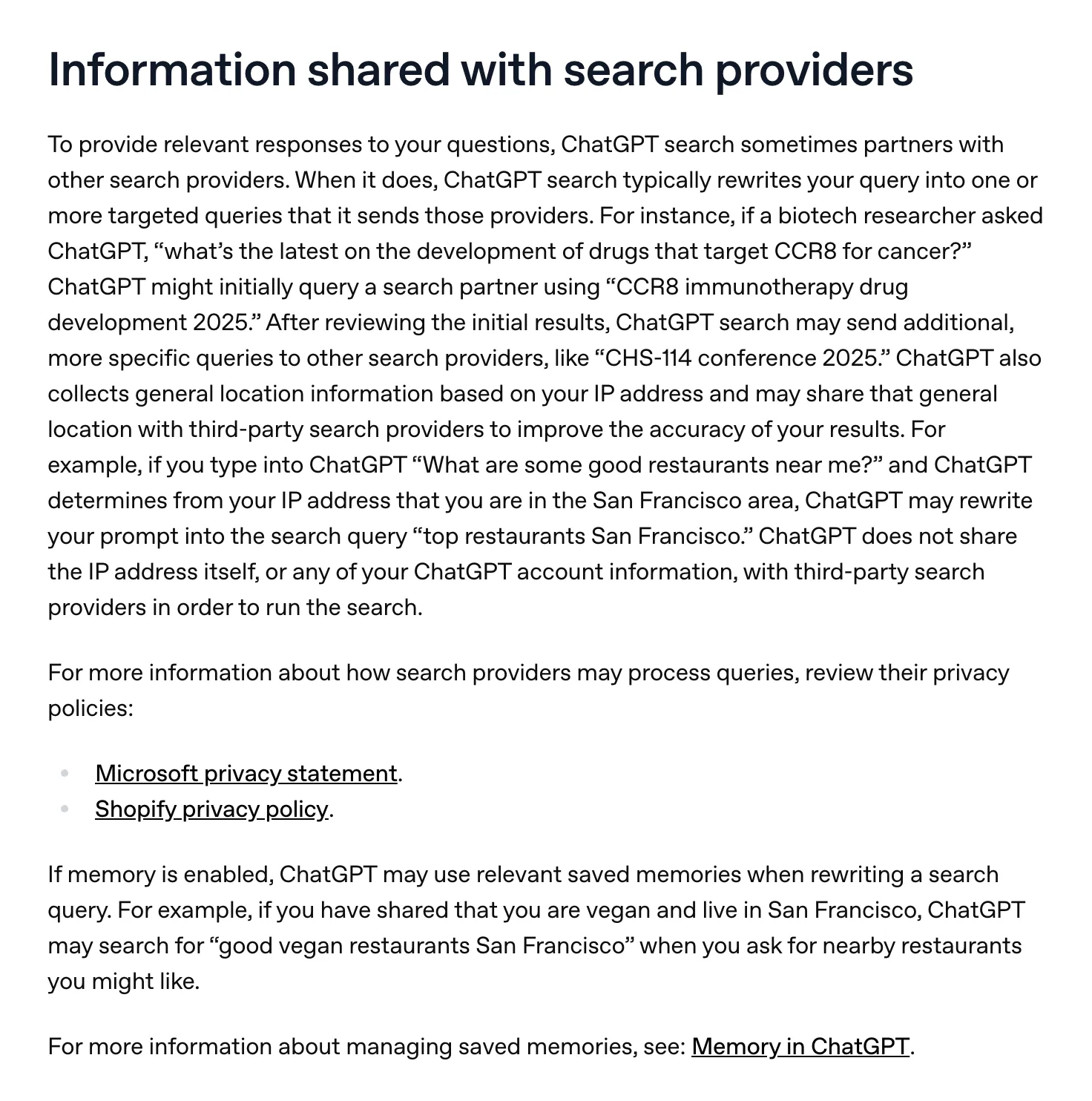
So a page does not need to rank for the whole question to be cited. A page that clearly answers one of the narrower searches can be picked. On ranking, OpenAI says ChatGPT uses several factors to help people find relevant, reliable information. It also says a place in the results is not guaranteed.
Does ChatGPT Search Use Bing Or Google
What OpenAI publishes points to Bing. Its help page lists the privacy policies of two search providers, Microsoft, which runs Bing, and Shopify. Google is not on that list. OpenAI also crawls sites itself with OAI-SearchBot.
So a site that wants to be in ChatGPT’s answers should be in Bing’s index and open to OAI-SearchBot. Bing Webmaster Tools shows which of your pages Bing has indexed, as Search Console does for Google.
Which OpenAI Crawlers To Allow On Your Site
Allow OAI-SearchBot, because ChatGPT search depends on it. OpenAI’s crawler documentation says sites that opt out of OAI-SearchBot are not shown in ChatGPT search answers. They can still appear as plain navigation links. OpenAI runs four user agents, and each one has a different job.
| Crawler | What it does | What to know |
|---|---|---|
| OAI-SearchBot | Crawls pages for search in ChatGPT | Block it and your site is left out of ChatGPT search answers |
| GPTBot | Crawls content that may be used to train OpenAI’s models | Blocking it has no effect on search, because it is a separate setting |
| ChatGPT-User | Opens a page when a person asks ChatGPT to | robots.txt may not apply, because a person started the visit |
| OAI-AdsBot | Checks landing pages submitted as ChatGPT ads | Visits only the pages submitted as ads |
Each setting is independent. So a brand can block GPTBot to say its content should not be used for training, and still allow OAI-SearchBot. ChatGPT-User plays no part in whether a site appears in search, and OAI-AdsBot only checks pages you submit as ads. Add the second group of lines below only if you do not want your content used for training.
User-agent: OAI-SearchBot
Allow: /

User-agent: GPTBot
Disallow: /
The robots.txt file alone is not enough. OpenAI’s help page says the website host or content delivery network (CDN) must also allow traffic from OpenAI’s published IP addresses. A firewall that blocks bots by default can shut ChatGPT out even when robots.txt allows it. Ask your developer or host to check it. After a robots.txt change, OpenAI says its systems can take about 24 hours to catch up.
Both conditions sit in one short section at the end of the same help page.
Which Sites AI Cites When Buyers Ask About A Brand
AI answers cite other sites about a brand far more often than the brand’s own site. Over the last month, Elevate, Primal’s AI Visibility Tracker, logged 285,098 AI answers to questions in the categories of 171 brands. For 121 of those brands, the site AI cited most often belonged to someone else. The brand’s own website came first for only 50.
The chart splits the 171 brands by the type of site AI cited most for them. Other third-party sites, such as publishers, review sites, forums and marketplaces, came first for 77 brands. Social media came first for 26, and a competitor’s website for 18.
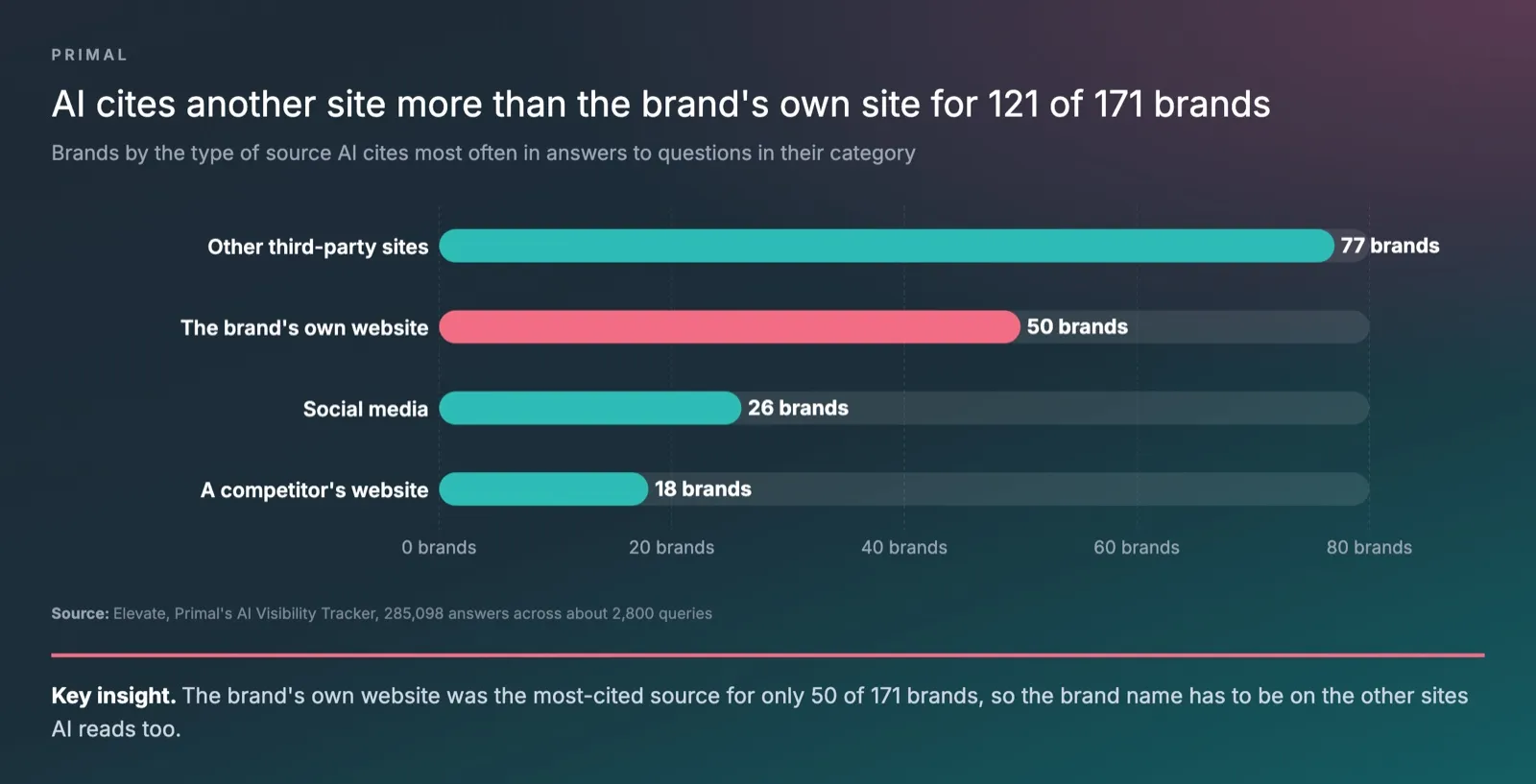
These answers come from several AI platforms, so the split describes AI answers in general. Facebook, YouTube and Pantip were among the sites cited most often for these brands.
Across 84,155 ChatGPT answers that Elevate, Primal’s AI Visibility Tracker, logged for 171 brand projects from 2026-09-20 to 2026-10-19, the brand’s own site was among the 10 most-cited sources for 99 of the 171, and about 1 in 5 of those top citations pointed at the brand’s own pages.
The study I presented at Marketing Oops Summit 2026 found the same pattern, and one of its principles was “Be the Name, not the Page”. Your own page is one source among many, so your name needs to be on the others too.
How To Rank In ChatGPT Answers
To rank in ChatGPT answers, your pages must be open to OpenAI’s crawler and answer buyer questions in their first lines. Your brand also needs mentions on the other sites in your category. The work has six steps.
- Let OAI-SearchBot in. Check robots.txt, then ask your host or CDN to allow the IP addresses OpenAI publishes.
- Get your site into Bing’s index. Verify the site in Bing Webmaster Tools, submit your sitemap and check that your main pages are indexed.
- Write headings as the questions buyers ask. Answer each one in the first 1 to 3 sentences under it. The targeted searches ChatGPT writes can then find their answer on your page.
- State facts a reader can check. Prices, specifications, service areas, terms and the date you last updated the page all help. Keep them the same on every page and every platform.
- Get your brand mentioned on other sites in your category. Use digital PR (public relations), articles in the media, customer reviews and answers on community sites.
- Ask ChatGPT the same set of questions every month. Note whether your brand is mentioned and which pages are cited.
In a recent review of a client account we work with, the brand showed in about half of Google’s AI Overviews for its prompts but in only about a quarter of ChatGPT’s answers. Two things sat behind the gap. ChatGPT reads very descriptive meta descriptions, which Google barely cares about, and it leans on press directories and research sources, so the plan added digital PR. The two engines read different websites, and the work for each is a different job.
The video below, from my YouTube channel, walks through how a brand gets into ChatGPT’s answers.
A video by Mark McDowell on how to get your brand to show up in ChatGPT.
How ChatGPT SEO Differs From SEO On Google
Both need pages that a crawler can reach and that answer the question clearly. They differ in the crawler you let in, where the pages come from, what the brand gets and how you measure it.
| SEO on Google | ChatGPT SEO | |
|---|---|---|
| Crawler to allow | Googlebot | OAI-SearchBot |
| Where pages come from | Google’s index | Partner search providers, Microsoft among them, and OpenAI’s own crawler |
| What the brand gets | A ranking in the results, and clicks | A mention in the answer, and a cited link |
| How you measure it | Google Search Console | A monthly question set, and ChatGPT visits in Google Analytics |
Generative engine optimisation (GEO) is the work of getting a brand mentioned in the answers of several AI tools at once. Those include ChatGPT, Gemini and Google’s AI Overviews. ChatGPT SEO is the part of GEO that deals with ChatGPT.
ChatGPT Prompts For SEO Work
ChatGPT is quick at first drafts of SEO tasks. It can group keywords after keyword research, outline a post, write meta descriptions and draft frequently asked questions (FAQ). Take numbers such as search volume from a keyword tool, such as Google Keyword Planner. Then paste them into the prompt.
Every prompt below has the same six parts. They are a role, a goal, the reader, real inputs, the output you want and a check. Replace the text in square brackets with your own.
Group Keywords By Search Intent
Use this once you have a keyword list with search volumes from a tool. It groups the keywords by search intent, which is the reason a person searches.
Role: You are an SEO specialist working on a website for buyers in Thailand.
Goal: Group the keywords below into article topics, one topic per group.
Reader: [your customer, for example a restaurant owner in Bangkok]
Input: Keywords and monthly search volumes from [tool name]
[paste the keyword list]
Output: A table with 4 columns: group, main keyword, supporting keywords, and search intent (learn, compare or buy).
Check: Do not add any keyword or number that is not in the input.
Outline A Post That Answers In The First Sentences
Use real buyer questions as headings, so each section answers one of the targeted searches ChatGPT runs.
Role: You are an SEO content editor.
Goal: Outline a blog post for the keyword [main keyword].
Reader: [who searches for it, and what they need to decide]
Input: Questions customers ask our team [paste questions] and the headings of the pages that rank on Google [paste headings]
Output: Section headings written as customer questions. Under each, a 1 to 2 sentence answer that makes sense on its own.
Check: Each heading answers a different question. Mark the sections that need our own data or experience.
Write A Title Tag And Meta Description
Use this on a finished page, with its first paragraph pasted in.
Role: You are an SEO specialist.
Goal: Write title tags and meta descriptions for the page [page name].
Reader: [who searches for this page]
Input: [paste the first paragraph of the page] The main keyword is [keyword].
Output: 5 title tags of up to 60 characters and 5 meta descriptions of up to 155 characters.
Check: Use the main keyword once. Say what the reader gets from the page. No overstated claims.
Draft FAQs With Schema Markup
Use real customer questions, and tell ChatGPT to answer only from the page. Then ask for the schema markup in JSON-LD (JavaScript Object Notation for Linked Data), the code format search engines read.
Role: You are a technical SEO specialist.
Goal: Draft 5 frequently asked questions for the page [page name], with FAQPage code in JSON-LD.
Reader: [a customer who is about to choose a supplier]
Input: [paste the page content] and real customer questions [paste questions]
Output: Each question with a 2 to 3 sentence answer, then the JSON-LD code.
Check: Use only facts that are in the page content I gave you.
Check Whether A Page Answers Clearly Enough To Be Cited
Run this before you publish a page, or before you rewrite an old one. It tests step 3 of the method above.
Role: You are an editor checking a page before it goes live.
Goal: Check whether this page answers [customer question] within the first 2 sentences of each section.
Reader: A customer reading on a phone who wants the answer straight away.
Input: [paste the whole page]
Output: A table with 3 columns: section, the sentence that answers the question (quoted exactly), and what is missing.
Check: If a section has no sentence that answers on its own, write "none" and suggest one, using only facts on the page.
Check Whether ChatGPT Mentions Your Brand
Use this in a new chat with search switched on, in an account that has not discussed your brand before. OpenAI says saved memories can change the searches ChatGPT writes.
[a question your customers really ask, for example: Which events company in Bangkok is good for a 200-person conference?]

After you answer, give me 2 lists.
1. Every brand you mentioned in your answer.
2. Every website you used as a source, with its link.
What ChatGPT Cannot Do In SEO Work
ChatGPT can be wrong, so check every fact before you publish. Google’s guidance on generative AI content explains why. Generative models do not look facts up. They predict a likely sequence of words from their training data.
ChatGPT also has no keyword database of its own. A search volume it writes without a tool behind it has no source you can check. It does not know your business either. Your own data, such as the questions buyers ask your team, has to come from you.
How To Measure ChatGPT SEO
Measure ChatGPT SEO in two places. One is the answers ChatGPT gives about your category. The other is the visits it sends to your site.
For the answers, ask the same set of real buyer questions every month. Note four things for each question, with the date. Is your brand mentioned? Which of your pages is cited? Which brands appear in your place? Are the facts in the answer right? Answers change from day to day and from person to person. OpenAI’s help page says search results and citations can be incomplete, outdated or incorrect. So a single check proves little.
For the visits, use Google Analytics 4 (GA4). OpenAI’s own web search example shows each cited link ending in utm_source=chatgpt.com. In GA4, open the Traffic acquisition report and filter the session source for chatgpt. Then add Landing page to see which of your pages those visitors reached. A page that ChatGPT visitors reach often is a page ChatGPT already cites.
Customers Often Ask Us Whether They Can See Which Questions Their Brand Is Missing From
Yes, if you track a fixed set of questions and record the result for each one with its date. A question where your brand appears this month may drop out within a few months. A record kept question by question shows which page to fix, or which site your brand still needs to appear on.
If you would rather a team ran this every month, that is Primal’s AI SEO service. The team uses Elevate, Primal’s AI Visibility Tracker, to follow the questions your buyers ask in ChatGPT and other AI platforms. Then it fixes your pages and the outside sources the data points to. The work runs from our Bangkok office.
Frequently Asked Questions About ChatGPT SEO
Does Blocking GPTBot Remove A Site From ChatGPT Search
No. OpenAI treats GPTBot and OAI-SearchBot as separate settings. GPTBot collects content that may be used to train OpenAI’s models, and OAI-SearchBot crawls for search. So you can block GPTBot and keep OAI-SearchBot open.
Do ChatGPT Ads Help A Brand Get Cited In Answers
No. OpenAI’s help page on ads in ChatGPT says ads run on separate systems from the chat model, and advertisers cannot alter or rank its answers. Ads appear below the answer, clearly labelled. So ChatGPT ads are a separate channel that runs alongside the work of getting into the answers.
How Long Before ChatGPT Sees Changes To A Website
A robots.txt change is the quickest, at about 24 hours, according to OpenAI. Getting your brand mentioned on other sites takes longer, because it depends on when articles and reviews about you are published. Measure it with the same question set each month.
Customers Often Ask Us Whether Google Penalises Posts Written With AI
Google’s guidance says generative AI can be useful for research and for giving original content structure. The risk it describes is using AI to make many pages with no value for users, which may break its spam policy. Before you publish, check every fact and add what only your business knows.
Customers Often Ask Us Whether SEO On Google Covers ChatGPT Too
Partly. A page that crawlers can reach and that answers clearly works on both. ChatGPT has its own crawler, searches through providers that include Microsoft, and needs measuring on its own. So add OpenAI’s crawler, Bing’s index and a monthly ChatGPT question set to your SEO plan.
Founder and Chief Executive Officer
Mark McDowell is the Founder and Chief Executive Officer of Primal, which he started in Bangkok in 2015. He is on the Forbes 30 Under 30 Asia 2020 list and was Campaign Asia’s Southeast Asia Young Achiever of the Year in 2018. He writes about AI search and search engine optimisation.
About The Author