

By Mark McDowellPosted: Updated: 12 min read
Perplexity SEO And How To Rank In Perplexity AI
Perplexity SEO means getting your pages cited, and your brand mentioned, when Perplexity answers a buyer's question. Perplexity runs its own search index, filters out pages that look stale and scores each section of a page on its own. A page is cited when PerplexityBot can reach it, its facts are current and one section answers the question in its first sentences.
Key Takeaways
- Perplexity searches its own index and scores single sections of a page as well as whole pages, so a section that answers its heading in the first 1 or 2 sentences can be cited on its own.
- Perplexity's crawler documentation recommends allowing PerplexityBot in robots.txt and letting in requests from its published IP address ranges, matched with the user agent at the firewall.
- Over the last month, Elevate, Primal's AI Visibility Tracker, logged 285,098 AI answers in the categories of 171 brands, and for 90 of those brands the brand's own website was cited in under 1 in 5 answers.
- The original GEO study retested its methods on Perplexity and found that added quotations and statistics made answers use more of a page, while keyword stuffing scored below the unchanged page on the paper's main measure.
- StatCounter shows Perplexity sent about 3 in 100 of the visits AI chatbots referred to websites in Thailand last month, so the work pays when it also serves ChatGPT and Gemini.
What Is Perplexity SEO
Perplexity SEO is the part of search engine optimisation (SEO) that aims at Perplexity. The goal is to have your pages cited, and your brand mentioned, when Perplexity answers a buyer’s question.
Perplexity lists its sources under every answer. That makes it the quickest place to see which sites artificial intelligence (AI) relies on in your category. In our data, most of those sites are not the brand’s own. Over the last month, Elevate, Primal’s AI Visibility Tracker, logged 285,098 AI answers to questions in the categories of 171 brands. For the typical brand, its own website was cited in about 1 in 5 of them.
So I treat Perplexity SEO as 2 jobs. The first is your own site, open to PerplexityBot and written so each section answers one question up front. The second is your brand’s name on the other sites Perplexity cites when buyers ask about your category.
What Is Perplexity AI
Perplexity AI is an answer engine. You type a question, it searches the web in real time, and it replies with a short summary in plain language. Its help centre page on how it works says each answer has numbered citations. Each one links to where the fact came from.
People can ask follow-up questions, and Perplexity keeps the context of the earlier ones. Its Research mode runs dozens of searches and reads hundreds of sources before it writes a report, according to the same page.
How Many People In Thailand Use Perplexity
Few, compared with ChatGPT and Gemini. StatCounter looks at the visits AI chatbots send to websites that use its code. In Thailand last month, Perplexity sent about 3 in 100 of those visits. ChatGPT sent about 7 in 10, and Gemini about 1 in 4.
SimilarWeb’s Thailand figures for April 2026 show a similar gap. They put Perplexity at about 1 million monthly visits, Gemini at about 40 million and ChatGPT at about 35 million.
So I would not make pages just for Perplexity. The same pages and the same mentions do the job in ChatGPT, Gemini and Google’s AI Overviews. Perplexity is still worth a check each month. Because it lists every source, a few questions show you which sites get cited in your category.
How Perplexity Picks The Sources It Cites
Perplexity finds its sources in a search index it runs itself. It scores each section of a page as well as the page as a whole, so one strong paragraph can be cited on its own.
Perplexity’s engineers wrote up how this search works. Their index covers over 200 billion web addresses (URLs). A machine learning model decides when each page is worth fetching again. Pages from sites the system rates as authoritative are kept in fast storage.
The same post sets out what happens when someone asks a question.
- The search pulls in possible pages in 2 ways, by the words they share with the question and by what they mean.
- Quick filters take out pages that miss the question or carry stale content.
- The rest are ranked in several rounds. In the final round, a model compares the question with each passage side by side.
- Pages and single sections are both scored. The best passages go to the model that writes the answer.
Steps 2 and 4 are the ones a site owner can act on. A section that answers its heading in its first 1 or 2 sentences can be cited even when the rest of the page covers other things. A page whose facts look old can be dropped before the ranking starts. My advice is to show the date of the last real change on every key page. Update the figures when new data comes in.
What Perplexity’s Source Labels Check
A source label marks a whole website as Government, Academic or Trusted. Perplexity’s help page on source labels says the label comes after a review of the site. A labelled source shows a small shield icon by its citation.
Trusted is the broad group. It covers sites that show up in results often and that publish on their own subject.
The capture below is the part of that page that lists the questions the review asks.
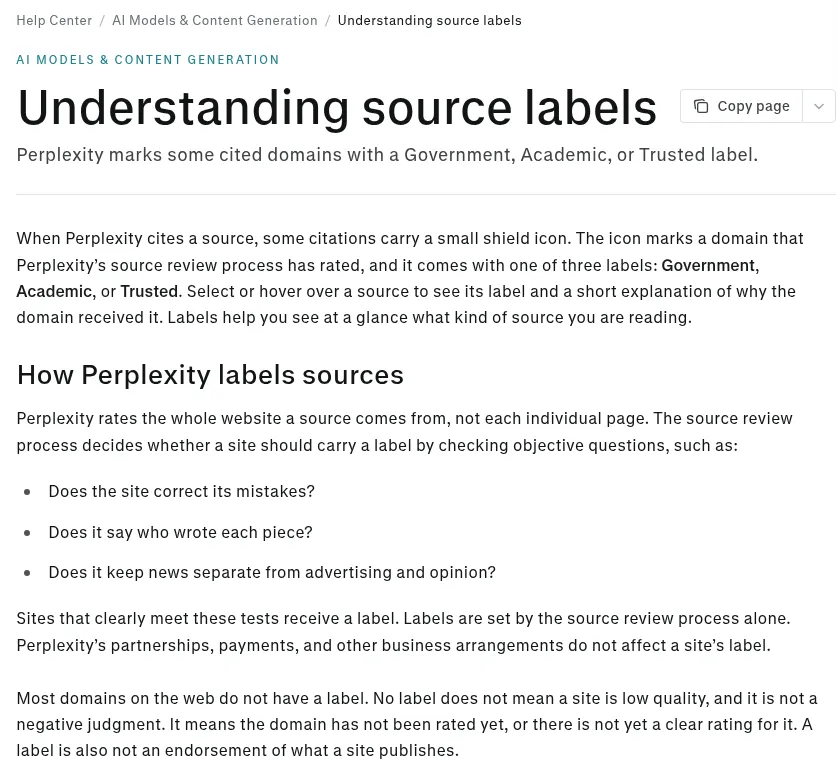
The review asks if the site fixes its mistakes and says who wrote each piece. It also asks if the site keeps news apart from advertising and opinion. The page also says that paying Perplexity or partnering with it has no effect on a label. Most domains have no label, and that is not a judgement that a site is low quality.
The labels are there to help readers judge a source. I read them as a guide for readers, not a ranking signal. The 3 questions still make a good checklist for any business site. Give every article a byline with the writer’s role. When you fix an error, add a short note that says so. Show clearly which posts are paid or sponsored.
Which Perplexity Crawlers To Let Into Your Site
Let PerplexityBot in. It is the crawler that lets Perplexity show and link your site in its search results.
Perplexity’s crawler documentation says the bot is there to show and link sites in search. It is not used to collect material for training AI models. It asks sites to allow the bot in robots.txt. It also asks them to let in requests from its published internet protocol (IP) address ranges.
Perplexity runs 2 bots, each with its own user agent, which is the name a bot sends with each request.
| User agent | What it does | Follows robots.txt |
|---|---|---|
| PerplexityBot | Crawls pages so Perplexity can show and link them in its search results | Yes |
| Perplexity-User | Opens a page while answering a person’s question, and may link it in the answer | Generally no, since the request comes from a person |
To open the whole site to PerplexityBot, add these 2 lines to robots.txt. Perplexity says its systems may need up to 24 hours to pick up the change.
User-agent: PerplexityBot
Allow: /
Next, look at the firewall. A web application firewall (WAF) may block a bot it does not know before the bot ever reads robots.txt. Perplexity’s page walks through the settings for Cloudflare and for Amazon Web Services (AWS). The safe setting checks 2 things on each request, the user agent and the IP address, against Perplexity’s lists. Perplexity updates those lists regularly, so the firewall setting should fetch the current ones.
The capture below is the table from that page. It shows both user agents in full, the links to the address lists and the note on robots.txt.
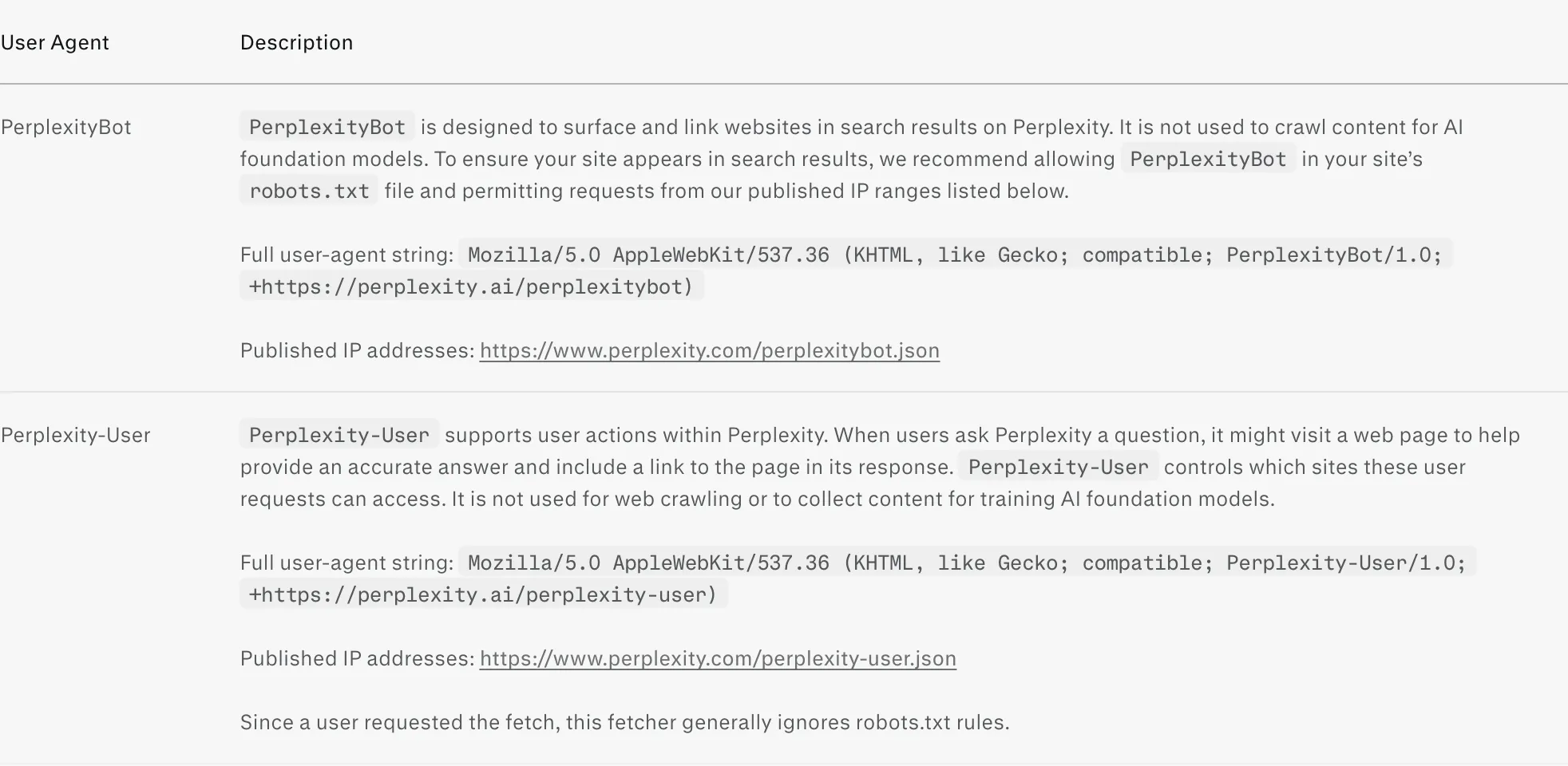
I would check the firewall first. Nothing else in this post works until the bot can get in.
How Perplexity Differs From ChatGPT And Gemini
The main difference is where each one finds its pages. Perplexity searches its own index, and Gemini searches Google’s. ChatGPT sends its searches to the search providers OpenAI works with, Microsoft among them, and crawls with its own bot too. So the crawler you need to let in is different for each.
| Perplexity | ChatGPT | Gemini | |
|---|---|---|---|
| Where its pages come from | Perplexity’s own index | Search providers that work with OpenAI, and OpenAI’s crawler | Google’s Search index |
| Crawler to allow for search | PerplexityBot | OAI-SearchBot | Googlebot |
| How people see the sources | Numbered citations in every answer | Links when ChatGPT searches the web | A Sources button, which not every answer has |
Our guides to ChatGPT SEO and Gemini SEO cover each of them in detail. For Perplexity, 2 things stand out. It drops pages that look out of date early, and its users see the sources every time they ask.
Customers Often Ask Us Whether Perplexity Needs Separate Work
Mostly no. Plain answers, current facts and mentions on other sites help in ChatGPT, Gemini and Google’s AI Overviews too.
Perplexity adds 3 checks. Let PerplexityBot through robots.txt and the firewall. Show a last-updated date on key pages. Then ask your buyers’ questions in Perplexity itself, not only in the other tools.
What The GEO Study Found When It Tested Perplexity
The paper that first set out generative engine optimisation (GEO) also ran its tests on Perplexity. Quotes and figures made the answers use more of a page. Keyword stuffing did worse than leaving the page alone on the paper’s main measure.
The paper by Pranjal Aggarwal and colleagues ran this test on 200 questions from its test set. Perplexity does not let users choose the source pages, so the team uploaded the source text as files. Perplexity then answered from those files only.
The study scored each page with 2 measures. The first, and the main one, is how many of the page’s words appear in the answer, weighted by how early they appear. The second is a language model’s score for how much the page influenced the answer.
- Added quotations did best on the first measure, at 22% above the unchanged page.
- Added statistics did best on the second measure, at about 37% above the unchanged page.
- Keyword stuffing scored about 10% below the unchanged page on the first measure.
- Added citations of other sources gave a mixed result. In the paper’s full Perplexity table, they scored higher on the first measure and lower on the second.
The results turn into page work. Quote an expert from your company by name and real role. Add figures you measured yourself, with the period they cover. Use your keyword only in the sentences that need it.
How Often AI Answers Cite A Brand’s Own Website
Most brands’ own websites are cited in under 1 in 5 of the AI answers about their category. Across 171 brands, the median brand had its own website cited in about 1 in 5 answers. The data is 285,098 answers that Elevate, Primal’s AI Visibility Tracker, logged over the last month.
The chart groups the 171 brands by that share. For 48 brands, the brand’s own website was cited in under 1 in 10 answers, and for 42 in 1 to 2 in 10. Another 30 sat at 2 to 3 in 10, and 41 at 3 to 5 in 10. Only 10 brands had their own website in half or more of the answers.
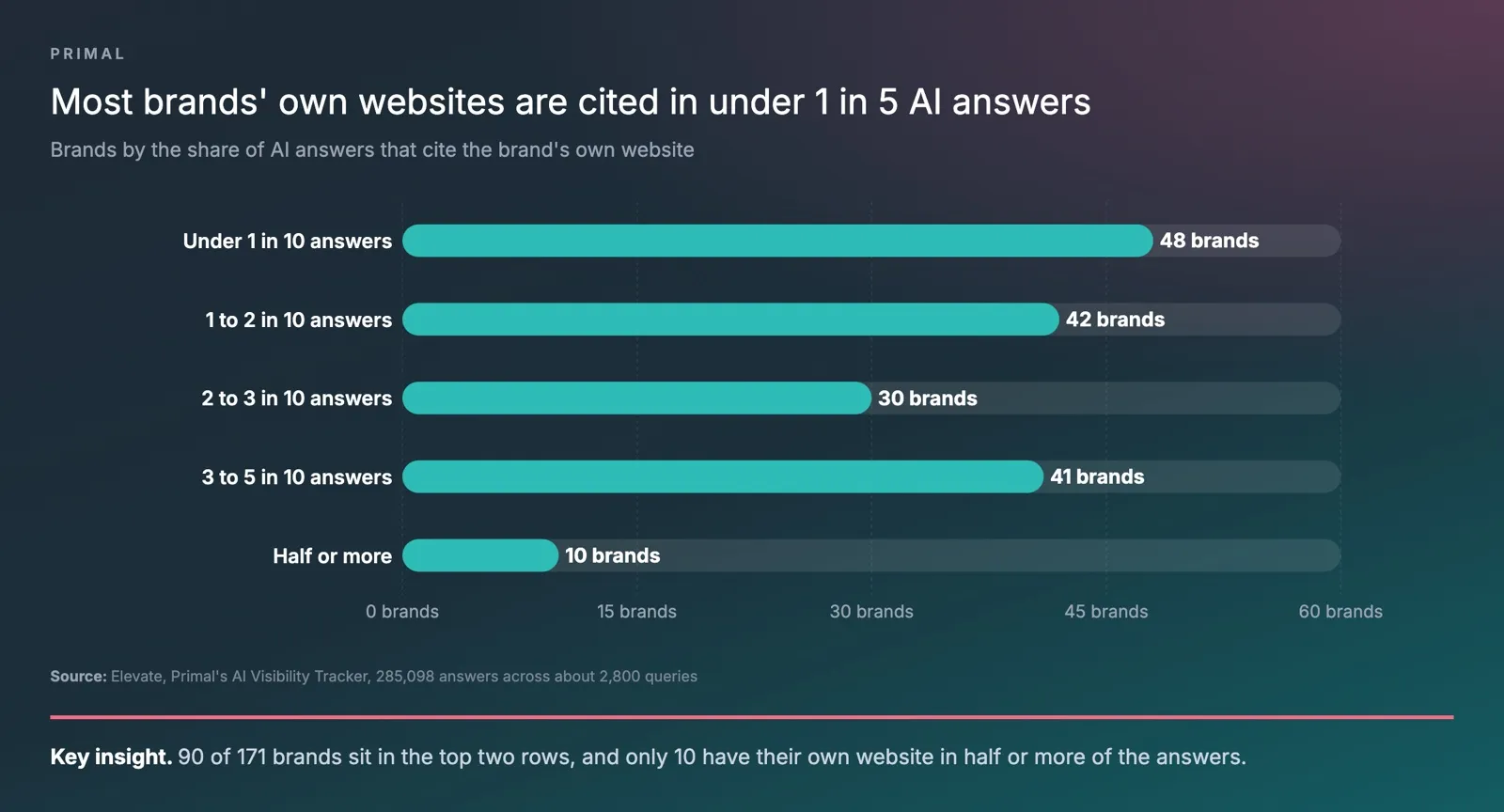
The answers in this data come from several AI platforms together. Most of what they cite sits on other sites, and Perplexity lists those sites under every answer. Ask Perplexity 10 of your buyers’ questions and write down the sites it cites. You will have a list of the review sites, media, communities and profiles where your brand’s name needs to appear.
How To Rank In Perplexity In 4 Weeks
To rank in Perplexity, let its crawler in first. Then fix your pages and the outside sources it already cites in your category. Ranking here means being one of the sources cited in the answer. Each week below has one block of work and a way to check it is done.
| Week | Work | How to check it |
|---|---|---|
| 1 | Allow PerplexityBot in robots.txt, and add a firewall setting that lets in its user agent from Perplexity’s published IP ranges | Your server logs show PerplexityBot requests answered with status 200 |
| 2 | Write 20 questions your buyers really ask, ask each one in Perplexity, and note the sites cited in each answer | A sheet of 20 rows with the question, the sites cited and the date |
| 3 | Rewrite the pages that answer those questions, with each heading a question, the answer in the first 1 or 2 sentences, figures you measured, a quote with a name and role, the writer’s name and a last-updated date | The first sentence under each heading still gives a full answer when read alone |
| 4 | Update your profiles, reviews and brand details on the outside sites Perplexity cited in week 2, and contact the media it cites most often | Ask the same 20 questions again and compare the answers with the week 2 sheet |
Write the week 2 questions the way a buyer who does not know you would ask them, by category rather than by brand. For example, ask “which international school in Bangkok teaches the British curriculum”. It tells you more than a question with your brand’s name in it.
Week 4 takes the longest, because it depends on when other sites update their pages or publish an article. Keep it going as monthly work after the first 4 weeks.
One reason a brand goes missing from Perplexity’s sources has nothing to do with the content. It is a firewall. On a site of our own we launched recently, the default bot protection was quietly turning the AI crawlers away while the robots file said they were welcome. The fix took minutes. Check the firewall before you rewrite a page.
How To Measure Perplexity SEO
Measure Perplexity SEO with the same set of questions every month. For each one, note whether your site is cited, which page is cited, which brands are mentioned instead, and whether the facts about your brand are right. Ask each question a few times before you call it a change, since AI answers vary from one try to the next.
Your server logs add the technical side. Requests from PerplexityBot show the bot still visits your pages. Requests from Perplexity-User show that people asked questions your page helped answer.
How To See Perplexity Visits In GA4
In Google Analytics 4 (GA4), create a custom channel group. Give it an AI assistants channel whose pattern includes perplexity.
Google’s help page on the default channels gives example sources for its AI Assistant channel. They are ChatGPT, Gemini, Deepseek, Copilot and Grok, with no Perplexity. Its help page on custom channel groups has an AI assistants example that does list Perplexity. It says to place that channel above Referral.
Our post on measuring AI search visibility walks through the setup and the pattern to use.
Primal’s AI SEO service does this work every month for brands, from our Bangkok office. We check your buyers’ questions in Perplexity, ChatGPT, Gemini and AI Overviews. We do it with Elevate, Primal’s AI Visibility Tracker. Then we fix the pages and work on the other sites the answers cite.
Frequently Asked Questions About Perplexity SEO
Does Perplexity Use Google’s Search Results
No, Perplexity answers from its own search index. When it launched in late 2022 it used search services run by other companies, its engineering team wrote. Those services were too costly, and too slow or out of date for AI answers, so it made its own. A page that ranks on Google still needs its own check in Perplexity.
How Do You Stop Perplexity From Using Your Content
Put a Disallow line for PerplexityBot in robots.txt, and give it up to 24 hours. Perplexity says this is the bot that puts your site in its search results.
Perplexity-User is different. It fetches a page only when a person asks, so it generally ignores robots.txt. Blocking it needs a firewall setting.
Do You Need To Pay Or Partner With Perplexity To Be Cited
No. Its crawler guide only asks you to let PerplexityBot in from its published IP ranges. The source labels page says payments and partnerships have no effect on a label.
Perplexity also runs a programme for publishers and a paid plan called Comet Plus. Both share revenue with news and media sites whose content it uses.
Does Schema Markup Or An llms.txt File Help In Perplexity
Perplexity has not said that either one helps. Its crawler guide, its help page and its post on search do not mention schema markup or llms.txt. The post on search says it reads each page with its own parser and splits it into self-contained passages. So clear headings with the answer first are the work its own pages point to.
How Many Sources Does Perplexity Cite In One Answer
It varies with the question and the mode. Its help page says each answer has numbered citations. Its Research mode reads hundreds of sources before it writes a report. To see the usual number in your category, ask a few buyer questions and read the list under each answer.
Founder and Chief Executive Officer
Mark McDowell is the Founder and Chief Executive Officer of Primal, which he started in Bangkok in 2015. He is on the Forbes 30 Under 30 Asia 2020 list and was Campaign Asia’s Southeast Asia Young Achiever of the Year in 2018. He writes about AI search and search engine optimisation.
About The Author