

By Mark McDowellPosted: Updated: 11 min read
Gemini SEO And How To Rank In Gemini Answers
Gemini SEO is the work of getting Google's Gemini to cite your pages and mention your brand, in the Gemini app and in AI Overviews and AI Mode on Google Search. When a question needs the web, Gemini searches Google's index and cites the pages it used. So a page has to be indexed, rank for the searches Gemini writes, and leave Google-Extended open if the app may use it.
Key Takeaways
- Across 995 keywords in Primal's rank-tracking data for 17 client brands, Google showed an AI Overview, which runs on a Gemini model customised for Search, on 859 of them.
- Google's developer documentation says Gemini decides whether a Google Search would improve its answer and then writes its own queries, so a cited page has to rank for those shorter searches.
- Blocking Google-Extended in robots.txt stops the Gemini app grounding its answers in your pages, and Google says it has no effect on whether a site appears or ranks in Google Search.
- Search Console's generative AI report shows your links in AI Overviews and AI Mode, while visits from the Gemini app sit in the AI Assistant channel of Google Analytics 4.
- SimilarWeb's Thailand figures for April 2026 put about 96% of Thai search and AI visits inside Google's ecosystem, which includes Google Search, AI Overviews and Gemini.
What Is Gemini SEO
Gemini SEO is search engine optimisation (SEO) for Google’s Gemini. It is the work of getting Gemini to use your pages and mention your brand when it answers a question. Some people call it Gemini search optimisation.
Gemini is Google’s artificial intelligence (AI). Its answers appear in the Gemini app and in 2 Google Search features, AI Overviews and AI Mode, which run on Gemini models Google made for Search. Our guide to AI search explains how these tools work in general.
Most of those answers sit on Google’s results page, not in the app. Across 995 keywords in Primal’s rank-tracking data for 17 client brands, Google showed an AI Overview on 859. For 13 of the 17 brands, it showed one on at least 8 in 10 of their keywords.
The chart groups the 17 brands by how many of their keywords showed an AI Overview.
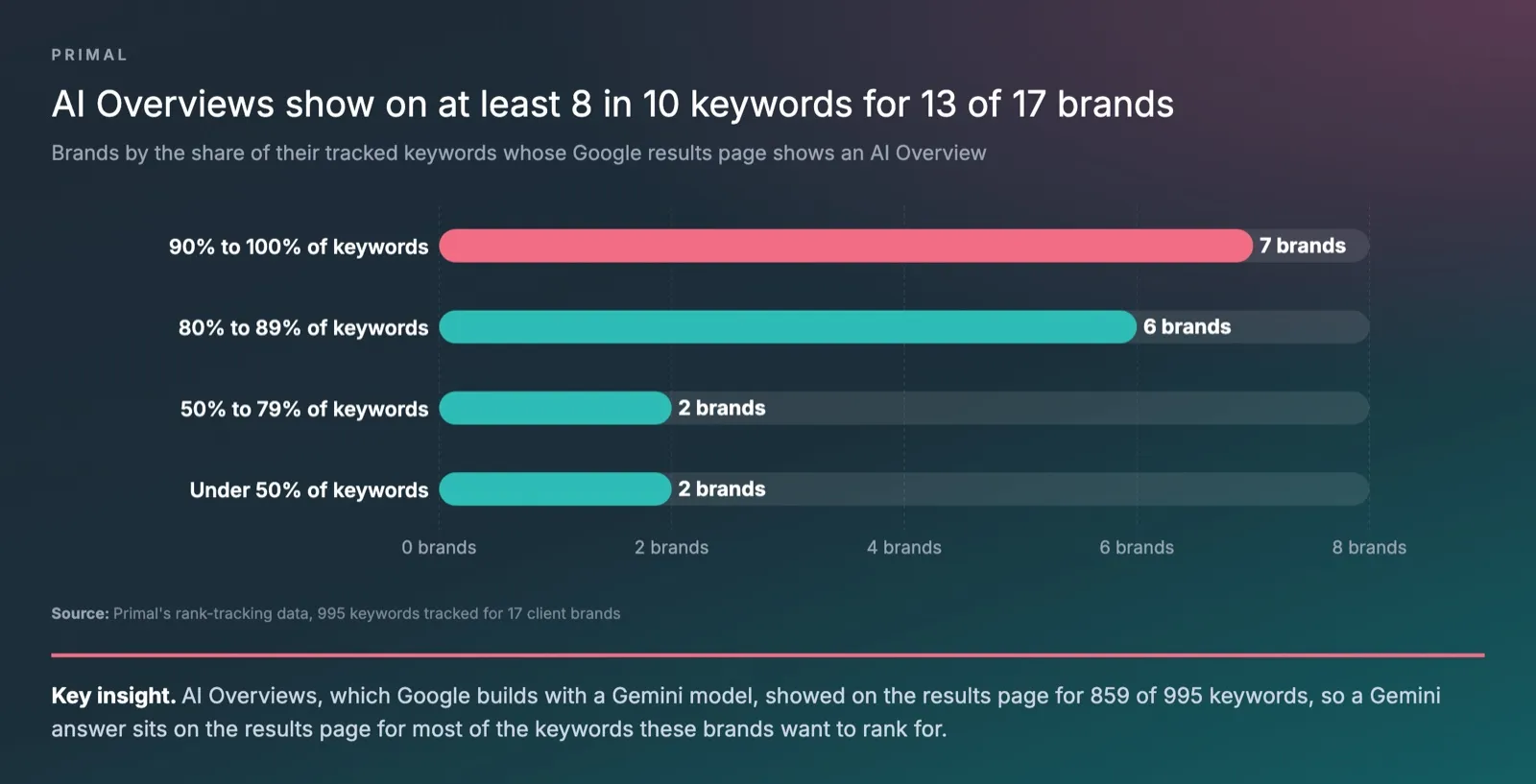
This matches SimilarWeb’s Thailand figures for April 2026. They put about 96% of Thai search and AI visits inside Google’s ecosystem. That ecosystem covers Google Search, AI Overviews and Gemini.
The Gemini app and Google’s AI features take their pages from the same Google index. So Gemini SEO starts with pages that Google already indexes and ranks well. Then it adds 2 jobs. The first is to keep Google-Extended open, so the Gemini app may use your pages. The second is to get your brand mentioned on the other sites that Google’s AI reads.
Where People In Thailand Meet Gemini
People in Thailand meet Gemini in 3 places, and 2 of them sit inside Google Search.
- The Gemini app, at gemini.google.com and on phones, which used to be called Bard. Google’s Gemini Apps Help lists Thai among the app’s languages.
- AI Overviews, the summary at the top of many Google results pages.
- AI Mode, a search inside Google where people ask and follow up in a chat. Google’s help page for AI Mode lists Thai among its languages and Thailand among its countries.
How Gemini Picks The Pages It Cites
Gemini searches Google when it judges that a search will improve its answer, then cites the pages it used. Google’s developer documentation on grounding sets out the steps.
The model reads the prompt and decides whether to search. If it searches, it writes one or more queries of its own and runs them. Then it writes the answer and links each part to the page it came from.
The capture below shows those 5 steps. It comes from Google’s page for developers who call Gemini through its application programming interface (API).
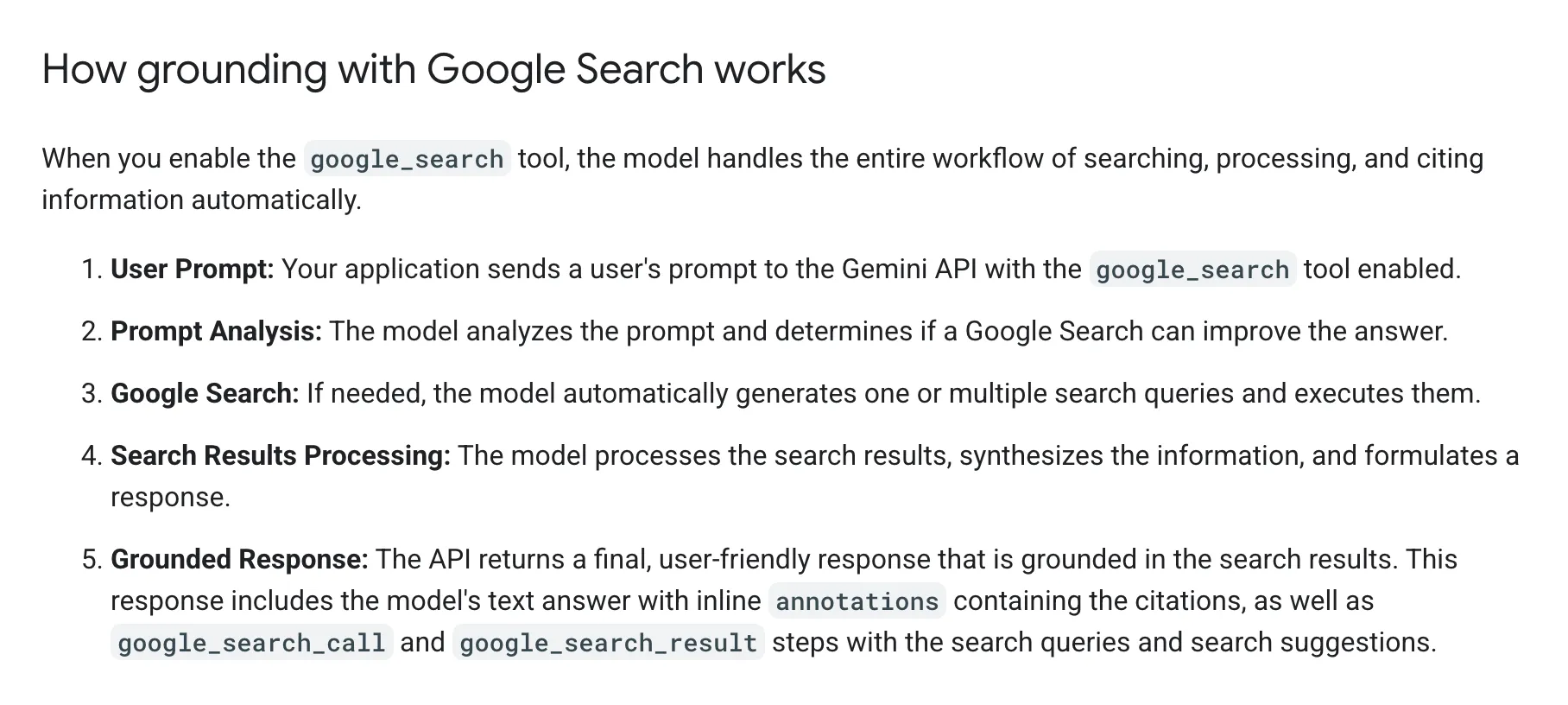
The Gemini app grounds its answers the same way, and Google’s page on its common crawlers describes how. When a person asks, the model is given content from the Google Search index.
The searches Gemini writes are often narrower than the question. Google’s guide to its AI features calls this query fan-out. Say a buyer asks which coworking space near Asok suits a team of 10 and what it costs. Gemini might search for coworking spaces in Asok, their monthly prices and their reviews one by one. A page that answers one of those searches well can be cited, even if it never ranks for the whole question.
In the app, the pages behind an answer sit under a Sources button. It appears at the bottom of the answer or inside the text. Google’s Gemini Apps Help says not every answer has sources. A question the model answers without a search may show no links at all.
Does Gemini Use Google Search
Yes. Gemini takes its web pages from Google’s Search index.
Google’s crawler page says Google-Extended has no crawler of its own. Google crawls with the user agents it already runs. So a page that Googlebot cannot reach, or that is not in Google’s index, cannot be cited when Gemini searches.
ChatGPT works another way. It sends its searches to the search providers OpenAI works with, Microsoft among them, and it has its own crawler. Our guide to ChatGPT SEO explains those settings.
How AI Overviews And AI Mode Relate To Gemini
AI Overviews and AI Mode are Google Search features that run on Gemini models Google customised for Search. Google said so when it launched AI Overviews. It calls the model behind AI Mode a custom version of Gemini 2.5 in Search.
Google’s guide sets 3 conditions for a page to appear as a link in these features. The page must be indexed. It must be able to show in Google Search with a snippet, the short text under a result. And the site must be included in the Search generative AI setting in Search Console, which is on by default.
The same guide says these features are rooted in Google’s core ranking and quality systems. So a page that ranks well for the narrower searches behind a question has a better chance of being chosen. Our guide to AI Overviews covers that feature on its own.
Does Gemini Cite The Same Pages As AI Overviews
Not always, because each one writes its own searches and its own answer. Google’s page on AI features says AI Mode and AI Overviews may use different models and techniques. So their answers and links vary.
In 38,867 Gemini answers across 78 brand projects that Elevate, Primal’s AI Visibility Tracker, logged from 2026-09-20 to 2026-10-19, Gemini’s cited sources sat closer to Google’s AI Overviews than to ChatGPT’s in 63 of the 78, yet even then the two Google products shared only about a quarter of their top sources at the median.
My study for Marketing Oops Summit 2026 found the same across platforms. AI Overviews, Gemini and ChatGPT can answer similar questions in different ways. So a page that shows in AI Overviews still needs its own check in the Gemini app and in AI Mode.
How Gemini SEO Differs From ChatGPT SEO
The main difference is where the pages come from. Gemini takes them from Google’s index. ChatGPT takes them from the search providers OpenAI works with and from OpenAI’s own crawler. So the robots.txt settings and the reports differ too.
| Gemini | ChatGPT | |
|---|---|---|
| Where people meet it | The Gemini app, AI Overviews and AI Mode | The ChatGPT app and website |
| Where its pages come from | Google’s Search index | Search providers that work with OpenAI, and OAI-SearchBot |
| The robots.txt setting | Googlebot for Search, Google-Extended for the Gemini app | OAI-SearchBot for search, GPTBot for training |
| Where you see results | Search Console’s generative AI report, and the AI Assistant channel in Google Analytics 4 (GA4) | A monthly question check, and the AI Assistant channel in GA4 |
People use Gemini about as much as ChatGPT, but it sends fewer visits to websites. SimilarWeb’s Thailand figures for April 2026 put Gemini at about 40 million monthly visits and ChatGPT at about 35 million. StatCounter’s figures for Thailand look at the visits that AI chatbots sent to websites last month. ChatGPT sent about 7 in 10 of them, and Gemini about 1 in 4.
So clicks alone miss much of what Gemini does for a brand. Check whether your brand is mentioned in its answers too.
What Google-Extended Does And Whether To Block It
Google-Extended is a name you can use in robots.txt to decide whether Google may use your content for Gemini. Google’s crawler page says it covers 2 uses.
One is training future Gemini models. The other is grounding answers in the Gemini app and in Vertex AI, Google Cloud’s platform for developers. The same page says Google-Extended does not affect whether a site appears in Google Search. It is not a ranking signal either.
The capture below is the Google-Extended section of that page, with the robots.txt token and the products it affects.
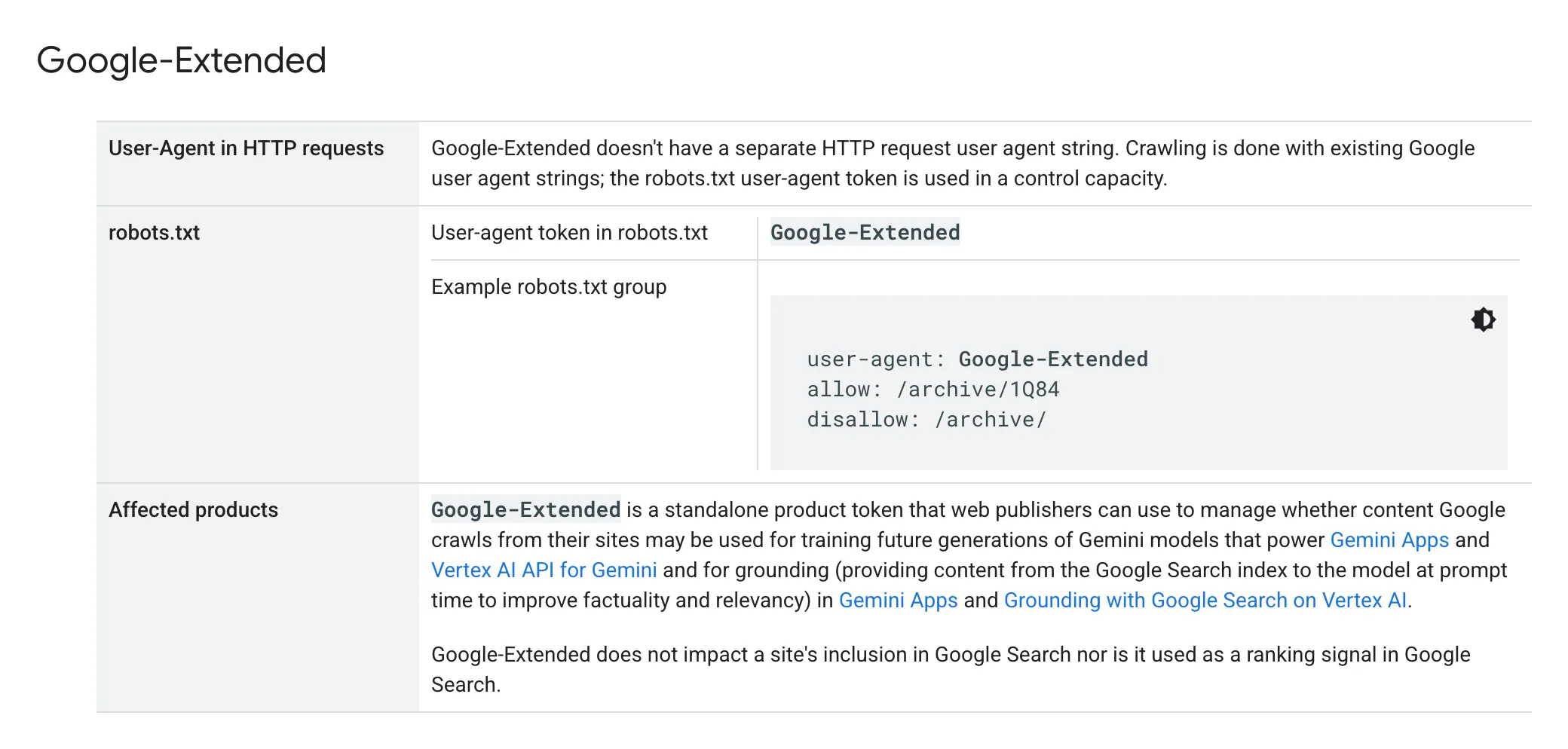
A site that wants no Gemini use of its pages adds these 2 lines to robots.txt.
User-agent: Google-Extended
Disallow: /
Those lines keep your pages out of Gemini’s training and out of the answers the app grounds in Google Search. A brand that wants the Gemini app to recommend it should leave them out.
AI Overviews and AI Mode use a different setting. The Search generative AI control sits under Settings in Search Console. It covers AI Overviews, AI Mode and the AI features in Google Discover. The Gemini app is not on its list. Google says an exclusion applies within 1 to 2 days, though some content takes longer. Blocking Googlebot or adding a noindex tag goes further, because it takes a page out of Google Search altogether.
How To Get Cited By Gemini
Gemini is more likely to cite a page that ranks on Google for the searches it writes. It is also more likely to mention a brand that other sites already talk about. These 6 steps cover both.
- Check that your main pages are in Google’s index. Search Console’s URL Inspection tool checks one web address (URL) at a time. Remove any noindex or nosnippet tag that nobody meant to add.
- Leave Google-Extended open if you want the Gemini app to use your pages. Keep the site included in the Search generative AI setting too.
- Start with the pages that already rank. Add headings that match the questions buyers ask, and answer each one in the first 1 to 3 sentences under it.
- Add facts that other pages lack, such as your prices, service areas, terms or results from your own work. Keep them the same on every page and platform.
- Embed a video in the posts that answer the questions buyers ask in your category. A video on the page helps AI tools understand the page and cite it, whichever engine reads it, and YouTube itself matters most for AI Overviews.
- Get your brand mentioned on other sites in your category. Press coverage, customer reviews, a complete Google Business Profile and answers on community sites each put your name on a site that is not yours.
People assume Gemini follows Google because it is Google. The figures above say that is only partly true. Gemini’s cited sources do sit closer to AI Overviews than to ChatGPT’s, but even the two Google products cite mostly different sites, so each engine needs its own work. We would much rather work from data like this than from the assumption.
Step 5 comes from my talk at Marketing Oops Summit 2026. AI reads what other people say about a brand, and video is part of what it reads. Over the last month, Elevate, Primal’s AI Visibility Tracker, logged 285,098 AI answers to questions in the categories of 171 brands. Split by platform for 2026-09-20 to 2026-10-19, YouTube took about 8 in 100 of the 10 most-cited sources in Google’s AI Overviews, across 80,201 answers for 171 brand projects, and under 1 in 100 in Gemini, across 38,867 answers for 78. So a video on your own page helps with every engine, and a video on YouTube matters most for AI Overviews.
Step 6 matters because AI rarely cites a brand’s own site. In the same data, a brand’s own website was cited in about 1 in 5 answers about its category. That is the median across the 171 brands. I put it as “Be the Name, not the Page” in the same talk. Your brand needs to come up on the many sites AI reads, not only on your own pages.
How To Measure Gemini SEO
Measure Gemini in 3 places, because the app and Google’s AI features report in different tools.
- Search Console’s generative AI report shows how often links to your site appeared in AI Overviews and AI Mode. You can split it by page, country, date and device. It shows impressions only.
- In GA4, the AI Assistant channel holds visits from Gemini, ChatGPT and other assistants. Clicks from AI Overviews and AI Mode stay in Organic Search.
- A monthly question check covers the answers nobody clicks. Ask the same buyer questions in the Gemini app and in AI Mode each month. Note whether your brand is mentioned, which brands are mentioned instead and which pages sit behind the Sources button.
Compare the same questions from month to month rather than judging a single check. The video below, from my YouTube channel, shows how to measure whether AI is recommending your brand.
A video by Mark McDowell on checking how often AI answers mention a brand.
Primal’s AI SEO service does this work for brands from our Bangkok office. The team follows your buyers’ questions across Gemini and other AI platforms with Elevate, Primal’s AI Visibility Tracker. Then it works on your pages and on the other sites AI cites, as the data shows.
Frequently Asked Questions About Gemini SEO
Do You Need Schema Markup Or An llms.txt File For Gemini
No, not for AI Overviews and AI Mode. Google’s guide says Google Search does not use llms.txt files or other special markup, and needs no structured data for its AI features. The Gemini app searches the same index. Schema markup still helps a page qualify for some rich results in Google Search.
Does Blocking Google-Extended Remove A Site From AI Overviews
No. Google says Google-Extended does not affect whether a site appears in Google Search, and AI Overviews and AI Mode have their own control in Search Console. Google-Extended covers the Gemini app, Vertex AI and model training. Search Console’s help adds that it also limits training of the models behind those Search features.
Can You Ask Gemini Why It Does Not Cite Your Site
You can ask, but do not rely on the answer. Google’s Gemini Apps Help says Gemini can misrepresent how it works, including how it cites sources. Check the Sources button and your monthly question set instead.
Does Gemini Answer In Thai And Cite Thai Pages
Yes. Google lists Thai among the languages of the Gemini app and of AI Mode. Its developer page says grounding with Google Search works with all available languages. So a page you want cited for Thai questions needs a Thai version that uses the words Thai buyers type.
Customers Often Ask Us Whether Good SEO Also Gets Them Into AI Overviews
It improves the odds. Google’s guide says its generative AI features are rooted in its core ranking and quality systems. So a page that ranks well for the narrower searches is more likely to be chosen. The Gemini app also needs Google-Extended open, and each place is worth checking every month.
Customers Often Ask Us Why They Rank First On Google But Not In ChatGPT
ChatGPT finds pages through the search providers OpenAI works with, while Gemini searches Google’s own index. So a first place on Google carries over more directly to AI Overviews, AI Mode and the Gemini app. My study found that a brand that stands out in Google’s AI can barely appear in ChatGPT, as Marketing Oops reported.
Founder and Chief Executive Officer
Mark McDowell is the Founder and Chief Executive Officer of Primal, which he started in Bangkok in 2015. He is on the Forbes 30 Under 30 Asia 2020 list and was Campaign Asia’s Southeast Asia Young Achiever of the Year in 2018. He writes about AI search and search engine optimisation.
About The Author