

By Pimlapat PhansuathongPosted: Updated: 10 min read
SEO Vs SEM And How To Choose For Each Search
Search engine optimisation (SEO) earns your pages a place in Google's unpaid results. Search engine marketing (SEM) usually means paid search, where you pay per click and ads show as soon as a campaign runs. In Search Console data from 117 Primal client websites, nearly half the unpaid clicks on searches without the brand name went to positions 1 to 3, so run ads where your page is not there yet.
Key Takeaways
- SEM stands for search engine marketing and covers both SEO and paid search, and Google says advertising with it has no effect on a site's place in its unpaid results.
- In one week of Google Search Console data from 117 Primal client websites, pages in positions 1 to 3 got about 1 in 7 impressions on searches without the brand name, but nearly half the clicks.
- For the median site, pages in positions 1 to 3 got about 31 clicks per 1,000 impressions, against about 7 in positions 4 to 10.
- In Thailand, ads can show above or below Google's AI Overviews but not inside them, because Google runs ads inside AI Overviews in English in 12 countries only.
- Run ads on searches where your page is not yet in positions 1 to 3, and test cutting them once it is, using combined clicks in the Google Ads paid and organic report.
What Is SEM
SEM stands for search engine marketing, the work of getting a business onto a search engine’s results page, such as Google’s. It has two parts. Search engine optimisation (SEO) earns your pages a place in the unpaid results, also called the organic results. Paid search places an ad on the same page, and you pay each time someone clicks it.
When people compare SEO vs SEM, they usually mean the unpaid results against the ads. This post uses SEM that way when it sets the two side by side.
We looked at one week of Google Search Console data from 117 Primal client websites. On searches without the brand name, pages in positions 1 to 3 got only about 1 in 7 of the impressions. Yet they got nearly half of the unpaid clicks. So the choice between SEO and SEM is made one search at a time. Where your page already sits in the first 3 places, SEO brings the clicks. Where it does not, an ad can put you at the top of the same page today, while the SEO work improves your page’s position.
Is SEO Part Of SEM
Yes, if you take SEM by its full name. Search engine marketing covers both the unpaid results and the ads. Some agencies and guides use SEM for ads only, and many people do the same when they talk about it. Before you sign a proposal that lists SEM, ask whether it includes SEO work or only ad management.
The Difference Between SEO And SEM
The difference is what you pay for. With SEO, you pay for work on your pages, content and links, and Google’s ranking systems decide which page shows first. With paid search, you pay for each click, and an auction decides where your ad shows each time someone searches.
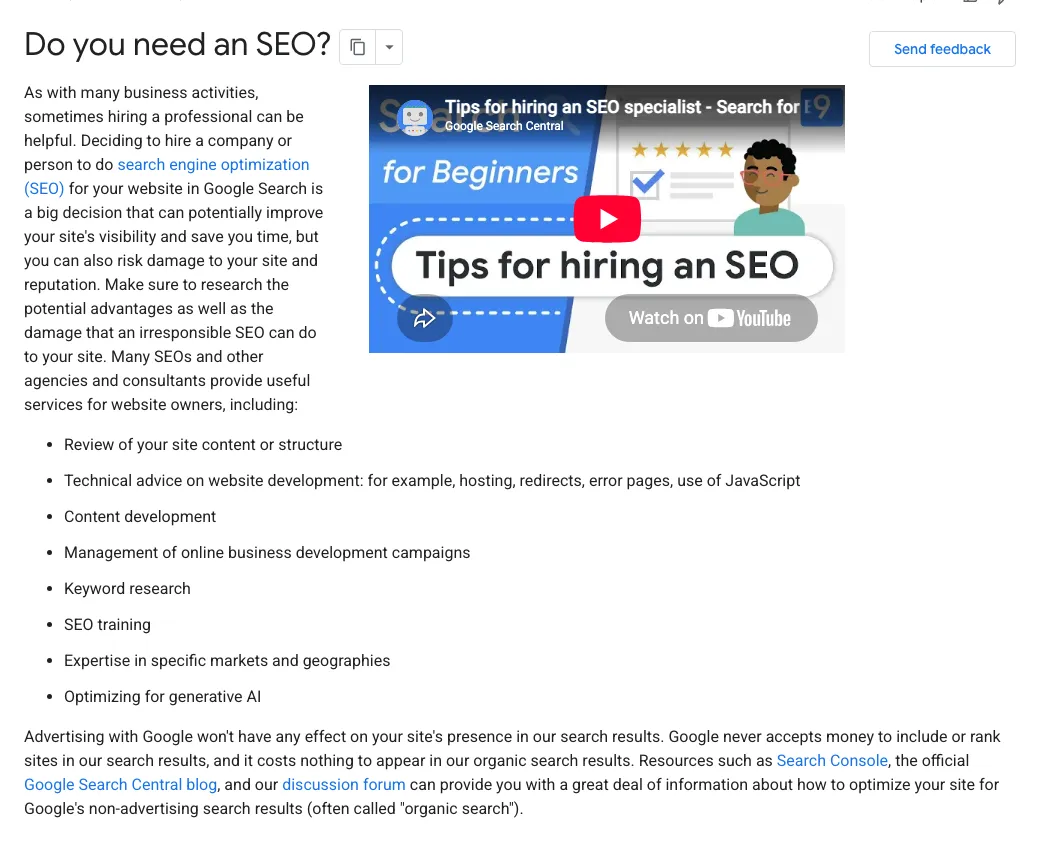
So money spent on ads cannot buy an unpaid ranking. Google’s Search Central guide Do you need an SEO? says advertising with Google won’t have any effect on your site’s presence in its search results. It adds that Google never accepts money to include or rank sites. The capture below shows that paragraph at the end of the guide’s opening section.
Each side also has its own data. You read SEO in Google Search Console. It shows the searches your pages appear for, how often they are shown, the clicks they get and their average position. You read paid search in Google Ads, which shows the search terms, the cost and the conversions. Our guide to what SEO is has a table of how the two compare on cost and timing.
What Pay Per Click Means
Pay per click (PPC) means you pay for an ad only when someone clicks it. An ad that is shown but not clicked costs nothing. Search ads are usually charged this way, so people often say PPC when they mean paid search.
In Google Ads, you set a maximum cost per click (CPC), which is the most you will pay for one click. Google’s page on the actual CPC says the final amount you are charged is often less than that maximum. Our post on what Google Ads is explains how the auction sets that price.
The price of a click also depends on the industry and the search.
How PPC Differs From CPC
PPC is how you pay, and CPC is the price of one click. Google’s definition of CPC says CPC pricing is sometimes called PPC, so the two terms often mean the same thing.
In a report, though, CPC is a number. Average CPC is your total ad cost divided by your clicks. So one PPC campaign has a different CPC for each search term and each day.
Where Ads And Unpaid Results Show On Google
Search ads usually show above the unpaid results. Google Ads Help’s page on top ads says top ads sit next to the top unpaid results. They are generally above them, though on some searches they show below.
The place of top ads can change with each search. Other ads can show lower on the page, below the results. Across the 149 accounts Primal manages with 1,000 or more Search impressions, the median account had its Search ads shown above the organic results on between 15% and 17% of the impressions it was eligible for, 12 months to 2026-09-30.
Can Ads Show In AI Overviews In Thailand
In Thailand, ads can show above or below the summaries that Google’s artificial intelligence (AI) writes at the top of some results, called AI Overviews. They cannot show inside them. Google Ads Help’s page About ads and AI Overviews says ads can show above or below AI Overviews in all 200+ markets where they run. Ads inside AI Overviews run only in English, in 12 countries, and Thailand is not on Google’s list.
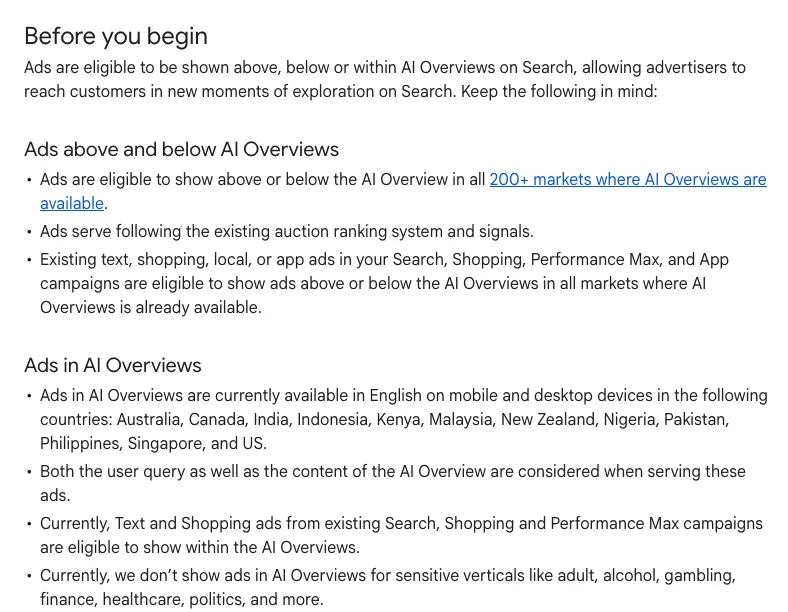
So a business in Thailand cannot buy a place inside an AI Overview. The only way to appear in it is to be one of the pages it cites, and that is SEO work.
What Position A Page Needs Before SEO Brings Clicks
A page needs to reach positions 1 to 3 to get most of its unpaid clicks. In our data, pages there got about 4 times as many clicks per impression as pages in positions 4 to 10.
We took the same week of Search Console data from 117 client websites and kept only the searches without each site’s brand name. Then we grouped each search by the average position of the site’s page. Pages in positions 1 to 3 got about 1 in 7 of each site’s impressions, but nearly half of its clicks. Pages in positions 4 to 10 got just over half the impressions, and about the same share of clicks as the first 3.
The click-through rate (CTR) is the share of impressions that turn into clicks, and it shows the gap. For the median site, pages in positions 1 to 3 got about 31 clicks for every 1,000 impressions. In positions 4 to 10 it was about 7, in positions 11 to 20 about 4, and from position 21 down about 1. The chart shows the four groups.
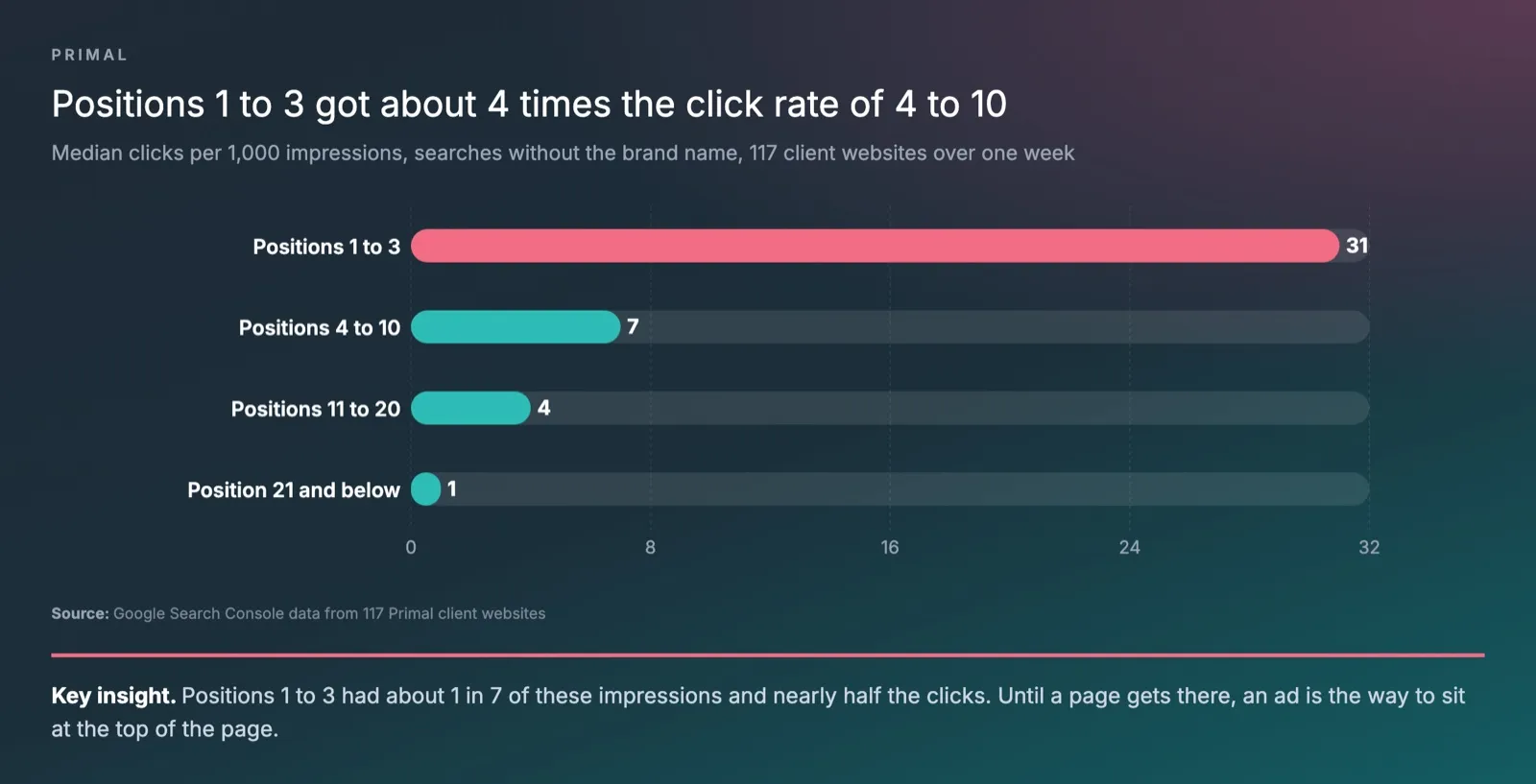
So a place on page one is not enough on its own. A page in position 6 is seen often, but it gets far fewer clicks per view than the pages above it. Until your page reaches the first 3 places, an ad is how you show at the top of the same results page.
When To Choose SEO, SEM Or Both
Use ads on searches where you need clicks now and your page is not yet in the first 3 places. Use SEO on searches that people make all year, where your page has a chance to reach those places. Many businesses do both at once, on different groups of searches.
| Your situation | Start with | Why |
|---|---|---|
| You need enquiries this month, or you run a promotion with an end date | Paid search | Ads can show once the campaign is approved, and rankings take time |
| A search for what you sell, where your page is not on page one | Both | Ads bring clicks now, while SEO works on the page for the same search |
| A search where your page sits in positions 4 to 10 | SEO | In our data, positions 1 to 3 got about 4 times the clicks per impression |
| A question people ask before they buy, such as “what is X” or “A vs B” | SEO and content | AI Overviews cite pages that answer it, and in Thailand ads cannot show inside them |
| A search for your own brand name | SEO first, then check for other advertisers | Your own site usually sits in the first 3 places already |
Should You Buy Ads On Your Own Brand Name
It depends on whether other advertisers show above your name. In the same data from 117 client websites, brand-name searches already had about 6 in 10 of their impressions and about 3 in 4 of their clicks in positions 1 to 3. For the median site, pages there got about 154 clicks per 1,000 impressions on those searches.
Searches for a brand name get a far higher click-through rate than generic searches, on ads as well as on unpaid results, because the person searching already knows which business they want.
To check your own case, open the auction insights report in Google Ads and see who else bids on your brand name. If nobody does, your unpaid listing already gets those clicks, and that part of the budget can go to other searches.
How To Split A Budget Between SEO And SEM
Split it by how many of your key searches already have a page in positions 1 to 3. At the start, most of the money goes on ad clicks. As your pages reach those places, the ad budget for each of those searches goes to new searches or to SEO work.
| Stage | SEO work | Ad work | Most of the budget goes to |
|---|---|---|---|
| 1. A new site, or not on page one for what you sell | Site structure, the main product or service pages, and tracking | Searches from people ready to buy or get in touch, and your brand name | Ad clicks |
| 2. Some key searches in positions 4 to 10 | Raising those pages into the first 3, and pages that answer questions before people buy | Searches where your page is not yet in the first 3 | Both, by how many searches still need ads |
| 3. Most key searches in positions 1 to 3 | Holding positions, adding new searches, and getting cited in AI answers | Promotions, new products, your brand name when others bid on it, and searches you do not rank for | SEO and content |
Before stage 1, set one goal you can measure, such as enquiries or orders. Then set a daily budget, a landing page for each group of searches, and conversion tracking. Keep one list of keywords that the ad team and the SEO team both use.
Once a page holds positions 1 to 3 for a search, test the ad on that search. Lower the bid or pause the ad, then compare the combined clicks from ads and unpaid results before and after. If combined clicks barely drop, spend that money on new searches. If they drop a lot, the ad was bringing visitors your unpaid listing could not.
Mark McDowell, who founded Primal, raises this with clients who spend a large budget on Google Ads every month. Once a page shows in Google’s results and in AI answers for a search, the business does not need to pay for that click, because the leads come in through the unpaid result. SEO results tend to show after 3 to 6 months, so the ads keep bringing in those searches while the pages rise. Then the test above shows which ads can be cut back.
How To Measure SEO And SEM In One Report
On the ad side, watch CTR, CPC, conversion rate and return on ad spend (ROAS). On the SEO side, watch impressions, clicks, CTR and average position in Google Search Console. You can see both side by side in Google Ads. Once you link Search Console to Google Ads, the paid and organic report shows your unpaid results next to your text ads for the same searches.
That report is where you run the test above. It covers text ads only and updates once a day. Its unpaid data starts on the day you link the two accounts, so link them before you need it.
Our Bangkok office plans Google Ads and SEO from one keyword list, so the ad budget goes to the searches your pages do not reach yet. You can read how we run search engine marketing and SEO on our service pages.
Frequently Asked Questions About SEO Vs SEM
Does Google Ads Improve SEO Rankings
No. Google says advertising with it has no effect on a site’s presence in its search results. Its page on the paid and organic report says paid search has no impact on unpaid rankings either. What ads give you is data, because the searches that bring enquiries from ads show which pages to write first.
How Does SEM Work
On the paid side, you choose keywords, write ads, and set a daily budget and a bid. When someone searches for a matching term, Google runs an auction, picks the ads to show, and charges you when someone clicks. On the SEO side, Google crawls and indexes your pages. It then shows the pages that best answer each search, with no fee per click.
Which Costs Less, SEO Or SEM
Neither has a set price. Paid search costs money for every click, and the auction sets the price. SEO costs the time and skill for pages, content and links, with no fee per click once a page ranks. Compare the two on the cost of each enquiry over the same months, because the price of a click on its own says little.
Customers Often Ask Us Whether To Run Ads Alongside SEO
We suggest running both when the budget allows. Put ads on the searches where people are ready to buy or get in touch, with a matching landing page and conversion tracking. Give SEO its own budget, because it is longer-term work.
If the budget covers only one, check whether people already search for what you sell. If they do and you can wait a few months, start with SEO. If you need enquiries this month, start with ads.
Customers Often Ask Us Whether To Wait For A New Website
Ads can start now, on the site you have or on a separate landing page. SEO work on the site’s structure should start once the new site’s structure and page addresses are settled. Until then, prepare the keyword list and the content.
Plan a redirect from each old page address to its new one, so the work on the old pages carries over when the new site goes live.
Content Writer
Pimlapat Phansuathong is a Content Writer at Primal with over 6 years of writing experience. She writes search engine optimisation (SEO) content, from search intent and keyword research to the structure of each article. She joined Primal in 2022.
About The Author