

By Mark McDowellPosted: Updated: 12 min read
First published by Sitvisut Anantnakarakul, 2023-12-06. Updated by Mark McDowell on 2026-10-20.
What Is SEO And How Does It Work For Your Business
SEO, or search engine optimisation, is the work of getting a website's pages into Google's unpaid results when people search for what the business sells. In Search Console data from 117 Primal client websites, searches without the brand name brought about half of the clicks, so SEO is how people who do not know your name yet find you.
Key Takeaways
- SEO stands for search engine optimisation, the work that helps Google crawl, index and show a site's pages in its unpaid results. Google says it does not accept payment to rank a site higher.
- In one week of Google Search Console data from 117 Primal client websites, searches without the brand name made up about 86% of impressions and 53% of clicks.
- In the same data, about 1 in 10 clicks from brand-name searches came from searches typed in Thai, against about half of the clicks from searches without the brand name.
- Google Ads charges for each click and stops showing when the budget stops, while a page that ranks in the unpaid results keeps getting clicks with no fee per click.
- Google says a page must be indexed and eligible to show with a snippet to appear as a link in AI Overviews or AI Mode, so SEO is still the first step towards AI answers.
What SEO Means
SEO stands for search engine optimisation. It is the work of getting your website’s pages into Google’s unpaid results when people search for what you sell. A search engine is a system such as Google or Bing that finds pages and lists them for each search. The unpaid results are called organic search, and they sit below or beside the paid ads.
We looked at one week of Google Search Console data from 117 Primal client websites. We split each site’s searches into the ones that contained its brand name and the ones that did not. Impressions are the times a site was shown in the results. On average across the sites, searches without the brand name made up 86% of the impressions and brought 53% of the clicks. Searches with the brand name made up 14% of the impressions and brought 47% of the clicks. The chart shows the four shares.
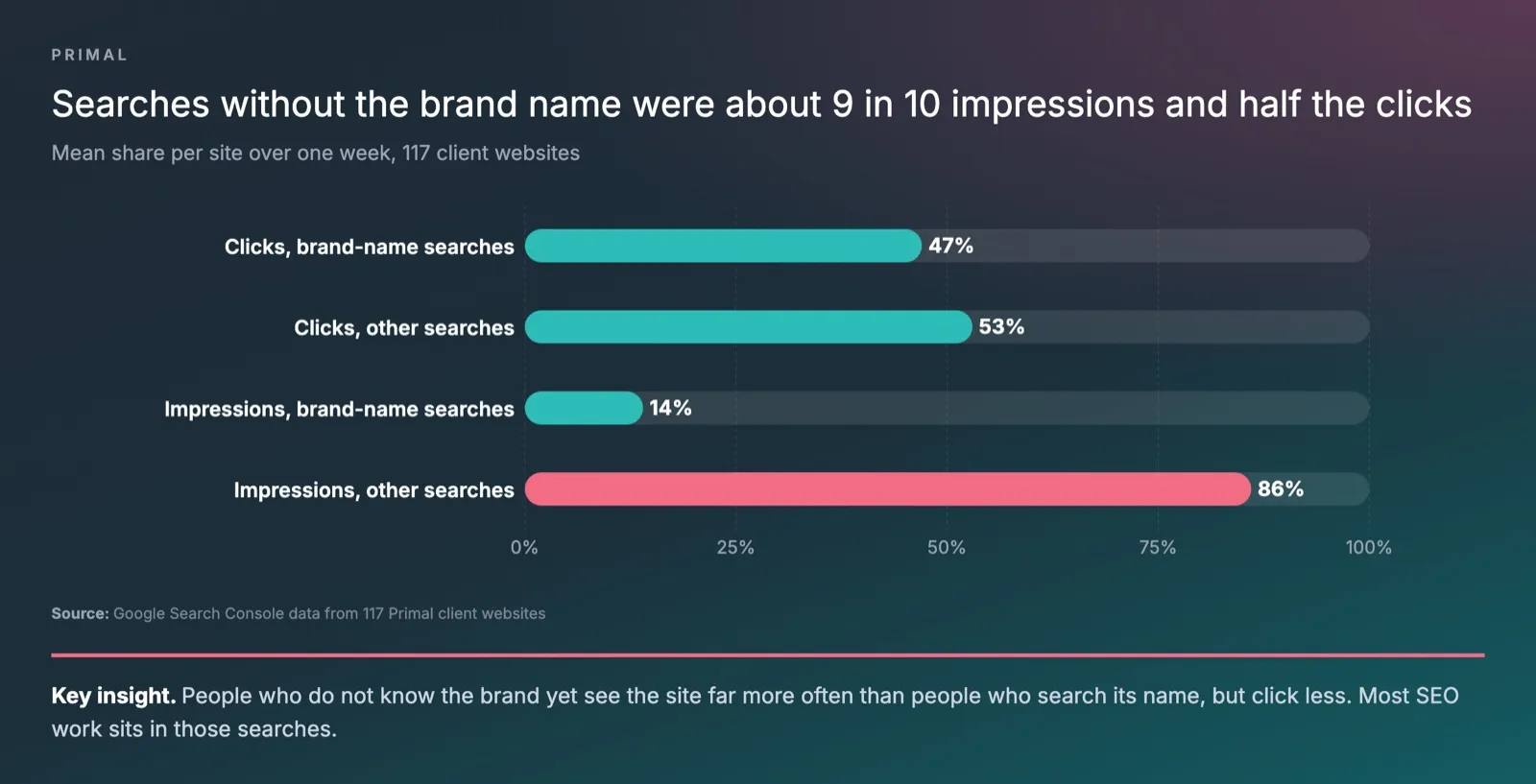
People who search for your brand name already know you, so they click often. Everyone else is looking for what you sell and has not met your business yet. They see your site far more often and click far less. Most SEO work happens in their searches. The job is to make a page that answers their search better than the pages above it, until it ranks in a position they click.
How SEO Works In Google’s 3 Stages
Google Search works in 3 stages, called crawling, indexing and serving search results. Google’s guide to how Search works says not every page makes it through each stage. If Google cannot reach a page, or does not keep it in its index, the page never shows in the results. The capture below shows the 3 stages in Google’s guide.
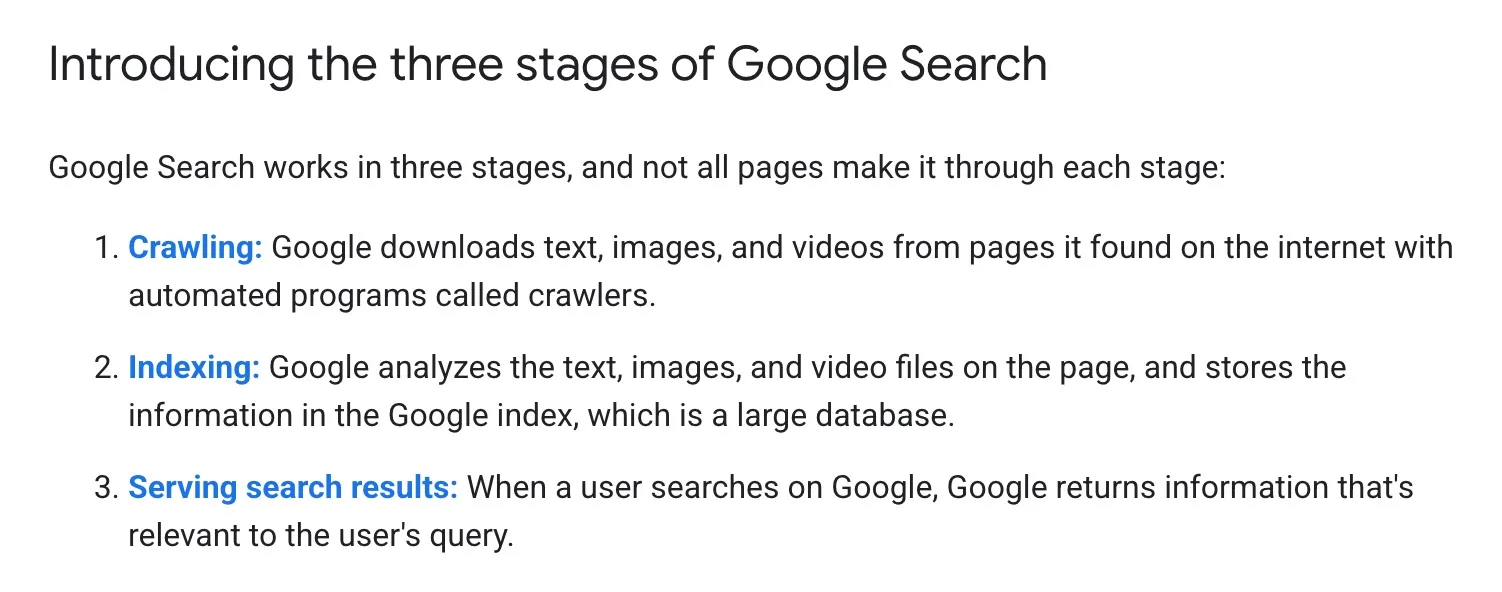
SEO does a different job at each stage.
- Crawling. Google’s crawler follows links from pages it knows to new pages. It also reads the sitemap the site owner sends. The SEO work here is to link every important page from the site, and to check that the robots.txt file does not block it.
- Indexing. Google reads the text, images and video on a page and stores them in its index. When several pages look the same, it picks one as the main version. At this stage, SEO makes each page clearly about one subject, so two of your pages do not compete for the same search.
- Serving search results. When someone searches, Google returns the pages from its index that are relevant to the search. To be chosen, your page has to answer the search more fully than the pages above it.
The same guide says Google does not accept payment to crawl a site more often or to rank it higher. So a place in the unpaid results cannot be bought. What a business can buy is an ad, which Google marks as sponsored.
What A Search Engine Is
A search engine is software that finds pages on the web and stores them in an index. When someone searches, it returns a list of those pages. Google and Microsoft Bing are search engines.
An artificial intelligence (AI) assistant such as ChatGPT works differently. It reads pages and writes an answer in its own words, often with links to the pages it used. Google now does both on one page, with an AI Overview above the list of results.
What Googlebot Does
Googlebot is the crawler Google uses to fetch pages. It decides which sites to crawl, how often, and how many pages to fetch from each one. During the crawl, Google opens the page in a recent version of Chrome and runs its JavaScript, the way your browser does. So Google may never see text that only shows after a login, or text that fails to load when a script breaks.
What Google’s Algorithm Is
Google’s algorithm is the set of ranking systems that choose and order pages from the index for each search. Google’s guide says relevance depends on hundreds of factors. They can include the searcher’s location, language and device. Google updates these systems from time to time, so a page’s position can change even when nobody has touched the site.
Google’s guide to creating helpful content adds that its systems look for content that shows experience, expertise, authoritativeness and trustworthiness (E-E-A-T). The same guide says trust is the most important of the four.
The 4 Types Of SEO
SEO has 4 types, sorted by where the work happens. On-page SEO is the work on your own pages, and technical SEO is the work on the site’s systems. Off-page SEO happens on other websites, and local SEO happens in maps and in searches for a place.
Each type is usually done by a different person in a company. All 4 start from the same list of words your customers type, which comes from keyword research.
On-Page SEO
On-page SEO is the work on each page of your site. It covers the title tag shown in the search results, the headings and the copy. It also covers the image descriptions, called alt text, and the links between your pages. The marketing or content team usually does it, because it is writing and editing.
Technical SEO
Technical SEO is the work on the site’s systems, so Google can reach, read and store your pages. It covers page speed and how pages look on a phone. It also covers the sitemap, the robots.txt file and the secure connection, Hypertext Transfer Protocol Secure (HTTPS). A web developer usually does it, because the fixes sit in the code or the server settings.
Off-Page SEO
Off-page SEO is the work that happens on other websites. It covers backlinks, which are links from other sites to yours. It also covers mentions of your brand in the media and on review sites. A public relations or partnerships team often does it, because it means working with other publishers.
Local SEO
Local SEO helps a business appear in searches for a place and in Google Maps. It suits clinics, restaurants, showrooms and any business with branches. The main task is a complete Google Business Profile with the address, opening hours, photos and reviews. The owner or the branch staff often keep it up to date, because they know when the hours change.
White Hat, Grey Hat And Black Hat SEO
White hat SEO is SEO done with pages and content made for readers. Black hat SEO tries to trick the ranking systems. Grey hat is a market term for methods somewhere between the two.
Common black hat methods include text hidden from people and a keyword repeated until the page is hard to read. Another is cloaking, which shows search engines different content from what people see. So are large numbers of thin pages made only for search engines.
The risk of black hat SEO is a manual action. Google’s Search Console Help says a human reviewer at Google issues one when pages on a site do not comply with Google’s spam policies. Most manual actions lead to pages or whole sites ranking lower or being left out of the results. A site owner can see any manual action in the Manual actions report in Search Console.
Grey hat has no agreed definition, and each provider uses the term for different things. Before you hire anyone for SEO, ask for the list of work they will do each month. Ask where any links to your site will come from, too. Then check that those sites have real readers in your field.
Why SEO Matters For A Business In Thailand
SEO puts your business in front of people who are searching for what you sell before they know your name. Clicks from organic search carry no fee per click. So a page that ranks keeps bringing visits for as long as it holds its position.
In Thailand, the language people type in decides which searches you appear for. In the same Search Console data, only about 1 in 10 clicks from brand-name searches came from searches typed in Thai script. Most people typed the brand in English letters. For searches without the brand name, about half of the clicks came from searches typed in Thai.
The question this post answers shows the same split. Ahrefs Keywords Explorer puts “what is seo” at about 400 searches a month in Thailand, and the Thai form, “seo คือ”, at about 8,700.
So a site with only English pages can rank for its own name. Yet it can miss about half of the clicks from people who have not heard of it. Open the Performance report in Google Search Console and list the Thai searches your customers type. Then write Thai pages that answer them in the same words. Our guide on how to do SEO covers planning pages in both languages.
We see this in our own work in Thailand. When we publish a blog post in English, it does not rank as high. As soon as we write the same post in Thai, on a topic where few sites publish much in Thai, it ranks almost immediately and starts to draw traffic.
How SEO Differs From Google Ads
Google Ads charges you each time someone clicks your ad. Your ad can show as soon as the campaign is approved, and it stops showing when you stop paying. SEO has no fee per click. But a page takes weeks or months to rank, and then it keeps getting clicks after the work is done.
Both appear on the same search engine results page (SERP), so you can run both for the same search.
| Point | SEO | Google Ads |
|---|---|---|
| What you pay for | The work on your pages and content, with no fee per click | Each click, at a price set by an auction for each keyword |
| When results show | After weeks or months | As soon as the ad is approved and running |
| When you stop paying | Pages that rank keep getting clicks until other pages overtake them | The ads stop showing |
| Where it shows | The unpaid results | Ad slots marked as sponsored, at the top and bottom of the page |
| What it suits | Searches people make all year, and the questions they ask before they buy | Promotions, new products and searches where your site does not rank yet |
The click-through rate (CTR) shows the gap. In our data, the median click-through rate on brand-name searches was about 12 clicks for every 100 impressions. On the other searches, it was under 1. Those other searches are where people who do not know you yet start. Ads can reach those searchers today, while SEO works to raise your page to the positions where they click. Search engine marketing (SEM) is the name for paid and unpaid search marketing together.
SEO Terms Every Business Owner Should Know
The table explains the terms that come up in SEO reports and in talks with an agency.
| Term | What it means |
|---|---|
| SERP | The search engine results page, with the ads, unpaid results, maps and AI answers you see after a search |
| Keyword | A word or phrase people type into a search box |
| Organic traffic | Visits that come from clicks on the unpaid results |
| Impressions | The number of times your page was shown in the results |
| CTR | Clicks divided by impressions, so 5 clicks from 100 impressions is 5% |
| Index | Google’s store of pages; a page that is not in it cannot show in the results |
| Canonical | The page Google treats as the main version when several pages look the same |
| Backlink | A link from another website to yours |
| Featured snippet | A box above the results that quotes an answer from one page |
| E-E-A-T | Experience, expertise, authoritativeness and trustworthiness, the qualities Google’s systems look for in content |
| Google Search Console | Google’s tool for site owners, at no cost, that shows a site’s searches, clicks, impressions and indexing problems |
Does SEO Still Matter When People Search With AI
SEO still matters, because Google’s AI Overviews, ChatGPT and Gemini search for pages and write their answers from what they read. Google’s guide to AI features and your website sets out what a page needs to appear as a link in AI Overviews or AI Mode. It must be indexed and eligible to show in Google Search with a snippet. The guide adds that there are no additional technical requirements, and that existing SEO fundamentals continue to be worthwhile.
The search for this post’s own question shows how it looks. In Ahrefs’ record of the results page for “what is seo” in Thailand, an AI Overview sits at the top. It links to a forum thread, a video, an encyclopaedia, a dictionary and a marketing glossary. Only 2 of those 5 pages are also in the first 10 unpaid results. So a page can be cited without holding the first position.
The work that AI answers add is mostly in the writing. Answer each question in the first sentence under its heading, in words that still make sense when quoted alone. Then get your brand mentioned on the sites the assistants read. Primal’s data on which sources AI answers cite about brands is in our post on what AI search is. Mark McDowell, Primal’s founder and chief executive, explains in this video why SEO still works when people search with AI.
A video on whether SEO still works when people search with AI, from Mark McDowell’s YouTube channel.
If you want a team to look after your rankings on Google and your citations in AI answers, see Primal’s SEO services. The SEO team in our Bangkok office plans the work around the searches that bring enquiries, in Thai and English. It reports citations in AI answers next to the rankings.
Frequently Asked Questions About SEO
What Is An Example Of SEO
Rewriting a page’s title tag so it carries the words customers type is an example of SEO. Adding a page for a service people search for, when your site has no page on it yet, is another. Fixing a robots.txt line that stops Google from crawling your product pages is a third. Each change helps Google find a page, read it or choose it for a search.
How Long Does SEO Take To Work
It depends on how strong the pages above yours are. In Primal’s work, a technical fix or a rewrite of an existing page can change its position within weeks. A search with strong competition takes several months of content and links. Set a target for each month, so you can see progress before the hardest searches rank.
Customers Often Ask Us Why Ranking For Their Own Name Brings No New Customers
A ranking for your own name brings people who already know you. New customers search for the product or the problem. In the data above, those searches made up most of the impressions.
Open Search Console and list the searches without your name that your site appears for. Then check which of your main services has no page that answers them.
Customers Often Ask Us Why They Need SEO When Ads Work Straight Away
For a new brand that people do not search for yet, we suggest starting with ads, content, TikTok and influencers. SEO suits a business whose customers already search for what it sells on Google or ask an AI assistant. Those visitors are already looking for it. Once a page ranks for a search, you can spend less on ads for that search and keep ads running where you do not rank yet.
Customers Often Ask Us Whether People Still Click When AI Answers The Question
In our experience, AI answers take the most clicks from searches that ask what something means. On searches where people compare options or decide to buy, they still click through. They click the links in the AI answer or the results below it. A page that is cited also keeps your brand name in the answer, even when the reader does not click.
Customers Often Ask Us Whether A Keyword In The Domain Name Puts A Competitor First
A keyword in the domain name helps to an extent, and other sites can still rank above it. When a competitor ranks above you, compare how many different websites link to each of you, called referring domains. Then see which questions their page answers that yours does not.
Founder and Chief Executive Officer
Mark McDowell is the Founder and Chief Executive Officer of Primal, which he started in Bangkok in 2015. He is on the Forbes 30 Under 30 Asia 2020 list and was Campaign Asia’s Southeast Asia Young Achiever of the Year in 2018. He writes about AI search and search engine optimisation.
About The Author