

By Mark McDowellPosted: Updated: 12 min read
First published by Sitvisut Anantnakarakul, 2021-06-10. Updated by Mark McDowell on 2026-10-20.
How To Do SEO For Your Website, Step By Step
You do SEO by measuring where your pages rank, choosing keywords that match what you sell, fixing technical problems, improving each page, writing content that answers buyer questions, earning links and reviewing the results each month. Aim for the top 3 positions, because across 117 Primal client websites, queries in positions 1 to 3 earned about two thirds of each site's clicks.
Key Takeaways
- In one week of Google Search Console data from 117 Primal client websites, queries in the top 3 positions earned about two thirds of each site's clicks, and queries on page 2 or lower earned under 1 in 20.
- Positions 4 to 10 held half of each site's impressions but under 3 in 10 of its clicks, so pages already ranking there are the fastest place to start.
- 110 of those 117 websites got clicks from searches typed in Thai and from searches typed only in English letters in the same week, so plan keywords in both languages.
- In Thailand, the Thai ways of asking how to do SEO are searched about 6 times as often as the English ways, by Ahrefs estimates.
- Google says a page needs no extra technical work to appear as a link in AI Overviews or AI Mode beyond being indexed and eligible for a snippet, so the SEO steps are also the first steps for AI answers.
How To Do SEO, And Which Positions Get The Clicks
Search engine optimisation (SEO) is the work of getting your pages into Google’s unpaid results for the searches your buyers make. It covers your own pages, the technical setup that lets Google read them, and the other websites that link to you and mention you. To learn how to do SEO well, start with where the clicks go.
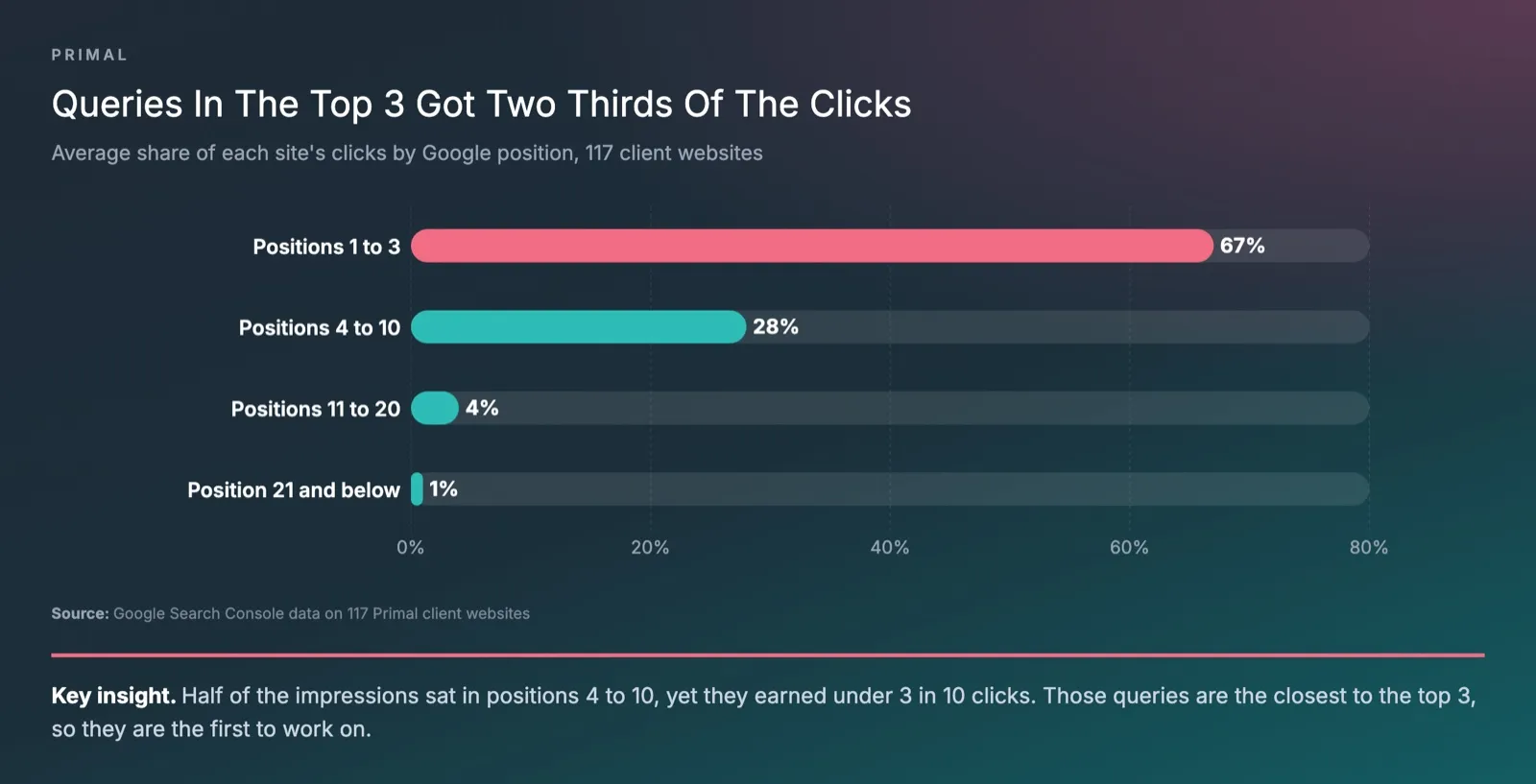
Aim for the top 3 positions on the searches that matter to your business. We looked at one week of Google Search Console data from 117 Primal client websites. On each site, queries in positions 1 to 3 earned about two thirds of the clicks, from only about a quarter of the impressions.
Positions 4 to 10 held half of the impressions and earned under 3 in 10 clicks. Queries on page 2 or lower earned under 1 in 20. The chart shows the average share of each site’s clicks for each group of positions.
So a good SEO plan picks a short list of keywords that bring customers, then improves each page until it reaches the top 3. The 9 steps below are in the order we work through them.
The 9 Steps Of SEO, In Order
SEO has 9 steps, done in order. You measure your starting point, choose keywords, read the results page and plan the site structure. Then you fix technical problems, improve each page, write content, earn links and review the results each month. Each step gives you one output that the next step uses.
- Measure where you start. Verify your site in Google Search Console, Google’s tool for site owners, which costs nothing. Note which pages get clicks, from which searches, and at what position. Set the goal in enquiries or orders from search, with rankings as a step towards them. The output is a list of the pages and searches you already have.
- Choose keywords. List the words buyers type when they look for what you sell, in Thai and in English. Check the monthly searches for each in a keyword tool, then group the terms that mean the same thing. The output is a set of keyword groups in order of value to the business.
- Read the results page. Search the main term of each group on Google. Note whether the first 10 results are articles, service pages, product pages or lists. The output is the type of page each group needs.
- Plan the site structure. Give each keyword group one page, and link related pages to each other with internal links. Keep each uniform resource locator (URL), the page’s web address, short and readable. The output is a map of which keyword group goes on which page.
- Fix technical problems (technical SEO). Check that Google can index your pages and that they load fast and work on a phone. The site should run on HTTPS (Hypertext Transfer Protocol Secure). Check that robots.txt does not block pages you want found. Then submit an XML sitemap, the list of your pages in Extensible Markup Language (XML), in Search Console. The output is a list of problems fixed.
- Improve each page (on-page SEO). Write a title tag and meta description that carry the keyword. The title tag is the line shown in search results and on the browser tab. The main heading (H1) is the heading on the page itself. Answer the question in the first sentence under each heading, and add alt text to images. The output is a set of pages that show readers and Google at once which question they answer.
- Write content that answers buyer questions. Start from the questions customers ask your team. Add what only your business knows, such as figures from your own work. Update old pages when the facts change. The output is a page for every keyword group on the map.
- Earn links and mentions (off-page SEO). Contact the sites your buyers read, such as trade media, industry associations and partners, and give them a reason to mention you. Links from other sites are called backlinks, and this work is called link building. Choose each site for its readers, its relevance to your business and its editorial standards. A business with a shopfront or a service area also keeps its Google Business Profile up to date, which is part of local SEO. The output is links and mentions from sites related to your business.
- Review the results each month. Check clicks, impressions and positions in Search Console, and the enquiries that came from search. Then choose the pages to improve next. The output is next month’s list of work.
On a strategy call this year with a business software company, one of the first things I showed was the list of keywords where its pages already sat on page 2 of Google. Those are the quick wins we plan to push onto page 1 first, and page 1 may also help the brand show in AI answers. Across 117 Primal client websites over one week, queries on page 2 or lower earned under 1 in 20 of each site’s clicks, so almost every click goes to page 1.
For step 7, Google’s guide to creating helpful content says its systems look for signs of experience, expertise, authoritativeness and trustworthiness (E-E-A-T). The same guide says trust is the most important of the four.
How To Choose Keywords For SEO
Choose keywords first by how closely they match what you sell, then by how often people search for them. A popular term that does not match your offer brings clicks that never become customers. A smaller term that names your service comes from people who are already looking for it.
Ask whether your buyers will search for the category, the product name or the problem they want solved. Each of these is its own keyword group, and each usually needs its own page. Keep a mix on the list. A few broad terms will take months to reach. More specific terms and longer phrases, such as a service with a city, can rank sooner.
Customers Often Ask Us Whether To Track The Most Searched Keywords Or The Most Relevant Ones
Track the relevant ones, in groups, with the most searched term in each group as its main keyword. That way each monthly report shows whether the groups that bring customers went up or down. A big term that does not match the business is not worth tracking, because its position tells you nothing about enquiries.
Check The Results Page Before You Choose A Page Type
Google shows the kind of page that fits what the searcher wants, which is called search intent. Before you make a new page, search the term and note what the first 10 results are. Then make the same kind of page. The table below shows two close searches on the English results page in Thailand.
| Search | First 10 results on Google | Page to make |
|---|---|---|
| how to do SEO | 7 articles, Google’s own guide, a forum thread and a video | A step-by-step article |
| SEO agency Thailand | 6 agency service pages and 4 agency lists or directories | A service page |
Both searches are about SEO, and they need different pages. A service page aimed at the first search would compete with Google’s own guide and 7 how-to articles. An article aimed at the second would compete with 6 agency service pages.
On-Page, Off-Page And Technical SEO Compared
On-page SEO is the work on your own pages. Technical SEO is the work on the site’s systems, so Google can reach and index those pages. Off-page SEO is the work that happens on other sites, such as links and mentions. You need all three, because a well-written page that Google cannot index will not rank at all.
| Part | Where the work happens | What it covers | How to check it |
|---|---|---|---|
| On-page SEO | Each page of your site | Title tag, meta description, headings, body copy, alt text, internal links | Read the page against its keyword group |
| Technical SEO | The site’s systems | Indexing, speed, mobile display, HTTPS, XML sitemap, robots.txt | The page indexing report in Search Console, and PageSpeed Insights |
| Off-page SEO | Other websites | Backlinks, media mentions, Google Business Profile, reviews | The links report in Search Console, and a backlink tool |
How To Do SEO For Searches In Thai And English
Plan your keywords in Thai and in English, because buyers search in both. In the same week, 110 of the 117 client websites got clicks from searches in Thai and from searches typed only in English letters.
For this question, the Thai ways of asking get more searches than the English ways. The table shows the question this post answers, typed 6 ways. The figures are monthly searches in Thailand from Ahrefs Keywords Explorer.
| Search | Language and form | Searches a month |
|---|---|---|
| how to seo | English, short form | 200 |
| how to do seo | English | 20 |
| ทำ seo | Thai, “do SEO” | 800 |
| การทำ seo | Thai, “doing SEO” | 350 |
| การ ทำ seo | Thai, with a space after the first word | 150 |
| ทํา seo | Thai, the same word typed with a different vowel form | 70 |
The 4 Thai forms add up to about 1,370 searches a month, and the 2 English forms to about 220. So the Thai searches are about 6 times as many. Keyword tools treat each spelling and spacing as a separate keyword. Group them, and answer each group with one page in each language. Separate pages for each spelling would compete with each other in the results.
Should A Site In Thailand Have Thai And English Pages
Yes, if your buyers search in both languages. Google’s guide to localized versions of your pages says to tell Google about each language version with hreflang. Search can then show each person the version in their language.
We write each language from its own keyword research. The words people type in Thai and in English are not direct translations of each other.
How Long SEO Takes To Show Results
In Primal’s SEO work, technical fixes and updates to existing pages can change rankings within weeks. Competitive keywords usually take several months of content and links. The real time depends on where the site starts, and on how long the sites on page 1 have been doing SEO.
The quickest place to start is searches where you already rank in positions 4 to 20. Google has already indexed and ranked those pages. The data above shows that positions 4 to 10 alone hold half of each site’s impressions. The work is to make each page answer the question more fully than the pages above it. Here is the order we use in the first 3 months.
- Month 1. Verify Search Console, record the starting point, choose keywords and fix technical problems. By the end of the month you have each keyword and page with its position on the start date.
- Month 2. Rewrite the title tag and first paragraph of pages that rank in positions 4 to 20. By the end of the month you have updated pages, and the next report shows how their positions changed.
- Month 3. Write new pages for keyword groups that do not have one yet, and start contacting sites for links. By the end of the month you have new pages in Google’s index and your first new links.
How To Measure SEO
Measure SEO in the Performance report in Search Console. It shows clicks, impressions, click-through rate (CTR) and average position for each search and each page. Then check Google Analytics 4 (GA4) to see how much organic traffic, the visits from unpaid search, became enquiries.
The number to watch each month is how many of your keywords sit in the top 3, because that is where most clicks go. The average position for the whole site is easy to misread. When a site starts to rank for new searches low on the page, its average position number goes up. That looks like a drop, even while clicks grow.
If your buyers also ask AI assistants, check how often AI answers cite your brand. Compare it with the same competitors each month.
How To Do SEO So AI Overviews And ChatGPT Cite Your Pages
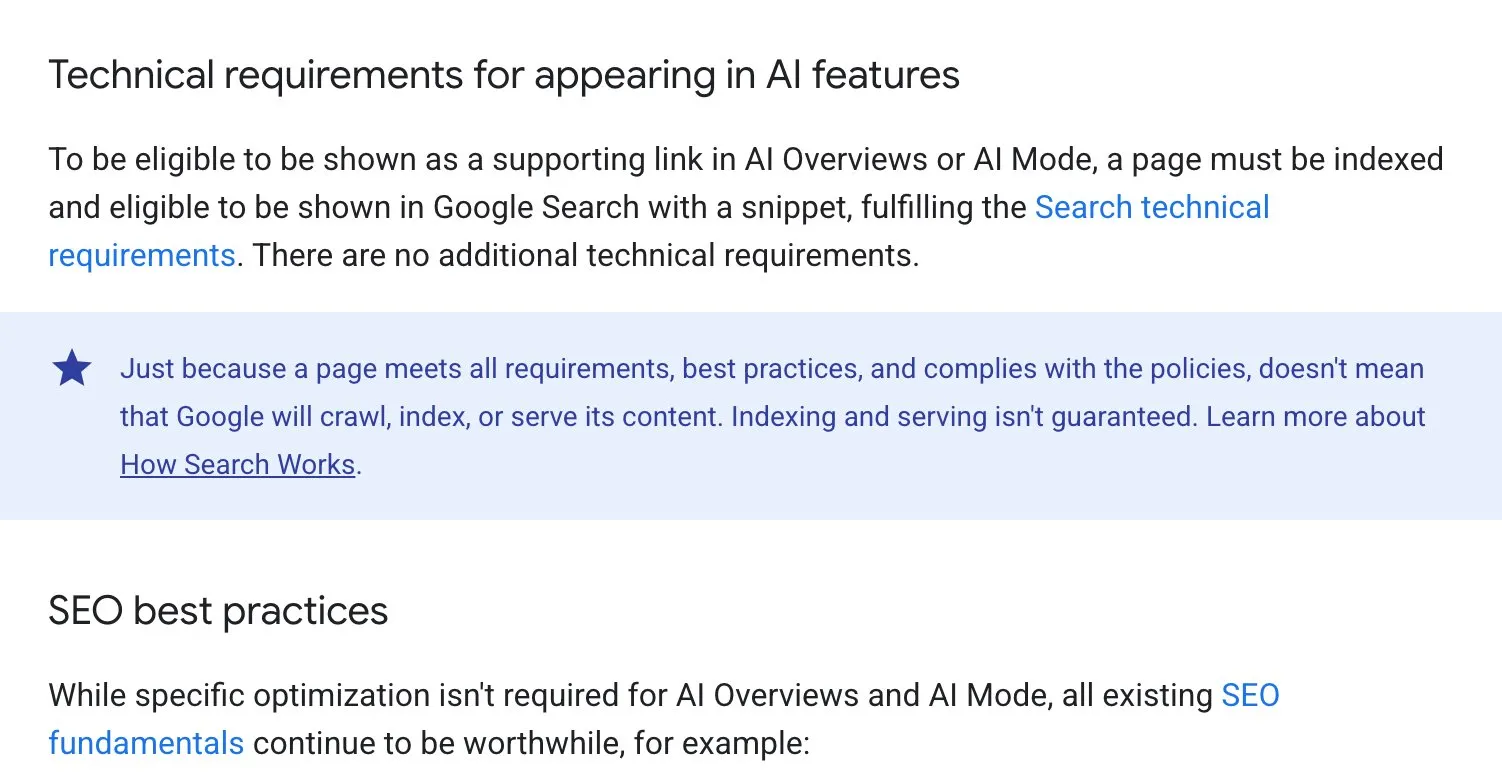
Do the same SEO steps first, then write answers that an artificial intelligence (AI) system can quote. Google AI Overviews, ChatGPT and Gemini cite pages their systems find when they answer a question. Google’s guide to AI features and your website says a page only has to be indexed and eligible for a snippet in Google Search. That is enough for it to appear as a link in AI Overviews or AI Mode.
The guide adds that there are no additional technical requirements. The capture below shows that part of the guide.
Elevate, Primal’s AI Visibility Tracker, shows AI answers citing the pages that already rank. Over the last month it logged 120 AI answers to a question about doing SEO. Every how-to article on Google’s first page for the same search was cited at least once. Google’s own documentation for site owners was cited in about 1 in 4 of the answers.
Once a page ranks, these 4 actions help an AI system choose it:
- Answer the question in the first sentence under each heading, in a sentence that still makes sense when it is quoted alone.
- Add what only your business has, such as figures from your own work and answers to the questions customers ask your team.
- Get your brand mentioned on the sites that AI answers cite most often in your category, such as trade media and review sites.
- Check that robots.txt does not block Google’s crawler or the AI crawlers you want to be cited by.
Google’s guide also says clicks from AI Overviews and AI Mode appear in the same Search Console Performance report as other web results. This work is called AI SEO. Mark McDowell, Primal’s founder and chief executive, explains how to prepare a whole site for AI search in this video.
A video on optimising a whole site for AI search, from Mark McDowell’s YouTube channel.
If you would rather have a team run these 9 steps, see Primal’s SEO services. The SEO team in our Bangkok office plans the work around the searches that bring enquiries. The same team looks after Google rankings and citations in AI answers.
Frequently Asked Questions About Doing SEO
Can A Beginner Do SEO On Their Own
Yes. A business owner can do the first steps alone, such as verifying Search Console, choosing keywords and rewriting title tags and page copy. The parts that usually need a specialist are technical fixes on a site with hundreds of pages, and contacting media for links. If page 1 for your main keywords is full of competitors with their own SEO teams, doing it alone will take longer.
How Can A Beginner Learn SEO
Start with Google’s SEO Starter Guide, then practise on your own site with Search Console. Pick 5 pages, note their searches and positions, change one thing on each, and compare the numbers a month later. Working through the steps on a real site teaches more than reading about them.
Customers Often Ask Us Whether To Start With Content, Keywords Or Fixing The Website
Start by measuring where you are and fixing anything that stops Google from indexing your pages, because content Google cannot reach will not rank. Then choose keywords, and only then write or rewrite content. Content written to be cited by AI goes on the same pages as your SEO content, so it is not a separate job.
How Often Should The Keyword Appear, And How Long Should A Page Be
There is no set percentage and no set length. Google’s SEO Starter Guide says the length of content alone does not matter for ranking. It also says Google Search does not use the keywords meta tag.
Put the keyword where readers look first, in the title tag, the main heading and the first paragraph. Then write the rest of the page to answer the question in full.
Is SEO A One-Off Job
No. Rankings change when competitors update their pages or Google updates its systems, and pages go out of date as facts change. A site that already ranks still needs a monthly review, so that pages that drop are fixed before their clicks are lost.
What Does The Cost Of SEO Depend On
The cost depends on how many keywords and pages you need, and how many competitors on page 1 do SEO. It also depends on the content and links needed each month, and on the technical work the site needs. If you do SEO in-house, the main cost is your team’s time. An agency’s fee depends on the same things.
Founder and Chief Executive Officer
Mark McDowell is the Founder and Chief Executive Officer of Primal, which he started in Bangkok in 2015. He is on the Forbes 30 Under 30 Asia 2020 list and was Campaign Asia’s Southeast Asia Young Achiever of the Year in 2018. He writes about AI search and search engine optimisation.
About The Author