

By Mark McDowellPosted: Updated: 12 min read
First published by Sitvisut Anantnakarakul, 2022-06-24. Updated by Mark McDowell on 2026-10-20.
What Is Keyword Research And How To Do It Step By Step
Keyword research is finding the words buyers type into Google, how often each is searched and what kind of page Google shows for it, then grouping the words so each page answers one group. In Search Console data from 117 Primal client websites, terms with 5 clicks or fewer in a week brought about half of each site's clicks.
Key Takeaways
- In one week of Google Search Console data from 117 Primal client websites, search terms with 5 clicks or fewer brought about half of each site's clicks, and terms with over 100 clicks brought only 12%.
- The median site in the same data got clicks from 134 different search terms in the week, so each page should answer a whole group of related terms.
- Keyword tools disagree. In Thailand, Ahrefs puts what is keyword research at 200 searches a month and Keyword Tool, which uses Google Ads data, puts it at 10, so compare terms inside one tool.
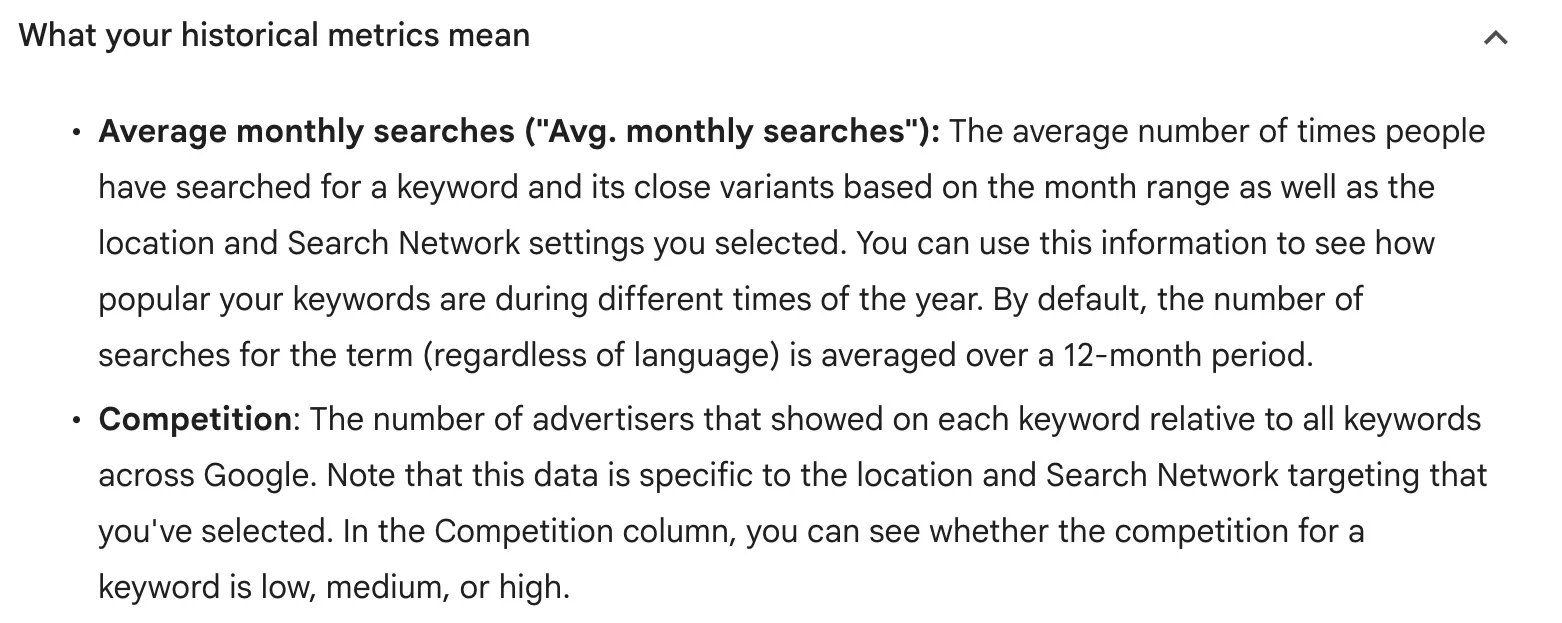
- Google's monthly figure for a keyword includes its close variants and searches in any language, which is why a tool on Google's data gives keyword and keywords the same 4,400 searches a month in Thailand.
- Google says AI Overviews and AI Mode may run several related searches across subtopics before they answer, so a page that answers the questions around a keyword has more chances to be linked.
What Keyword Research Is And Why SEO Starts With It
Keyword research is the work of finding the words your buyers type into Google. You check how often each word is searched and what kind of page Google shows for it. Then you group the words so each page on your site answers one group. It is the first step of search engine optimisation (SEO), because page titles, content and links all use the list it produces.
A keyword list made of a few big terms misses most of the clicks. We looked at one week of Google Search Console data from 117 Primal client websites. On each site, search terms that brought 5 clicks or fewer in that week added up to about half of the clicks.
So keyword research finds the groups of words buyers use for the same need, and gives each group a page that answers it in full. The method below starts with the searches your site already gets, and checks what Google shows before anything is written.
What A Keyword Is In SEO
A keyword is a word or phrase that people type into a search engine to find something. In SEO, it also means the phrase a page is written to rank for. A keyword can be one word, such as “keywords”, or a full question, such as “what is keyword research”.
Google matches the words people search for with the words on a page. If your page uses different words from your buyers, Google has a harder time matching the two. So the research starts from the words buyers use.
The Types Of Keywords
Keywords are sorted in two ways that matter in practice. The first is by length, which shows how broad the search is. The second is by search intent, which shows what the person wants from the search.
Keywords By Length
A head keyword is short and broad, such as “condo”. Many people search for it, and they want different things. Some want to buy and some want to rent.
A mid tail keyword adds a detail, such as “condo for rent in Bangkok”. A long tail keyword is longer and more exact, such as “2 bedroom condo for rent near Asok with a pool”. Each long tail keyword gets few searches. The person who types it already knows what they want.
Keywords By Search Intent
Search intent is what the person wants from a search. Google chooses the type of page it shows to match that intent. The words around the main term often show the intent, as in the table below.
| Intent | Words often in the search | Pages Google often shows |
|---|---|---|
| Informational, to learn | what is, how to, why, guide | Articles, guides and videos |
| Commercial, to compare before buying | best, review, vs, compare | Reviews and list articles |
| Transactional, to buy | price, buy, book, order | Product pages and service pages |
| Navigational, to reach a known site | a brand name, login | The brand’s own site |
Searches with a place name or “near me” form another group. Google often shows a map and a list of businesses from Google Business Profile above the usual results. A business with a shopfront needs both its pages and its Google Business Profile kept up to date, which is the work of local SEO.
Long Tail Keywords And How Many Clicks They Bring
Long tail keywords are the many specific searches that each get only a few searches a month. One of them brings few clicks. Together they bring more clicks than a few big terms.
In our Search Console data, the median site got clicks from 134 different search terms in one week. On 62 of the 117 sites, the 10 terms with the most clicks brought less than half of the site’s clicks.
The chart splits each site’s clicks by how many clicks each term got that week. Terms with 1 or 2 clicks brought 39% on average, and terms with over 100 clicks brought 12%.
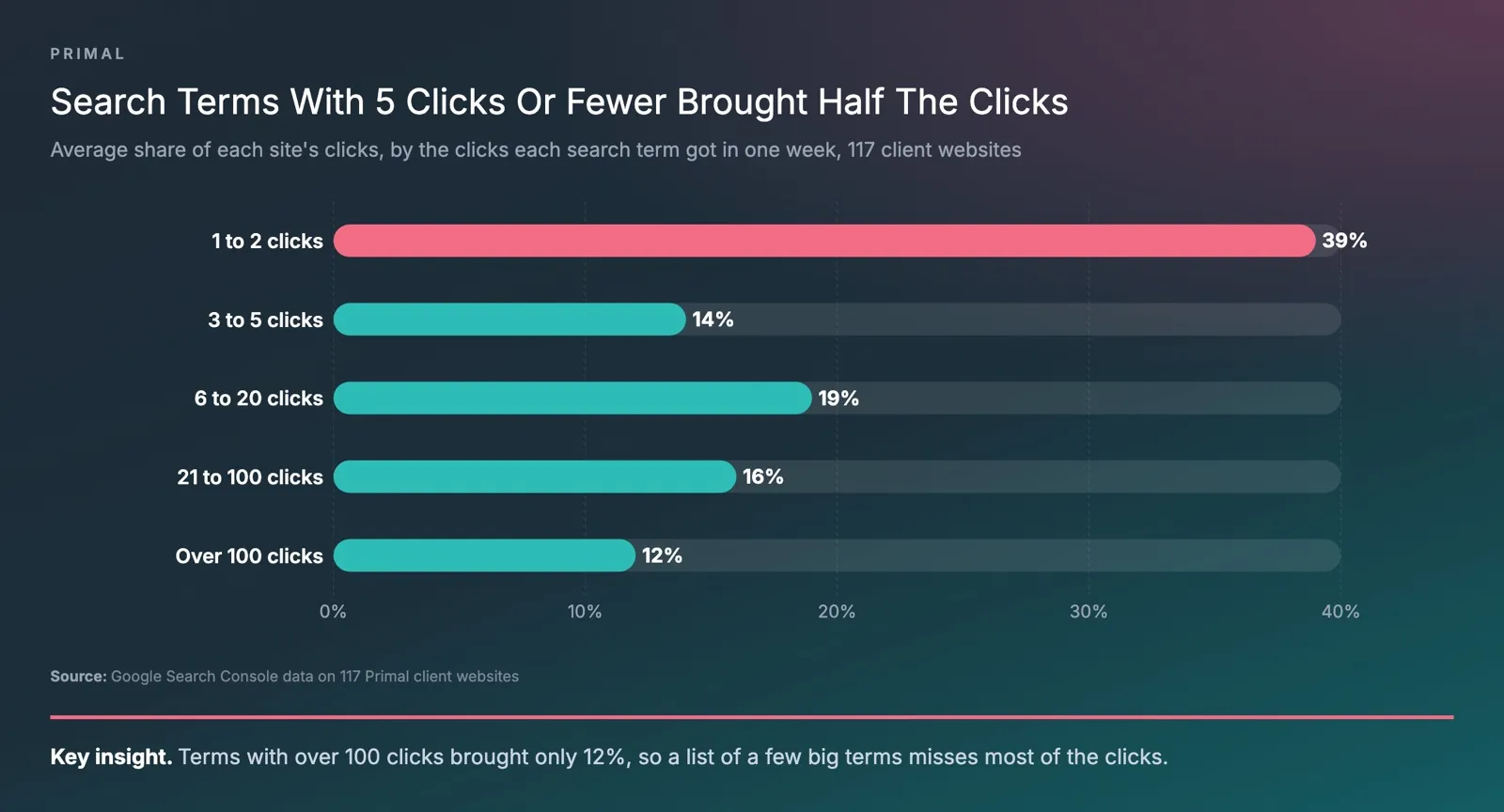
Big terms with thousands of searches a month still matter. But many small terms never show up in keyword tools. Google’s guide to using Keyword Planner says keywords with very low search volumes are not discoverable or forecastable. Search Console is where you see them. A page that answers the main question and the questions around it can collect clicks from many of them at once.
How To Do Keyword Research In 6 Steps
Keyword research takes 6 steps. You start from what you sell and finish with a list of keyword groups in order of priority. Each step gives an output that the next step uses.
- List what you sell and the words customers use. Write down your products, services and the problems customers want solved. Read the questions customers send your team by email and LINE, because they are in the customer’s own words. The output is a list of seed keywords, the starting terms for the rest of the work.
- See the searches your site already gets. The Performance report in Google Search Console lists the searches your site appeared for, with impressions, clicks and average position. Terms with impressions on page 2 or 3 are terms Google already connects with your site. The output is a list of current terms and their positions.
- Widen the list with tools. Put the seed keywords into Google Keyword Planner or Ahrefs to see related terms and monthly searches. Then type them into Google and note the autocomplete suggestions and the People Also Ask questions. The output is a longer list with a search volume beside each term.
- Read the results page for each main term. Search the term on Google from Thailand, in the language you are writing in. Note whether the first 10 results are articles, product pages, list articles, tools or videos. The output is the type of page each term needs.
- Group the terms into pages. Terms that share many of the same results go on one page. Terms that share none get their own page. The output is a table that matches each group of terms with one page.
- Put the groups in order. Rank the groups by how closely they match what you sell, how likely a searcher is to contact you, the search volume and how hard the term is to rank for. The output is the order in which you make or update pages.
On a luxury travel account this year, every term we planned carried the word Thailand, and I expected the search volume to be very low almost everywhere. Panlert, a senior SEO specialist on our team, checked the tool, and once the word luxury was added the terms showed very few searches a month worldwide. We tracked the rankings from both the United States, where the buyers are, and Thailand, where the owner searches.
Why Keyword Tools Show Different Search Volumes
Search volume is the estimated number of times a term is searched in a month. Each tool uses its own data and its own method, so two tools rarely show the same number for the same term.
The table shows 7 terms from this topic in two tools, both set to Thailand on the same day. Ahrefs Keywords Explorer uses its own data, and Keyword Tool uses Google Ads data.
| Search term | Ahrefs (searches a month) | Keyword Tool (searches a month) |
|---|---|---|
| keyword | 2,400 | 4,400 |
| keywords | 600 | 4,400 |
| keyword research | 600 | 480 |
| what is keyword research | 200 | 10 |
| how to do keyword research | 100 | 20 |
| seo keywords | 100 | 140 |
| keywords in seo | 0 | 140 |
The two tools are close on keyword research. On “what is keyword research”, Ahrefs shows 20 times the number Keyword Tool shows. Keyword Tool also gives keyword and keywords the same figure, and gives seo keywords and keywords in seo the same figure.
The reason is on Google’s own help page about Keyword Planner forecasts. It says average monthly searches cover a keyword and its close variants. It also says the figure covers searches regardless of language. The capture below shows that part of the page.
Use the figures to put terms in order inside one tool, and keep the same tool for the whole list. Once a page ranks, its impressions in Search Console show how often it appeared for each term.
What Keyword Difficulty Measures
Keyword difficulty is a tool’s estimate of how hard it is to reach the first 10 results for a term. Ahrefs scores it from 0 to 100. In Thailand it scores keyword research at 89 and long tail keywords at 0.
For keyword research in Thailand, 7 of the first 10 results were tool pages from software companies, so a new article has to compete with them. The Competition column in Keyword Planner measures something else. As the capture above shows, it is the number of advertisers that showed ads on a term, which is a measure of paid search.
Which Keyword Research Tools To Use
Start with Google’s own tools, which cost nothing to use, then add a paid SEO tool when you need data on competitors.
- Google Keyword Planner sits inside Google Ads. You need to enter billing details in a Google Ads account before you can get keyword ideas. It has two parts, Discover new keywords and Get search volume and forecasts.
- Google Search Console shows the searches your own site appears for. No outside tool has this data.
- Google Trends shows interest in a search as a score from 0 to 100, which is relative and cannot be read as a number of searches. The Google Trends data FAQ says search terms with low volume appear as 0. Use it to compare two terms and to see which months people search most.
- Autocomplete and People Also Ask sit in Google’s own results page. They show longer searches and the questions people ask.
- Ahrefs, Semrush and Ubersuggest are paid tools. They show which terms a competitor’s site ranks for, a difficulty score and many related terms.
How To Group Keywords Into Pages
Put terms on one page when Google answers them with the same pages. To check, search both terms and see how many of the first 10 results they share.
Also check whether one page ranks near the top for both. If they share many results, one page can answer both. If they share none, Google treats them as different questions.
We ran this check on 6 terms from this topic. We compared each term’s first 10 results in Thailand with the first 10 for keyword research, on the same day. The monthly searches are from Ahrefs.
| Search term | Searches a month | Results shared with keyword research | What the first 10 hold | Page plan |
|---|---|---|---|---|
| what is keyword research | 200 | 3 of 10 | 9 articles and a video | Same page. The article in first place also ranks for keyword research |
| how to do keyword research | 100 | 1 of 10 | 7 articles, a forum thread and 2 videos | Same page, in its own section. The same article ranks second |
| seo keywords | 100 | 5 of 10 | 5 tool pages, 4 articles and a video | A section on what keywords are. All 5 shared results are tool pages |
| keyword difficulty | 200 | 0 of 10 | 7 difficulty checkers and 3 articles | A short section here, or its own page to rank for it |
| long tail keywords | 150 | 0 of 10 | 10 pages on long tail keywords alone | Its own page to rank for it |
| google keyword planner | 2,500 | 1 of 10 | Google’s own pages, then guides to the tool | A separate guide to the tool |
Most results for keyword research are tools, while its question forms show articles. So one article can answer the head term and its questions together, while long tail keywords and Keyword Planner each need a page of their own.
The groups that come out of this check are the content plan for the site, one group to a page. That plan is where content marketing starts.
What Keyword Cannibalisation Is
Keyword cannibalisation is when two or more pages on your site answer the same term. The pages compete with each other. Google usually shows one of them at a time, and which one it shows can change.
To fix it, choose one page as the main page and merge the overlapping content into it. Then add a 301 redirect from the old pages to the main page, and point your internal links at the main page.
Keyword Research In Thai And English
In Thailand, do keyword research in both languages, because buyers search in both and the words are not translations of each other. Ahrefs puts the Thai word คีย์เวิร์ด at about 1,300 searches a month in Thailand. The Thai question keyword คือ, which means “what is a keyword”, gets about 450. The English question “what is a keyword” gets about 10.
Google’s figure also covers searches in any language, as its help page above says. On the results page in Thailand, an article written in Thai was among the first 10 for the English term keyword research. This means some of the people behind an English figure are Thai readers who typed in English letters.
Read the results page in each language and make each page from its own list of terms. A Thai page and an English page on the same topic can then each use the words their readers type.
Keyword Research When Buyers Ask AI Assistants
Keyword research is still needed when buyers ask artificial intelligence (AI) assistants, and the list now has to cover more questions. Google’s guide to AI features and your website says AI Overviews and AI Mode may use a “query fan-out” technique. They issue several related searches across subtopics before they write an answer. One question from a buyer can then draw on pages written for narrower questions.
The same guide says people can ask in one go a detailed question that once took several searches. For keyword research, that means collecting the questions as well as the terms. Take them from People Also Ask, from the long searches in Search Console and from the questions customers ask your team. Then answer each one under its own heading, with the answer in the first sentence.
Google’s guide also says a page must be indexed and eligible to show with a snippet in Google Search to appear as a supporting link in AI Overviews or AI Mode. Getting a brand cited in AI answers on Google and other assistants is the work of AI SEO.
In Primal’s SEO work, we rank keywords and pages by how likely they are to bring enquiries before we look at search volume, and we plan them in Thai and in English. If you want a team to take the research through to page changes and reporting, see Primal’s SEO services.
Frequently Asked Questions About Keyword Research
Where Should A Keyword Go On A Page, And How Often
Put it once in each place that readers and Google read first. Those are the title tag, the main heading, the first paragraph, a subheading where it fits, the meta description, the alt text of a related image and the page’s web address. Repeating the keyword again and again is called keyword stuffing, and it makes the page harder to read.
Should You Target Keywords With Zero Search Volume
Yes, when the term matches what you sell. Keyword Planner cannot find terms with very low search volumes, so a 0 in a tool does not mean nobody searches for it. In our Search Console data, terms with 5 clicks or fewer a week brought about half of the clicks. Start with the terms customers use when they contact you, then check in Search Console whether the page gets impressions for them.
How Many Keywords Should One Page Target
One main term and its group. The group holds the close variants, the questions and the longer forms whose results pages share many of the same first 10 results. A term that shares no results with the main term usually needs its own page.
Customers Often Ask Us Whether Their Buyers Search For The Category Name
You can check before you make the page. Put the category name into Keyword Planner to see the monthly searches, then look at the results page. If the results are sellers, buyers search for the category. If they are explanations, people are still learning what it is.
For a product the market does not know by name yet, buyers tend to search for the problem it solves, so write the page around that problem and keep the category name on the same page.
Customers Often Ask Us Whether To Use The Same Keywords As Competitors
Use a competitor’s keywords as a list of ideas, then keep only the terms that match what you sell. Ahrefs and Semrush show which terms a competitor’s site ranks for. Look first at the terms where no competitor has a page that answers the search. If you copy every term, your page has to compete with pages that already rank, using the same kind of content.
Founder and Chief Executive Officer
Mark McDowell is the Founder and Chief Executive Officer of Primal, which he started in Bangkok in 2015. He is on the Forbes 30 Under 30 Asia 2020 list and was Campaign Asia’s Southeast Asia Young Achiever of the Year in 2018. He writes about AI search and search engine optimisation.
About The Author