

By Jonathan StaceyPosted: Updated: 10 min read
What Is B2B Marketing And How It Differs From B2C
B2B (business to business) marketing is the marketing of products or services to other companies. The buying company decides as a group and searches with few, narrow terms, so B2B marketing starts from a list of target companies and their questions and is judged on qualified leads and closed deals.
Key Takeaways
- B2B (business to business) marketing sells to companies, and each purchase passes through several people, such as procurement, the engineer who uses the product and the manager who approves the budget.
- Across the 957 keywords in Primal's rank-tracking data for 20 B2B client websites, about 3 in 4 get 50 searches a month or fewer, so a B2B search plan starts from the buyer's question.
- LinkedIn had 6.5 million members in Thailand in DataReportal's Digital 2026 Thailand report, and its ads can target people by company industry, company size, job title and seniority.
- In 61, 469 artificial intelligence (AI) answers logged over the last month by Elevate, Primal's AI Visibility Tracker, for 44 B2B brands, Facebook was cited more often than LinkedIn for 37 of the brands, and a supplier directory or B2B marketplace was cited for 40.
- B2B marketing is measured by qualified leads and closed deals, with the source of every lead recorded in a customer relationship management (CRM) system.
What Is B2B Marketing
B2B (business to business) marketing is how a firm wins other firms as customers. The buyer is a firm, a factory or a public body that buys for its own work or to resell. Marketing to people who buy for themselves is called B2C (business to consumer).
That difference changes how the marketing is planned. The seller has few possible buyers. Each purchase passes through several people, and those people search with narrow, exact terms. Primal’s rank-tracking data shows how narrow. Across 957 keywords tracked for 20 of Primal’s B2B client websites, about 3 in 4 get 50 searches a month or fewer.
So a plan aimed at search volume finds very little. A better plan starts from the firms you want to sell to. It lists the questions each person there asks. It puts the answers where those people look, on Google, LinkedIn, Facebook and in artificial intelligence (AI) answers. Then it is judged on qualified leads and closed deals.
Examples Of B2B Businesses In Thailand
B2B covers services as well as goods. These are common types in Thailand.
- A factory that makes parts for other factories, such as moulded plastic, steel fittings or printed cartons.
- A dealer in machinery, safety equipment or office supplies.
- A logistics, cold storage or office rental company.
- A software firm that sells payroll, accounting or stock systems to other firms.
- Law firms, accounting firms, recruiters, security firms and marketing agencies.
- A hotel or travel firm that sells meeting packages and staff trips to other businesses.
One business can be both B2B and B2C. A coffee roaster may supply cafés and hotels and also sell bags of beans online. Plan the two sides apart. The two groups of buyers ask different questions.
How B2B Marketing Differs From B2C
B2B marketing speaks to a group of people at a company. They buy for business reasons and take longer to decide. B2C marketing speaks to one person or a household. They buy for themselves and often decide faster.
The table compares the two on the points that change the marketing.
| B2B | B2C | |
|---|---|---|
| Who buys | A company, factory or public body | A person or a household |
| Who decides | Several people, such as procurement, the user and the budget holder | One person, sometimes with family |
| Why they buy | Cost, risk, specification and the effect on the business | Taste, convenience and price |
| Before the purchase | A quotation, a supplier comparison and an approval | Reviews, a price check and a purchase |
| Number of customers | Few, each worth a lot and often buying again | Many, each worth less |
| Search terms | Exact terms with few searches each | Broader terms with many searches each |
| Main measure | Qualified leads and closed deals | Orders and the cost of each order |
The buyer is rarely one person. Procurement checks the price and the contract terms. The engineer or production manager who will use the product checks the specs. They often help choose the shortlist. A manager then signs off the budget. Each decision-maker needs different answers, so the content speaks to each role in turn.
What B2B2C, B2G And D2C Mean
B2B2C (business to business to consumer) describes a brand that reaches shoppers through another business. A brand that sells through a marketplace app or a supermarket chain works this way. The middleman serves the shopper and often keeps the shopper data. So the brand sees less of its own buyers.
- B2G (business to government) is selling to public bodies, usually through a tender.
- D2C (direct to consumer) is a brand selling to shoppers through its own website or shops, with no retailer in between.
- C2C (consumer to consumer) is people selling to each other, such as on a second-hand marketplace.
How To Create A B2B Marketing Strategy
A B2B marketing strategy is a plan to get the right firms to know you and contact you while they choose a supplier. It starts from the buyers and picks the channels last. Work through these steps in order.
- Write your ideal customer profile (ICP). Note the industries, company sizes and problems your product solves best. Then list the firms that fit.
- Map the buying group. For each type of firm, list who takes part, such as procurement, the user and the budget holder. Write down the questions each one needs answered before they sign.
- Make pages that answer those questions. Give each product a page with its specs, standards and lead time. Add pages for each industry you serve and pages that compare options.
- Pick the channels your buyers use. In Thailand the usual set is Google, LinkedIn, Facebook, LINE Official Account, email and trade shows.
- Nurture the leads that are not ready yet. Lead nurturing means sending each lead the next useful piece by email or LINE. Marketing automation keeps the follow-up going through long decisions.
- Hand leads to the closing team through a customer relationship management (CRM) system and measure to the deal. Agree with that team what a ready lead looks like. Then check how many leads from each channel become deals.
These steps follow the same logic as any marketing strategy. What differs is the small group of buyers and the number of people in each decision.
Why B2B Keywords Get So Few Searches
B2B keywords get few searches because few people buy each product. Those buyers search by product name, size or standard. A plant manager who needs a spare part types the part’s name and size, not a general word for the machine.
So search engine optimisation (SEO) for these firms picks keywords from buyers’ questions. It judges each page by the enquiries it brings.
Primal’s rank-tracking data gives the numbers. Of the 957 keywords tracked for 20 B2B client websites, about 3 in 100 reach 1,000 searches a month. Consumer brand websites in the same data reach that level on about 9 in 100 keywords. The chart below shows the full split.
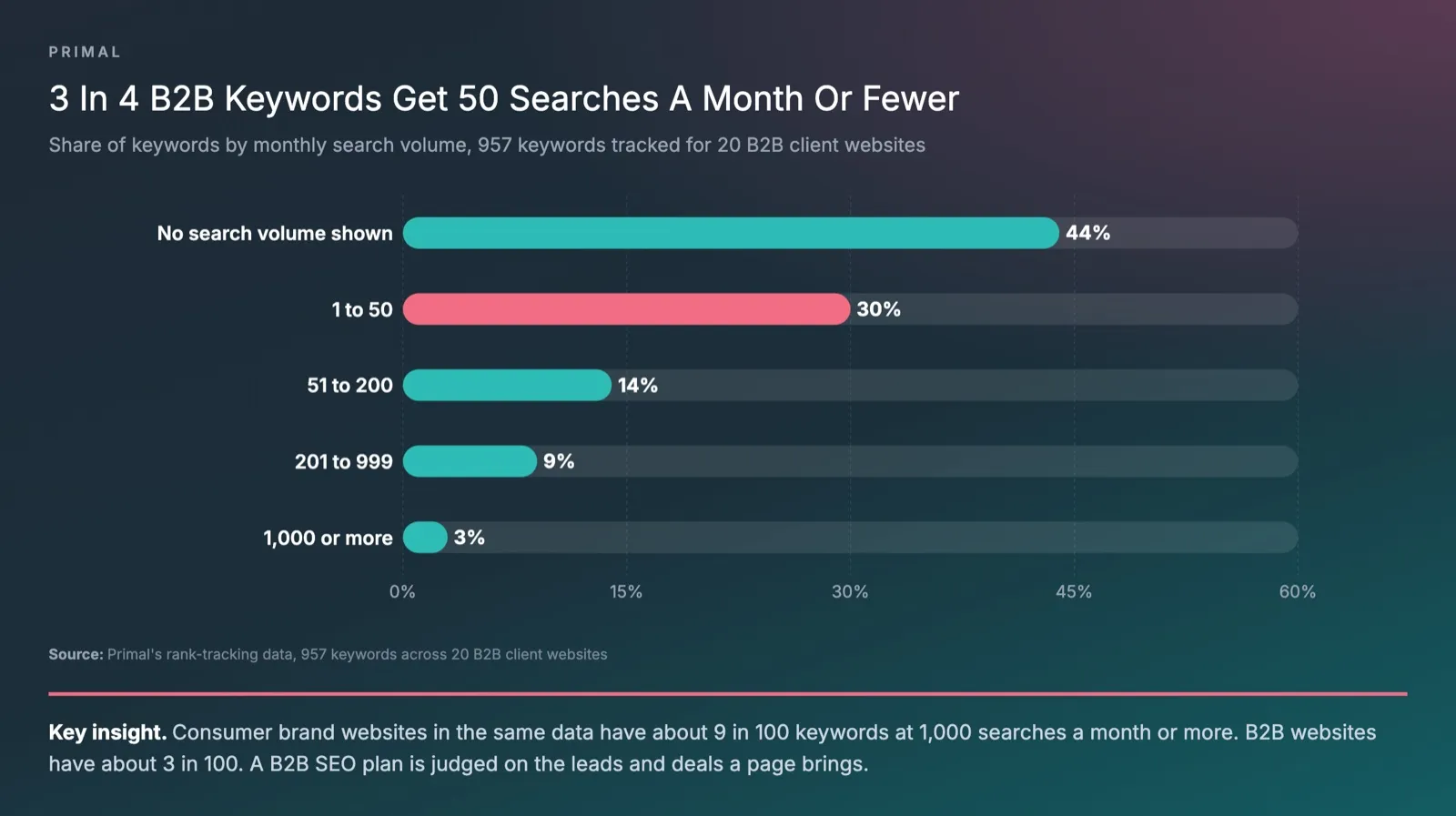
In 17 of the 20 websites, more than half the keywords get 50 searches a month or fewer. Most of the keywords are written in Thai, about 7 in 10. The ones written in English letters are smaller still. So a website for buyers in Thailand needs its product pages in Thai as well as English. Its reports should show enquiries and deals per page. Visits this small are too few to judge the work by.
Mark McDowell, who founded Primal, has seen this with niche B2B clients. One client makes moulded and cast parts for automotive and industrial customers, and its small website now ranks above larger competitors. For firms like this, I choose keywords that show buying intent and put the product information in tables that people and AI can read. To trace enquiries, we connect the website’s forms to the client’s customer relationship management system, such as HubSpot, when the client gives us access, and many do not, so they tell us how many qualified leads came in each month.
What Account-Based Marketing Is
Account-based marketing (ABM) picks the target firms first, then markets to the people inside each one. Traditional marketing attracts many people and filters them down. ABM starts from a short list of firms and grows from the first customer.
The Primal diagram below sets the two side by side. The traditional funnel narrows from attract to nurture to close. ABM widens from identifying the companies to engaging them, then expanding after the first deal.
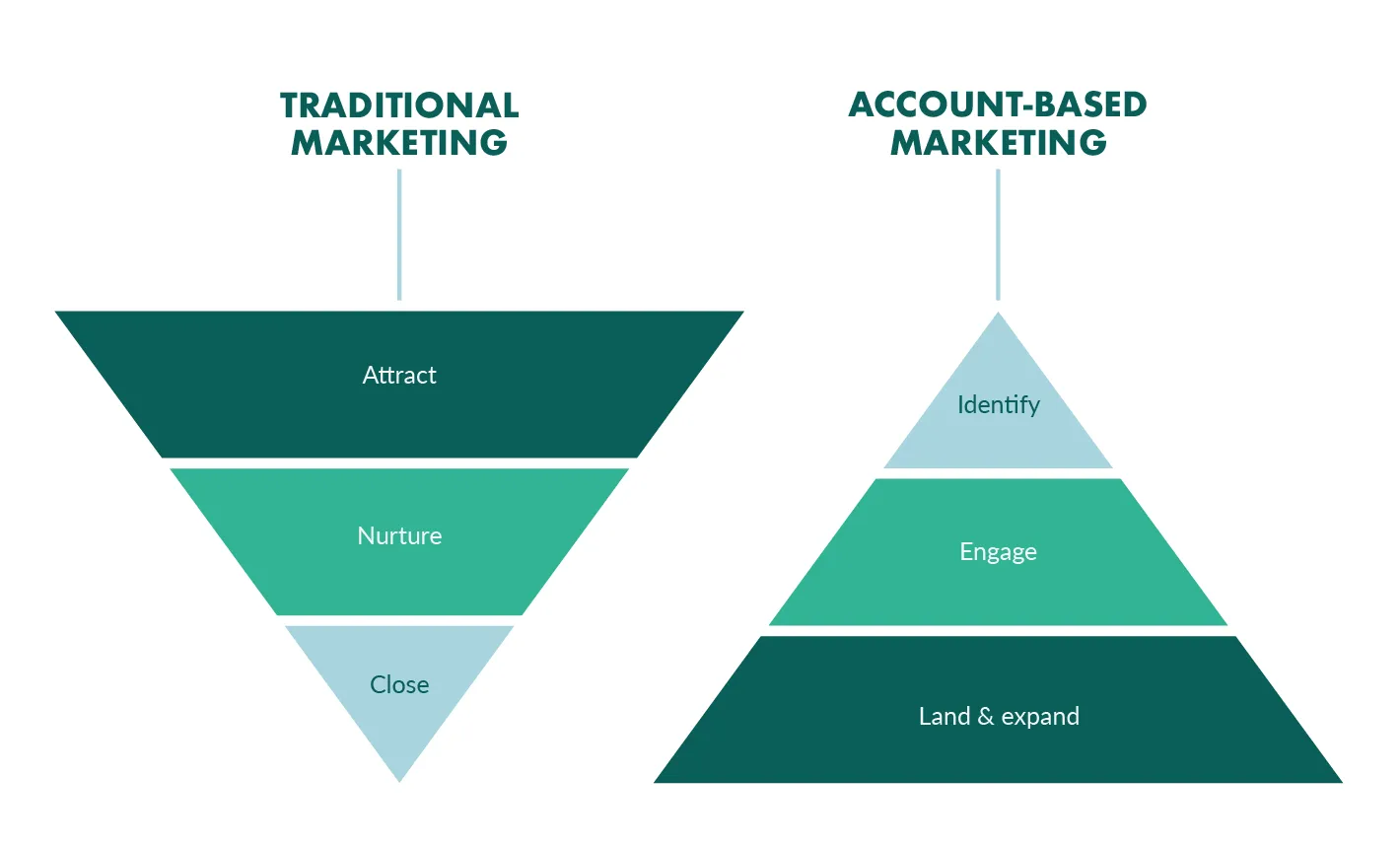
- Identify. Choose the firms that match your ICP and are most likely to buy. Then find the buying group in each one.
- Engage. Send each firm content written for its own problem. Use ads aimed at the firm by name, email and calls from the closing team.
- Expand after the first deal. Once the first order is signed, offer the same product to the firm’s other sites. Or offer them your next product.
ABM suits a short list of possible buyers, with deals large enough to justify content for one firm. If your buyers are many small firms, search and ads targeted by industry reach them better.
Which Channels Work For B2B In Thailand
The right channels are the ones your buyers already use. In Thailand that often means Google search, LinkedIn, Facebook and LINE Official Account, plus email and trade shows. Each does a different job.
- Google search. SEO and Google Ads reach people who are looking for a supplier today. Write the key pages in Thai and English, because buyers in Thailand search in both.
- LinkedIn. LinkedIn’s ads can target by company industry, company size, job title, job function and seniority. So they reach the people who approve a purchase. DataReportal’s Digital 2026 Thailand report puts LinkedIn at 6.5 million members in Thailand.
- Facebook. The same report puts Facebook at 51.5 million users in Thailand. Keep the company page’s product names, address and contact details the same as the website’s.
- LINE Official Account. Use it to send updates to customers and dealers who have added the account. Answer their questions there too.
- Email. Email suits the long follow-up between a first enquiry and a quotation.
- Trade shows. At a trade show you meet buyers from one industry in person. Enter every contact into the CRM the same week.
How B2B Buyers Use AI To Find Suppliers
B2B buyers can ask AI assistants such as ChatGPT, Gemini and Google’s AI Overviews to suggest suppliers. They ask narrow questions, such as which factory makes a part to a given standard. The assistant reads pages that match and cites its sources in the answer.
Elevate, Primal’s AI Visibility Tracker, logged 61,469 answers across 566 queries for 44 B2B brands over the last month. For 36 of the 44, the brand’s own website was among the 5 most cited sources. Yet it took only about 6 in 100 of the citations for a typical brand. Facebook was cited more often than LinkedIn for 37 of the brands, and a supplier directory or B2B marketplace was cited for 40.
So a supplier needs clear pages on its own site and the same facts on the other sites the assistant reads. These 4 steps cover both.
- Open each product and service page with a sentence that answers the buyer’s question. Then give the specs, the standards and the area you serve.
- Make your Facebook page match the website on product names, address and contact details.
- Check your listing on the supplier directories and B2B marketplaces in your industry.
- Measure how often AI answers mention your brand, and compare it with your competitors.
This work is how a brand gets chosen in AI search. Mark McDowell, Primal’s founder, explains how a brand gets mentioned in ChatGPT’s answers in the video below.
A video from Mark McDowell’s YouTube channel on how a brand gets mentioned in ChatGPT’s answers.
How To Measure B2B Marketing
Measure B2B marketing by qualified leads and by how many of them become deals. Record every step in a CRM. Visits and clicks show whether a channel is working. Budget decisions use the deal data.
Record each lead at these stages in a CRM such as HubSpot or Salesforce, with the channel and the campaign that brought it.
- Lead. Someone who got in touch by form, phone, LINE or a LinkedIn lead form.
- Marketing qualified lead (MQL). A lead that fits the ICP, judged by tests that marketing and the closing team agree on.
- Meeting. The closing team has booked a call or a product demonstration.
- Quotation. The buyer has asked for a price and terms.
- Deal. The order is signed, with its value recorded.
Deals take time, so a monthly report should also show the pipeline. The pipeline is the total value of open deals at each stage. With every stage recorded, you can see which channel brings many leads and which one brings deals. Ways to find new leads in each channel are in our guide to lead generation.
Primal’s B2B marketing services plan SEO, LinkedIn and Google Ads around how your buyers decide. The team reports in leads and deals. The work runs from our Bangkok office. About 150 people work across Primal’s 3 offices in Bangkok, Kuala Lumpur and Singapore. They plan search, advertising and AI search together.
Frequently Asked Questions About B2B Marketing
What Does B2B Mean
B2B means business to business. It describes trade where both the buyer and the seller are organisations. You may also see it written as B to B, with the same meaning.
Customers Often Ask Us Why Most Of Their Leads Do Not Fit
Start by agreeing with the closing team what a good lead looks like. Note the industry, company size, job role and minimum order. Ask for those details on the form and use them in the ad targeting.
Bid on terms only business buyers use, such as a part name with its size or the word wholesale. Then send each lead’s outcome from the CRM back to Google Ads and Meta, so their systems look for people like your real buyers.
Customers Often Ask Us Whether SEO Is Worth It When Few People Search For Their Product
Yes, when the few people searching are the buyers you want and one deal is worth a lot. Group the related terms your buyers use on one page, so the page answers their whole question. Check which pages your competitors rank with for the same products. Then judge each page by the enquiries it brings.
How Long B2B Marketing Takes To Show Results
LinkedIn and Google Ads start to bring leads as soon as the tracking and the landing pages are live. SEO takes weeks for technical fixes and months for competitive terms. Revenue from those leads follows your own buying cycle. A firm whose deals take months to close sees the revenue months after the first lead.
Digital Project Manager
Jonathan Stacey is the Digital Project Manager at Primal and runs web projects from brief to launch. He is a dual British and Thai citizen, has lived in Thailand for over 20 years and is fluent in English and Thai.
About The Author