
By Methinee SopaPosted: Updated: 11 min read
What Is A Marketing Strategy And How To Create One
A marketing strategy is the set of decisions on who a brand sells to, what it offers that competitors do not, where it meets those buyers and which numbers show it is working. The marketing plan turns those decisions into tasks, budgets and dates, and a tactic is one piece of work inside the plan, such as a single ad campaign.
Key Takeaways
- A marketing strategy makes 4 decisions in order, who to sell to, what to offer, where to meet buyers and how to measure the result, and SWOT, STP, the 4Ps and the funnel each help with one of them.
- In the latest check of the 995 keywords in Primal's rank-tracking data for 17 client brands, Google showed an AI Overview on 861 of the results pages, nearly 9 in 10.
- If a change leaves the target customer and the offer as they were, it is a change of tactic. If it changes either one, it is a change of strategy.
- Google's guide for site owners says a page needs no extra technical work to appear as a link in an AI Overview, beyond being indexed and able to show a snippet in Google Search.
- Primal writes marketing plans in rolling 90-day horizons and reviews them every quarter, instead of writing one plan a year.
What Is A Marketing Strategy
A marketing strategy is a brand’s choice of who to sell to, what to offer and where to meet buyers. It also sets how you will tell whether it works. A brand that picks one group of customers also picks where it will not spend.
The tools most marketers learned each help with one of these choices. A SWOT analysis (strengths, weaknesses, opportunities and threats) reads the market. STP (segmentation, targeting and positioning) picks the customer. The 4Ps set the offer, and the funnel places the channels.
The choice that has changed most is where buyers meet a brand. Primal’s rank-tracking data holds 995 keywords tracked for 17 client brands. In its latest check, Google showed an artificial intelligence (AI) summary, called an AI Overview, on 861 of those results pages. That is nearly 9 in 10. So a buyer often reads a summary of other sites before they see the brand’s own page.
A plan that covers only rankings and ads misses the first thing the buyer reads. So make the decisions in order, and treat AI answers as a channel when you choose channels. Then review the plan every quarter.
How A Marketing Strategy Differs From A Plan And A Tactic
A strategy is the choice of where to compete and with what offer. A tactic is one piece of work that carries out that choice. The marketing plan says which tactics run when, on what budget and who owns each one.
The quickest test is to ask whether a change alters the target customer or the offer. If it does, the strategy has changed. If it does not, only a tactic has changed.
| Strategy | Tactic | Marketing plan | |
|---|---|---|---|
| Answers | Who to sell to, what to offer, where to meet them | What to do in each channel | When, on what budget, who does it |
| Time span | Long term, changed when the market changes | Short term, can change each week | A 90-day round or a year |
| Example | Focus on mid-sized firms that research on Google before they buy | A guide that answers a buyer’s question, a Google Ads campaign | A content calendar, a monthly ad budget and the measures for each |
How To Create A Marketing Strategy In 6 Steps
Start with the business goal. Then make each decision in turn, from the market to the customer, the offer, the channels and the measures. Each step gives one output that the next step uses.
- Set the business goal. Write down the result the business needs and by when. It might be new customers a month or revenue from online channels. The output is 1 to 3 goals you can measure.
- Read the market with SWOT. List the brand’s strengths, weaknesses, opportunities and threats, and look at what competitors do. The output is the strengths you can compete on and the risks to plan for.
- Choose the customer with STP. Split the market into segments and pick the one to target. Then write the brand’s position for it. The output is the target audience and a one-sentence position.
- Set the offer with the 4Ps. Decide the product, the price, the place it is sold and the promotion. The output is an offer whose parts agree with each other.
- Choose channels along the funnel. Place channels at every stage the buyer passes through, from the first search to the purchase. Include the AI answers on Google, ChatGPT and Gemini. The output is a list of channels and content for each stage.
- Set the budget, the KPIs and the review date. Split the budget by funnel stage. Set a key performance indicator (KPI) for each stage. The output is a plan the team can run, with the date of the next review.
Mark McDowell, who founded Primal, sorts a plan’s keywords by the buyer’s stage before he chooses the channels. Some people do not know they have the problem yet, some are researching, and only a small share are ready to buy or talk to someone now. When the goal is enquiries, I put the budget on high-intent searches first, the phrases people type when they compare and buy rather than “what is” questions, and add searches for the earlier stages as more budget becomes available. In the channel plan, Meta reaches people at the awareness and consideration stages, and Google Search is where people already looking for the brand find it. The final keyword list comes from our research and the client’s own knowledge of its customers.
Where SWOT, STP And 4P Fit In The Plan
SWOT comes first because it shows where the brand can compete, and STP follows to decide who the offer has to suit. The 4Ps come last and turn both answers into a product, a price and a message.
What Is A SWOT Analysis
A SWOT analysis lists a business’s strengths, weaknesses, opportunities and threats. Strengths and weaknesses are internal, so the brand controls them. Opportunities and threats are external. They include competitors, regulation, the economy and the way customers search and buy.
A SWOT only helps when every line is a fact someone can check. The facts come from market research, such as customer interviews and search data. “Repeat customers come back within 3 months” can guide a plan, and “good service” cannot. Once the boxes are full, match each strength with an opportunity. Then match each weakness with a threat. Each pair is an option to carry into STP.
How To See A Competitor’s Marketing Strategy
You can see most of a competitor’s strategy from public sources. Read their website for the customer they speak to and the offer they lead with.
Check their live ads in Meta’s Ad Library and Google Ads Transparency. Then search your own keywords and note which of their pages rank. Together these show who they target, what they offer and where they spend.
What Is STP Marketing
STP marketing stands for segmentation, targeting and positioning. These are the 3 steps a brand uses to choose its customer. You split the market into groups, pick the group to sell to, and decide what the brand should mean to that group.
Segments can come from age and income, where people live, how they buy or the problem they want solved. Choose the target by the size of the group and how easy it is to reach. Then check the margin each customer brings. The position fits in one sentence. For example, “For (target customer) who need (need), (brand) is the (category) that (difference), because (proof).” The difference and its proof make up the value proposition, the reason a buyer picks the brand.
What Are The 4Ps And How Do 7P And 8P Differ
The 4Ps are the marketing mix, the parts of an offer a brand decides for itself. They are product, price, place and promotion. Price includes the pricing approach, such as a premium price, a bundle or a launch price.
The 7Ps add people, process and physical evidence for service businesses. Physical evidence is what a customer can see and touch, such as the shop, the website and the reviews. The 8Ps come in more than one version, because sources add a different eighth P. The most common are performance, productivity and packaging. Before a team uses 8P, agree which one it means.
What Is 4E Marketing
4E marketing replaces the 4Ps with experience, exchange, everywhere and evangelism. Each part of the offer is then judged from the customer’s side. The 4C model sits between the two, with customer, cost, convenience and communication. The Primal table below lines up all 3 models row by row.
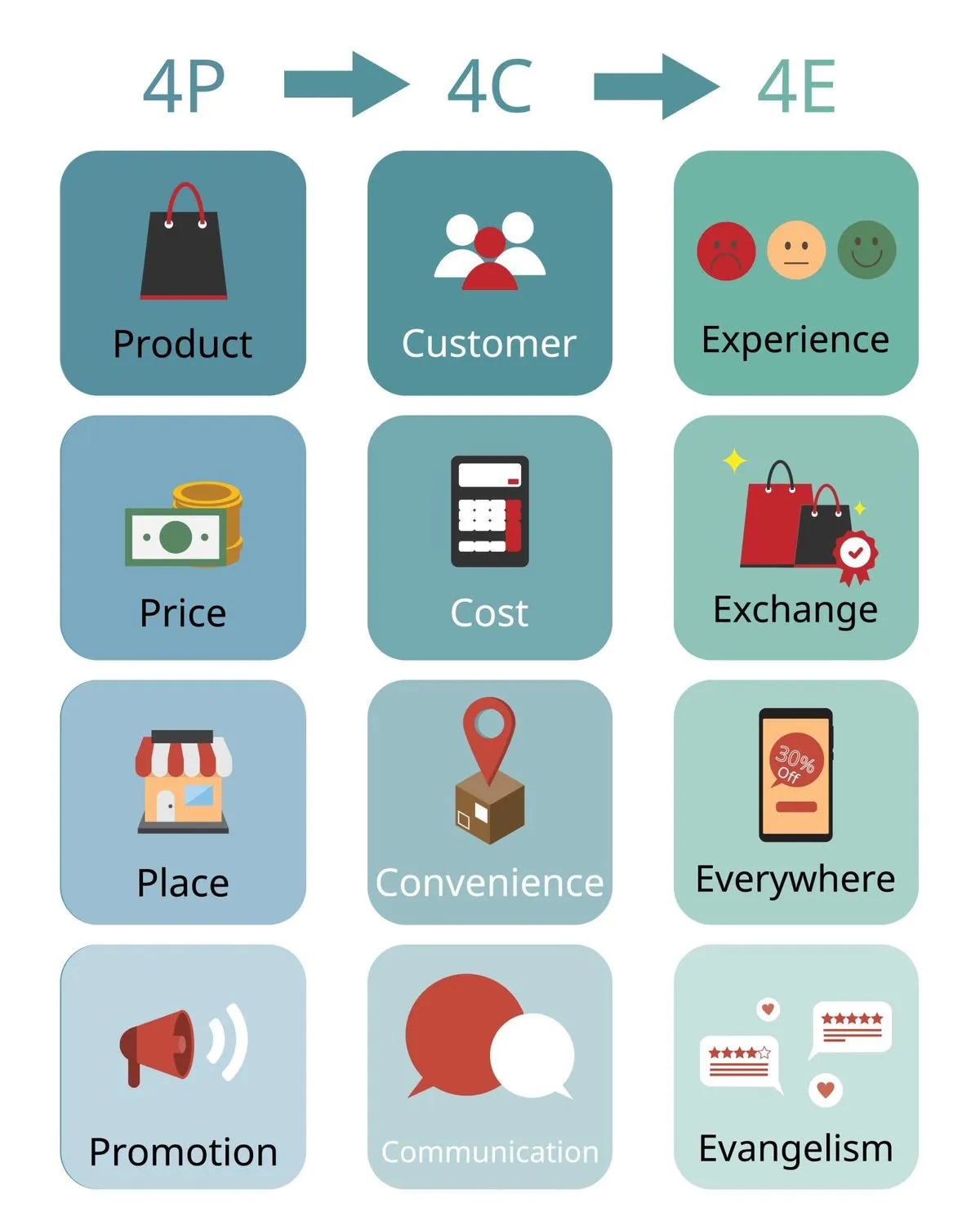
Use the 4Ps for the decisions the brand controls. Then check each one against the 4C and 4E columns. A price, for example, has to make sense against the full cost to the customer, delivery and time included. It also has to match what they feel they get in exchange.
What Is A Marketing Funnel
A marketing funnel is the set of stages a buyer goes through, from first hearing of a brand to buying from it. It splits the customer journey into parts. Fewer people reach each stage, and each stage needs different information.
A strategy uses the funnel to choose channels and content for each stage. That way no stage is left empty.
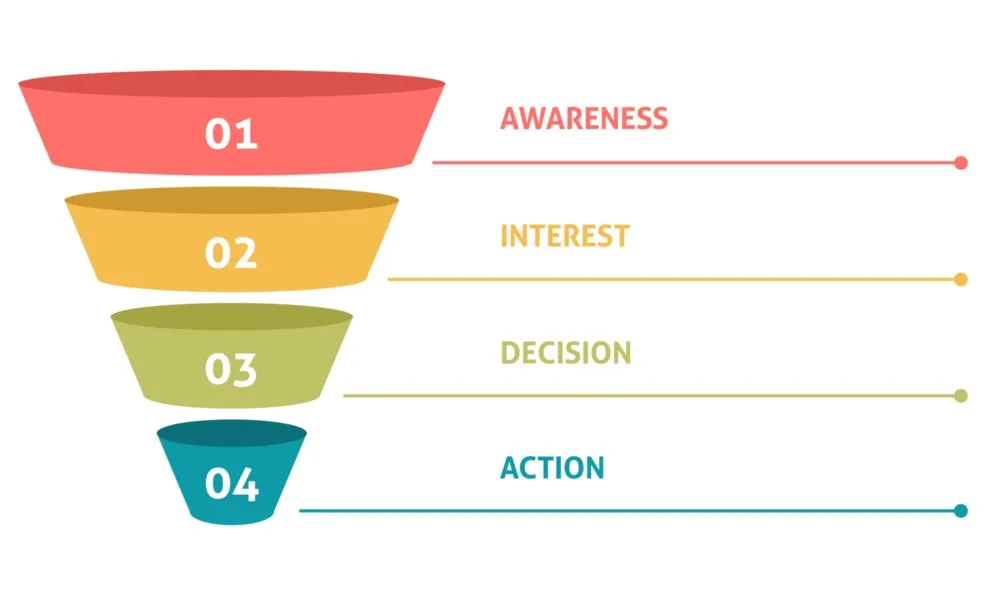
The Primal funnel below uses the 4 stages of the AIDA model. AIDA is short for awareness, interest, decision and action. Some versions put desire in place of decision at the third stage.
What TOFU, MOFU And BOFU Mean
TOFU, MOFU and BOFU are the 3 parts of the funnel. The top of the funnel (TOFU) is people who have just noticed a problem. The middle (MOFU) is people comparing options. The bottom (BOFU) is people ready to buy.
In the AIDA funnel above, awareness is the top, interest and decision are the middle, and action is the bottom.
| Stage | What the buyer asks | Content and channels that answer | What to measure |
|---|---|---|---|
| TOFU | What is this problem and what causes it | Guides, short videos, social media | Reach, new visitors |
| MOFU | Which option suits us and how do two options differ | Comparisons, reviews, examples of use, email | Time on page, sign-ups |
| BOFU | What does it cost and how do we start | Service pages, search ads, a LINE Official Account | Leads and purchases |
How A Marketing Funnel Differs From A Deal Pipeline
A marketing funnel covers the buyer until they become a lead. The deal pipeline takes over from the lead to the signed deal, through calls, meetings and quotes.
Both teams need one shared definition of a lead that is ready to hand over. With two definitions, marketing passes on names the closing team never calls. A business that sells straight from its website can run one funnel for both. Its buyers check out without talking to anyone.
What Types Of Marketing Strategy Are There
The classic types come from Igor Ansoff’s growth matrix, often called the Ansoff matrix. They depend on whether the product and the market are new or existing.
Market penetration sells an existing product to an existing market. Product development brings a new product to an existing market. Market development takes an existing product to a new market. Diversification is a new product for a new market, and it carries the most risk.
Other types group by the decision they serve. A brand can run several at once, as long as each one serves the same customer and offer.
- Customer choices, such as niche marketing for one tightly defined group, or account-based marketing for a chosen list of business accounts.
- Offer choices, such as product differentiation, a pricing approach or bundles.
- Channel choices, such as inbound, outbound, influencer and omnichannel marketing. Omnichannel joins online channels to physical stores. Our guide to digital marketing covers the online channels one by one.
- Retention choices, such as loyalty programmes, and messages after a purchase that bring the customer back.
How Inbound And Outbound Marketing Differ
Inbound marketing brings buyers to the brand through content that answers their questions. Search engine optimisation (SEO) and content marketing are inbound. Outbound marketing goes to the buyer first, through ads and email to a chosen list.
Inbound usually takes longer to show results, because content needs time to rank and gather readers. Outbound can work faster, but the results stop when the ad spend stops. Most plans use both and split the budget by funnel stage.
How AI Search Changes A Marketing Strategy
AI search changes where buyers meet a brand. An AI summary often sits at the top of the results page, and it cites sites the brand does not own. So the channel step of a strategy has to include being cited in those answers.
Across the same 995 keywords, the results page showed an AI Overview on 87%. A People also ask box showed on 64%, a video block on 24% and a local map pack on 19%. The chart below sets the 4 shares side by side.
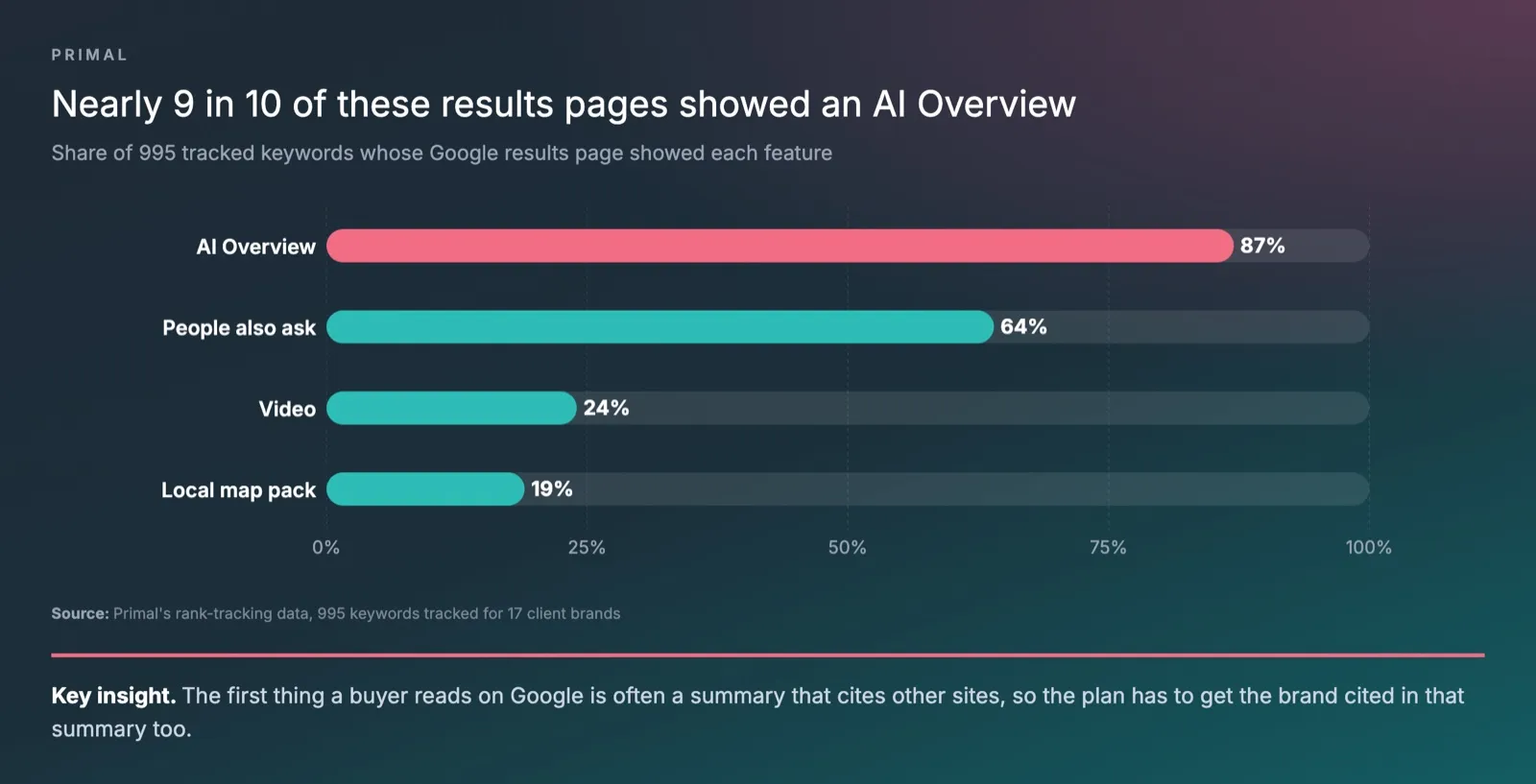
11 of the 17 brands saw an AI Overview on 80% or more of their keywords. The 2 brands that saw the fewest are local service and venue businesses. Their keywords showed a map pack more often than the rest of the data. So a business whose buyers search by area needs an up-to-date Google Business Profile as well.
Google’s guide AI features and your website says what a supporting link in an AI Overview needs. The page must be indexed and able to show a snippet in Google Search. The guide lists no other technical requirement. So the strategy has to plan the content and the places the brand is mentioned.
- Publish answers to the questions buyers really ask on the brand’s own site. Make the first sentence under each heading answer the question.
- Cover every stage of the funnel. The same guide says AI Overviews and AI Mode may run several related searches before they answer. Google calls this query fan-out.
- Get the brand mentioned on the sites AI answers cite most in your category. Trade media and review sites are common ones.
- Measure how often AI Overviews, ChatGPT and Gemini cite the brand. Compare it against the same competitors each time.
This work is called AI SEO, or SEO for AI search. In this video, Mark McDowell, Primal’s founder and chief executive, explains how Google picks pages for AI Overviews.
A video from Mark McDowell’s YouTube channel on how to rank in Google AI Overviews.
If you want senior strategists to plan with AI search included, see Primal’s marketing strategy service. The team plans in rolling 90-day horizons and reviews the plan each quarter. To plan and review faster, it uses INSTINCT®. This is Primal’s internal AI capability, based on a decade of marketing work across Asia Pacific.
Frequently Asked Questions About Marketing Strategy
How Often Should You Review A Marketing Strategy
Check the KPIs every month and review the main decisions every quarter. Primal plans in rolling 90-day horizons. A strategy is rewritten when a major condition changes, such as a new competitor, a new market or a change in where buyers search.
Where Should A Small Business Or Startup Start
Start with the smallest group of customers you can serve better than your competitors do. Pick 1 or 2 channels that group already uses to research. Spend the budget there until the results are clear, then add the next group.
How Is PEST Different From SWOT
PEST looks only at outside factors. They are political, economic, social and technological. SWOT covers inside and outside factors together. Teams often run PEST first and use what it finds as the opportunities and threats in the SWOT.
Customers Often Ask Us How A Marketing Strategy Links To SEO, The Website And The Funnel
The strategy sets what buyers ask at each stage of the funnel. SEO makes the website’s answers show up in Google and in AI search. The website is where the buyer decides. So map each group of keywords to a funnel stage, and to the page that serves that stage.
Customers Often Ask Us How To Tell Whether The Budget Is In The Right Channels
Compare channels within the same funnel stage. Judge each one by the cost of the result that stage should produce.
A reach campaign and a search campaign do different jobs. Judging both by leads makes the top of the funnel look wasted. Agree a test window before launch, and shift budget only when it ends.
Content Writer
Methinee Sopa is a Content Writer at Primal who writes search engine optimisation (SEO) content for Google Search and AI search. Since joining Primal in 2023 she has handled content from keyword research and outlines to blog articles and landing pages.
About The Author