

By Mark McDowellPosted: Updated: 12 min read
First published by Sitvisut Anantnakarakul, 2021-04-20. Updated by Mark McDowell on 2026-10-20.
What Is Content Marketing And How To Get Started
Content marketing is creating and publishing content that answers your customers' questions, such as articles, videos, social media posts and emails, so people who do not know your brand yet can find it and later get in touch. In Search Console data from 78 Primal client websites, almost every click to an article came from a search without the brand name.
Key Takeaways
- The Content Marketing Institute defines content marketing as creating and distributing valuable, relevant and consistent content to attract and keep a clearly defined audience, and in the end to drive profitable customer action.
- On the median site among 78 Primal client websites with an article section, 99% of clicks to articles came from searches without the brand name over one week, against 9% for the home page.
- On the same sites, articles got about 1 in 4 of a site's impressions on Google but about 1 in 6 of its clicks, so an article has to answer the question in its first lines and show the next step.
- In 285, 098 artificial intelligence (AI) answers about 171 brands, logged over 30 days by Elevate, Primal's AI Visibility Tracker, a brand's own website was cited in only about 1 in 5.
- Measure content in Google Search Console by each page's impressions, clicks and searches, then in Google Analytics 4 by the contact clicks and forms each article leads to.
What Is Content Marketing
Content marketing is marketing with content that answers your customers’ questions. A brand publishes articles, videos, social media posts or emails that help people make a decision. It puts them where those people already search and scroll.
The Content Marketing Institute defines it as making and sharing valuable, relevant and consistent content for a clearly defined audience. The aim is to attract and keep that audience, and in the end to drive profitable customer action.
We looked at Primal’s client websites that have an article section. On those sites, almost every click to an article came from a search without the brand’s name. Clicks to the home page came mostly from people who already knew the brand. So articles are where new people first meet a brand.
People see articles in search results far more often than they click them. Artificial intelligence (AI) tools such as ChatGPT and Google’s AI Overviews also read content. They answer from it, often with no click at all. So good content answers the question in its first lines and then tells the reader what to do next. It also sits on Google and on the platforms people and AI use to find answers.
How Content Marketing Differs From Advertising
Advertising pays for space so people see a brand’s message. Content marketing makes content that people look for or choose to read.
An ad stops when the budget runs out. An article can rank on Google through search engine optimisation (SEO). It is then seen for as long as it still answers the question well.
The two can work together. A brand can run ads on Facebook or TikTok to show a video or an article to new people. An article can also be an ad’s landing page. That works well when a product needs explaining first, such as insurance or a course. Most ads ask for an action straight away. Content answers the question first, then offers the next step.
Types Of Content Marketing With Examples
Content marketing comes in 8 common types. They are blog articles, videos, social media posts, email newsletters, guides to download, infographics, podcasts, and quizzes or calculators. People find each type in a different place, so each one suits a different job.
DataReportal’s Digital 2026 report for Thailand puts the number of social media user identities in the country at 56.6 million. That equals about 8 in 10 people. So social content can reach a large share of people in Thailand. Articles reach the people who are searching Google for an answer right now. The table shows where people find each type, the job it does and an example.
| Type | Where people find it | The job it does |
|---|---|---|
| Blog articles and guides | Google and AI answers | Answer questions before a purchase, such as how to choose a supplier, and bring people who do not know the brand to the website |
| Videos | YouTube, TikTok and Facebook | Explain something people need to see, such as how to set up a product |
| Social media posts | Facebook, Instagram and LINE Official Account feeds | Keep the brand in front of people and start conversations, such as a weekly tip in a carousel post |
| Email newsletters | The inboxes of people who signed up | Keep in touch with customers and people who have shown interest, such as a monthly round-up of new guides |
| Guides and e-books to download | A page that asks for a name and email before the download | Collect contact details from people interested in a complex topic, such as a buyer’s checklist |
| Infographics | Articles and social media posts | Sum up data or steps in one image, such as a process in 5 steps |
| Podcasts | Spotify and YouTube | Give longer explanations people listen to while travelling, such as an interview with a specialist |
| Quizzes and calculators | The brand’s website and social media posts | Help a buyer work out their own case, such as a cost or a size |
Start with the one or two types your buyers use before they contact you. Publish those on a steady schedule before you add more.
How The Content Matrix Sorts Content By Purpose
The content matrix sorts content by 4 purposes. They are to entertain, inspire, educate and convince.
Smart Insights’ Content Marketing Matrix places content on 2 axes. One runs from emotional to rational decisions. The other runs from people who have just heard of a brand to people who are ready to buy.
- Entertain suits people who do not know the brand yet, with a short clip or a quiz.
- Inspire makes people want to start, with a customer’s story or a review.
- Educate suits people doing research, with a how-to article, a guide or an infographic.
- Convince suits people who are choosing, with a comparison table, a pricing page or a frequently asked questions (FAQ) page.
To use it, put one month of planned content in the 4 boxes. Then look for the empty ones. A brand that only posts promotions has all its content in the convince box. People who are not ready to buy then have nothing to read.
Why Businesses Use Content Marketing
Businesses use content marketing so that people who do not know their name yet can find them. People who know a brand search for its name and go to the home page. People who do not know it search for their question or problem. Content is the page that answers them.
We checked this in Google Search Console data from 117 Primal client websites over one week. Of those, 78 keep their articles in a section of their own. We sorted each site’s pages into articles, product and service pages, and the home page. Then we split the searches that contained the brand’s name from the ones that did not. On the median site, 99% of clicks to articles came from searches without the brand name. Product and service pages were at 60%, and the home page was at 9%. The chart shows the 3 page types side by side.
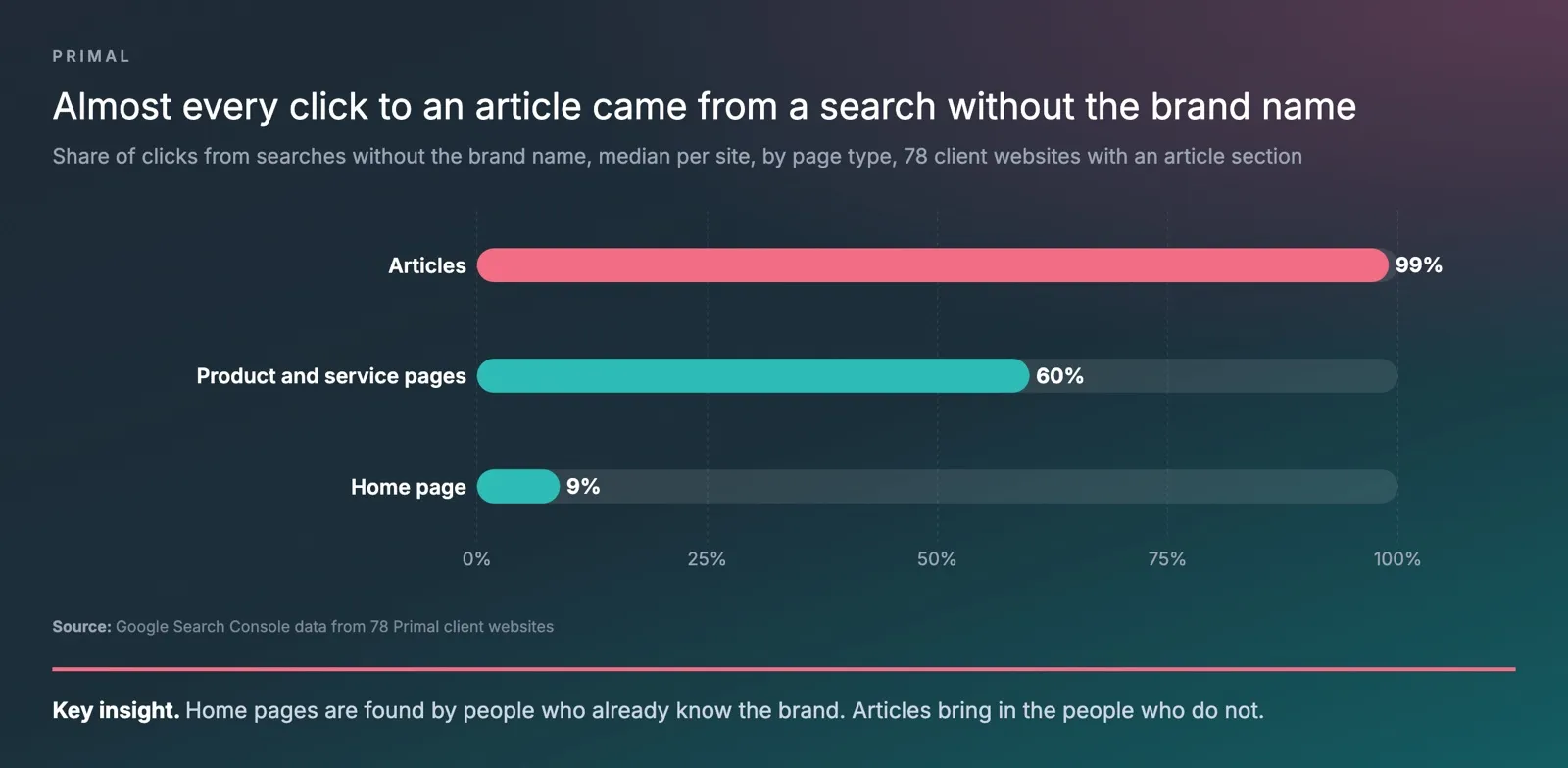
Articles also take a large share of those clicks. On the median site, articles brought in about 1 in 4 of all clicks from searches without the brand name.
Content saves time in daily work too. Customers ask some questions again and again. An article that answers one lets your team send a link instead of typing the same reply. One piece of content also works on several channels. A single article can become a carousel post or a short clip.
How To Create A Content Marketing Strategy
A content marketing strategy starts with one business goal and the questions your customers really ask. From those, you choose the types of content and the channels. Then you plan topics in groups and write each piece so the answer comes first. Last, you publish, measure and update.
Each of the 7 steps below ends with an output the team can check.
- Set one business goal. Pick one goal for each period, such as enquiries from the website or sign-ups to an email list. The goal should come from your business’s marketing strategy. The output of this step is one line with a number and a date.
- Collect the questions customers really ask. Start with the questions your customer service team and your LINE chat answer every week. Then check the searches in Google Search Console. Do keyword research to see which words people type and how often. The output is a list of questions, in order of how likely the person asking is to get in touch.
- Choose a type and channel for each question. Match each question to the type that answers it best. A question people type into Google suits an article. A topic people need to see suits a video. To pick social platforms, see our guide to creating a social media strategy. The output is a table that says which question becomes which type of content, and where it goes.
- Plan topics in groups. Make one main page that covers the broad topic, called a pillar page. Then write shorter articles that answer narrower questions. Each one links back to the pillar page. The output is a content calendar with the topic, writer, due date and publish date of each piece.
- Write so the answer comes first. Use the question people search, in their own words, as the headline. Answer it in the first sentence under each heading, then tell the story or give the example. Keep one brand voice in every piece. End with a clear call to action (CTA), such as a button to ask for a quote or to chat on LINE.
- Publish and share. Put the article on your website, then turn its best parts into a post or a short clip. Link to the article from the related service page, so people and Google can find it.
- Measure and update. Check the results every month. Update an article when its facts go out of date or its rankings drop. Evergreen content answers a question whose answer changes little over time. It keeps working for longer when someone updates it.
At Primal we go through every discovery call for the questions buyers ask. My video on keyword research for AI search exists because that list kept showing me the same research question. Articles that answer questions like these reach people who do not know the brand yet, since across 78 Primal client websites with an article section, 99% of clicks to articles on the median site came from searches without the brand name over one week.
How To Measure Content Marketing
You measure content marketing in two parts. The first is how often your content is seen and clicked, which Google Search Console shows. The second is whether readers take the next step, such as sending a form or a LINE message. Google Analytics 4 (GA4) shows that part.
In our content work, the team reports each article’s visits, its rankings, and the CTA clicks and forms that start from it.
Start with impressions, because people see articles much more often than they click them. Across the same 78 client websites, articles got about 1 in 4 of a site’s impressions (median 24%) but about 1 in 6 of its clicks (17%). Their click-through rate (CTR) was 0.8%, against 1.7% for product and service pages and 3.5% for the home page. The chart compares the 3 page types.
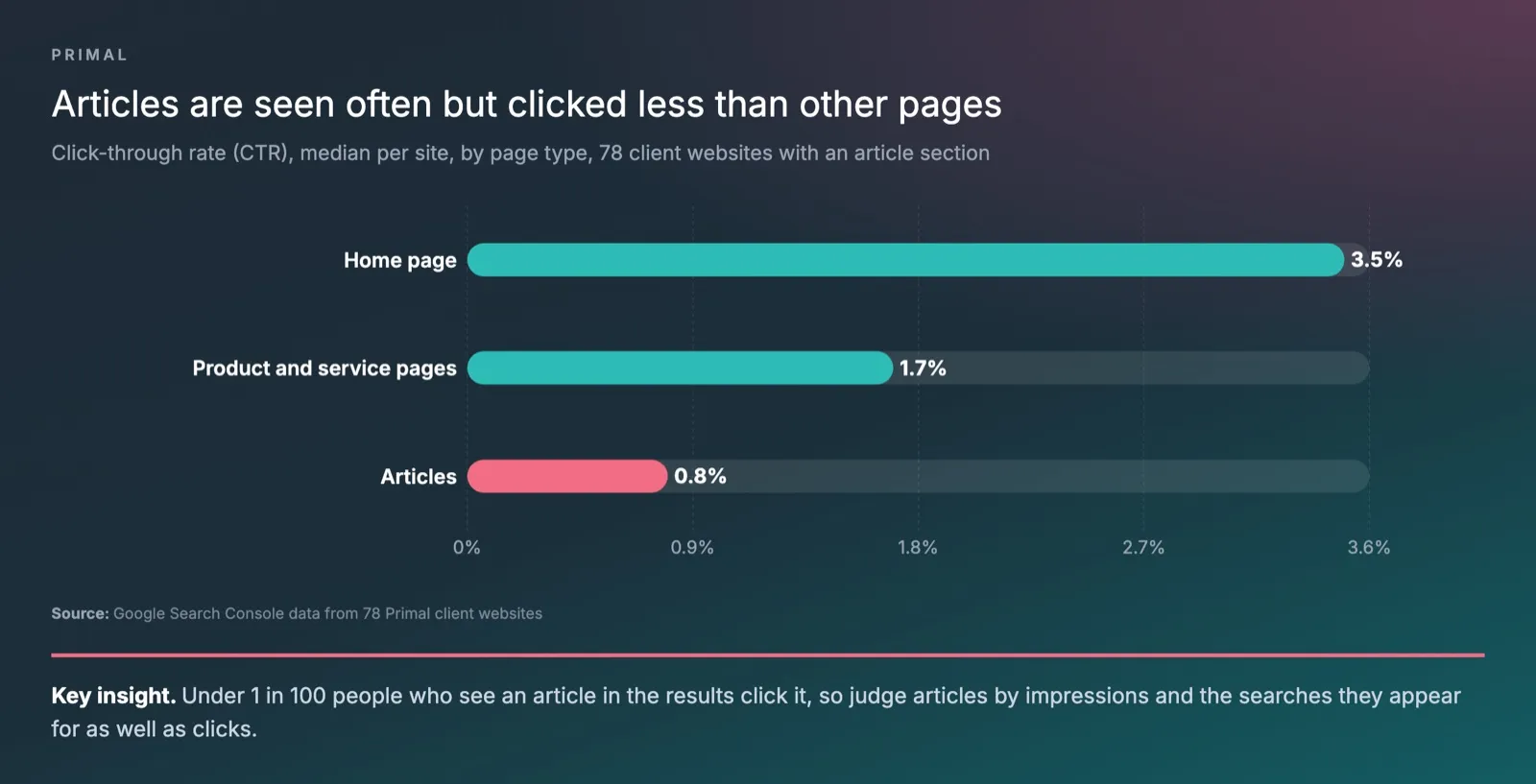
So a new article whose impressions grow each month is working, even while its clicks stay low. Google’s help page for the Performance report explains how the data is grouped by query and by page. Pick an article’s page, then open the queries tab to see every search it appeared for. The table sums up the measures most teams use, where to find each one and what it tells you.
| Measure | Where to find it | What it tells you |
|---|---|---|
| Impressions | Google Search Console | How many times the article appeared in search results |
| Queries per page | Google Search Console | How many different questions the article answers, and which ones are growing |
| Clicks and CTR | Google Search Console | How well the title and description on the results page earn a click |
| CTA clicks and form sends | GA4 | Whether the article leads people to get in touch |
| Citations in AI answers | An AI answer tracking tool | Whether ChatGPT and AI Overviews use the article in their answers |
How Content Marketing Helps A Brand Get Cited In AI Answers
Content marketing gets a brand cited in AI answers when its content answers a question in the first sentence. The content also has to sit where AI tools read.
Google’s page on AI features and your website explains what AI Overviews and AI Mode need. To appear there as a supporting link, a page must be indexed and able to show in Google Search with a snippet. Google adds that there are no other technical requirements.
A brand’s own website is only one of the sources AI uses. Over 30 days, Elevate, Primal’s AI Visibility Tracker, logged 285,098 AI answers about 171 brands. A brand’s own website was cited in only about 1 in 5 of them. Facebook was among the 15 sites cited most for 161 of the 171 brands. YouTube was on that list for 88 brands, and Pantip, a Thai web forum, for 48. A brand can act on this in 4 ways.
- Write headings as the questions people really ask, and answer each one in the first sentence under it.
- Add comparison tables, such as the pros and cons of each option. In Primal’s work, comparison content is one of the formats AI cites most often.
- Make YouTube videos and Facebook posts that answer the same questions as your articles.
- Use the words people really search with, in Thai and in English.
In this video, Mark McDowell, Primal’s founder and chief executive, explains how to get a brand mentioned in ChatGPT’s answers.
Our Bangkok team plans and writes articles, guides and service pages in Thai and English. Each one starts from what your customers search for. If you want a team to do this work, see our content marketing services.
Frequently Asked Questions About Content Marketing
What Does A Content Marketer Do
A content marketer plans what content a brand makes and measures what it brings in. They choose which questions to answer, what types of content to make and where to publish them. Content creators or key opinion leaders (KOL) may make some of the pieces. The content marketer still decides what the plan covers and how it is measured.
How Content Marketing Differs From Copywriting And Content Writing
Copywriting is writing that asks people to act now, such as ad text or the words on a button. Content writing is producing the articles, scripts and posts themselves. Content marketing is the plan that decides what that writing covers, where it goes and how it is measured. It uses copywriting in a few places, such as headlines and CTAs.
Customers Often Ask Us How Long Content Marketing Takes To Work
Updates to articles that already rank can change their positions within weeks. New articles for competitive searches usually take several months. In Primal’s work, the first month usually goes to planning topics and fixing the site’s basics. Impressions rise first, then clicks and enquiries follow.
Customers Often Ask Us Whether Google Penalises Content Written With AI
Content written with help from AI can rank when it answers the question well and its facts are right. Google’s guidance on generative AI content says AI can help with research and structure.
It also warns against using AI to make many pages that add no value for users. That may break its spam policy on scaled content abuse. And it notes that these models predict likely words rather than look up facts, so a person needs to check every fact. At Primal, a person plans the topic and INSTINCT® helps draft it. A specialist then checks the facts, headings and links before the client approves it.
Customers Often Ask Us Whether A Blog Still Works Or An FAQ Page Is Enough
Both are useful, because they answer people at different times. An FAQ section on a service page answers people who are already choosing a supplier. Articles answer the broader questions that come earlier.
In the data above, almost every click to an article came from someone who did not search for the brand. In Primal’s work, articles are also the main way brands get cited in ChatGPT, Perplexity and Google AI Overviews.
Customers Often Ask Us Whether To Write In Thai Or English
Write in the language your customers use to search for that topic. Many people in Thailand type English words into Thai searches. One example is content marketing คือ, which means “what is content marketing”.
In Ahrefs’ keyword data for Thailand, the English term “content marketing” gets about 1,100 searches a month. The Thai word การตลาดเชิงเนื้อหา gets about 10. So check the real searches in each language before you write. Our Bangkok team researches the keywords for each language on its own. It writes in both when customers search in both.
Founder and Chief Executive Officer
Mark McDowell is the Founder and Chief Executive Officer of Primal, which he started in Bangkok in 2015. He is on the Forbes 30 Under 30 Asia 2020 list and was Campaign Asia’s Southeast Asia Young Achiever of the Year in 2018. He writes about AI search and search engine optimisation.
About The Author