
By Mark McDowellPosted: Updated: 14 min read
First published by Sitvisut Anantnakarakul, 2021-02-10. Updated by Mark McDowell on 2026-10-20.
What Is Digital Marketing And How To Start
Digital marketing is marketing through digital channels, such as Google, artificial intelligence (AI) assistants like ChatGPT, social media, LINE, websites and email, so customers find a brand, choose it and buy again, with each step measured. Online marketing is the part that runs on the internet. Digital marketing is the wider term, as it also covers text messages and digital billboards.
Key Takeaways
- Digital marketing is wider than online marketing, because it also covers digital channels that need no internet connection, such as text messages and digital billboards.
- The Digital Advertising Association (Thailand) and Kantar forecast about 32 billion baht of digital ad spend in Thailand in 2026, with 25% going to Meta and 24% to TikTok.
- In a study Primal presented at Marketing Oops Summit 2026, covering more than 1.1 million AI citations about 128 brands, about 8 in 10 sources were third-party websites and only about 4 in 100 were the brand's own site.
- Across 995 keywords in Primal's rank-tracking data for 17 client brands, Google showed an AI Overview on 860 of the results pages, nearly 9 in 10.
- Thailand's Personal Data Protection Act requires consent before or when personal data is collected, unless the law allows otherwise, so lead forms and customer lists need a clear consent step.
What Is Digital Marketing
Digital marketing is marketing through digital channels. These include Google search, answers from AI assistants, social media, LINE, websites, email and text messages. The aim is for customers to find a brand, choose it, buy and come back. Each step can be measured, so you can see what each baht of spend brought in.
Almost every buyer in Thailand uses these channels. DataReportal’s 2026 report on Thailand puts internet users at almost 68 million. That is about 95% of the population.
What has changed is where buyers meet a brand. When AI answers a question about a brand, it cites other people’s sites far more often than the brand’s own. A study Primal presented at Marketing Oops Summit 2026 looked at AI answers about 128 brands. About 8 in 10 of the sources cited were third-party websites. The brand’s own website made up only about 4 in 100.
So digital marketing today is the work of being found and chosen everywhere buyers look. It covers 3 kinds of media. Owned media is the channels a brand runs itself, such as its website and LINE account. Paid media is the ads it buys. Earned media is the reviews, forums and articles where other people mention the brand.
What Digital Marketing Does For A Business
Digital marketing does 4 jobs, in the order a customer decides. Each channel is better at some jobs than others. So choose channels by the job you need done first.
- Get found (awareness). Social media ads, short videos and a place in search results show the brand to people who do not know it yet.
- Get chosen (consideration). Content that answers buyers’ questions, reviews and clear web pages help people compare.
- Turn interest into a lead or an order (conversion). Search ads and LINE chats do this job. So does a landing page, which is a page made to collect enquiries. Ads shown again to past visitors, called retargeting, help too.
- Bring customers back (retention). A LINE Official Account (LINE OA) and email do this job. So does a customer relationship management (CRM) system, which keeps each customer’s purchase history.
A business people already search for, such as a dental clinic or a car repair garage, can start with job 3. A new product that nobody knows yet has to start with job 1.
How Digital Marketing Differs From Online Marketing
Online marketing is marketing on channels that need the internet, such as websites, Google, social media, LINE and email. Digital marketing is the wider term, so online marketing is one part of it.
Digital marketing also covers digital channels that work without the internet. Examples are text messages (SMS), digital billboards and apps that run offline.
Primal’s diagram below shows the split. Online channels sit on the left, and digital channels that work off the internet sit on the right. The mobile app sits between them, because an app can work either way.
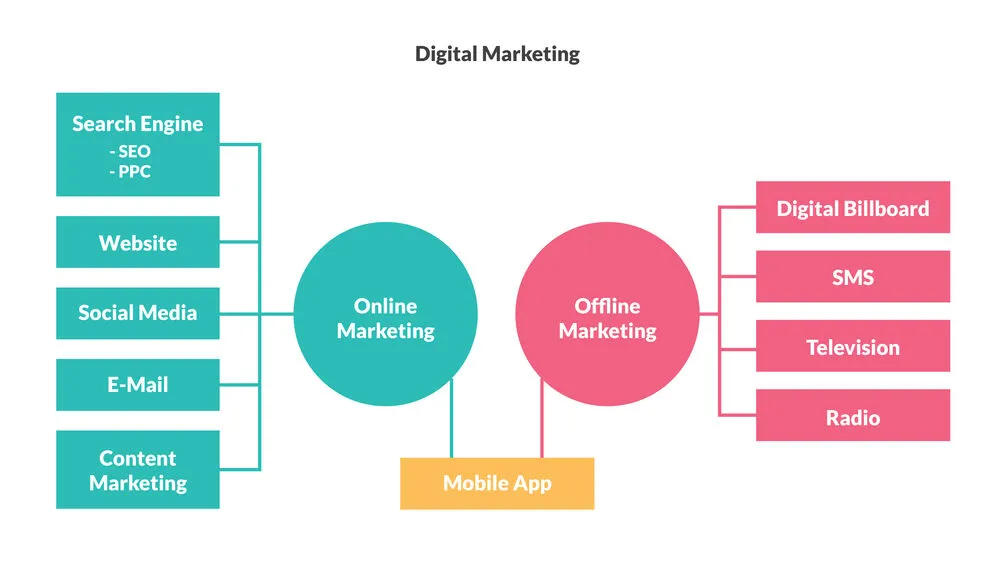
In practice, most digital marketing runs online, so people use the terms as if they mean the same thing. The difference matters for SMS and digital screens. You measure those in a different way from online ads.
How Digital Marketing Differs From Traditional Marketing
Traditional marketing buys space in advance and shows one message to everyone who passes. Billboards, newspaper ads and flyers work this way. Digital marketing lets you choose who sees the message, change it while it runs, and measure what it brought in. The table compares them point by point.
| Traditional marketing | Digital marketing | |
|---|---|---|
| How you buy | Book space or airtime ahead and pay in one sum | Pay per view, per click or per result, and start small |
| Who sees it | Everyone who passes the media | People chosen by interest, age, area or search term |
| Changing a campaign | Wait for the next booking | Pause, edit or add budget the same day |
| Measuring | Estimate how many people saw it | See the clicks, leads and orders from each ad |
| Talking with customers | One way | Customers reply in comments and chat |
Both work well together, most of all for a business with a shop, a restaurant or a hotel that people visit. A sign with a quick response (QR) code that adds the brand’s LINE account is a common example.
The Main Types Of Digital Marketing
Digital marketing has 5 main types. They are search, social media and video, LINE, content and influencers, and email, SMS and CRM.
Nearly half of Thailand’s digital ad spend in 2026 is forecast to go to Meta and TikTok. Thairath reported the 2026 forecast from Kantar and the Digital Advertising Association (Thailand), or DAAT. They expect about 32 billion baht of digital ad spend, with 25% going to Meta and 24% to TikTok.
The table shows what each channel does well, how you pay for it and when results start to show.
| Channel | What it does well | How you pay | When results show |
|---|---|---|---|
| Search engine optimisation (SEO) | Brings people to your site when they search on Google or ask AI | A team or a monthly fee, with no charge per click | After several months, and the results do not stop the day the work stops |
| Google Ads | Reaches people who are searching for the product now | Per click | From the day the ads run |
| Facebook, Instagram, TikTok, YouTube | Shows the product to people who do not know the brand, and shows it again to people who showed interest | Per 1,000 views or per result | Within days |
| LINE OA and LINE Ads | Talks with customers and sends news to people who added the account | A monthly package by message volume, plus ad spend | As soon as messages reach the people who added you |
| Content | Answers buyers’ questions and feeds SEO and social media | Writing and production fees | Grows piece by piece |
| Influencers and key opinion leaders (KOLs) | Has people your buyers trust talk about the brand | Per post or video, or a commission on each order | From the day the post goes out |
| Email, SMS and CRM | Brings past customers back | A monthly system fee and a cost per message | As soon as you send |
Search Engine Optimisation And Google Ads
Search is the channel where customers tell you what they want. SEO gets your pages into Google’s results without paying for each click. Google Ads buys a place on the same page, and you pay when someone clicks. Many businesses run both. Ads bring quick results, and SEO lowers the cost of each new customer over time.
Social Media And Video
Facebook, Instagram, TikTok and YouTube are where customers meet brands without searching. Social media work has 2 parts. One is posts and videos on the brand’s own pages. The other is ads aimed at people by interest, age and area. Ads on Meta’s apps run through Facebook advertising, and ads on TikTok through TikTok Ads.
LINE
Businesses in Thailand use a LINE OA to answer questions and take bookings and orders. They also send news to customers who have added the account. LINE Ads find new people to add the account and show ads in LINE’s chat list and news pages. Someone who messages a brand on LINE to ask a price is closer to buying than someone who likes a post. So many brands run ads on other channels that ask people to message them on LINE.
Content And Influencer Marketing
Content marketing is articles, videos and posts that answer customers’ questions before they buy. One piece can serve several channels. An article on your site helps SEO, and one video can go on both TikTok and YouTube. Influencer marketing pays people your buyers trust to review the product. A brand pays per post. Or it pays a commission when someone buys through the creator’s link, which is called affiliate marketing.
Email, SMS And CRM
Email and SMS reach customers who have already given you their contact details. Each message costs little, and both work well for offers and reminders to buy again. A CRM system keeps each customer’s purchase history. So the brand can send messages that match what each person bought before.
How To Collect Customer Data Under Thailand’s PDPA
A brand needs consent before it collects or uses a person’s data for marketing, unless the law says otherwise. Section 19 of the Personal Data Protection Act B.E. 2562 (2019), or PDPA, says consent must come before or at the time the data is collected.
The request must be explicit, in writing or by electronic means. It must also say what the data will be used for.
The same section says consent has to be the person’s own choice. A business may not make a contract depend on consent to use data the contract does not need. People can withdraw consent at any time, and withdrawing must be as easy as giving it.
This covers lead forms, email lists, phone numbers for SMS and any data you load into a CRM. A form that follows the Act keeps the consent box for marketing news apart from the contact fields. Leave that box unticked, and say how the data will be used.
Customers Often Ask Us How These Channels Link Back To The Website
Every channel leads customers to the same place, a page or a LINE account where they can contact you or buy. A TikTok video makes people aware of the brand. Some of them search for the brand on Google later and find its site through SEO. People who visit the site but do not buy then see its ads again on Facebook, and some come back to send a message.
You can only measure this path if the tracking is in place before the ads start. That means Google Analytics 4 (GA4) and the Meta Pixel on the site. It also means a tag on every ad link that records where the visit came from. This tag is called an Urchin Tracking Module (UTM) code. Then you can see which channel each lead came from, and which channels helped before the customer decided.
How AI Is Changing Digital Marketing
AI now gives customers an answer before they see any links. Google shows an AI Overview, a short summary written by AI, at the top of many results pages. Some buyers ask ChatGPT or Gemini before they choose.
Primal’s rank-tracking data holds 995 keywords tracked for 17 client brands. On its latest check, Google showed an AI Overview on 860 of those results pages, nearly 9 in 10.
The sites AI cites are mostly not the brand’s own. The chart below comes from the study Primal presented at Marketing Oops Summit 2026. It covered more than 1.1 million AI citations about 128 brands over 90 days.
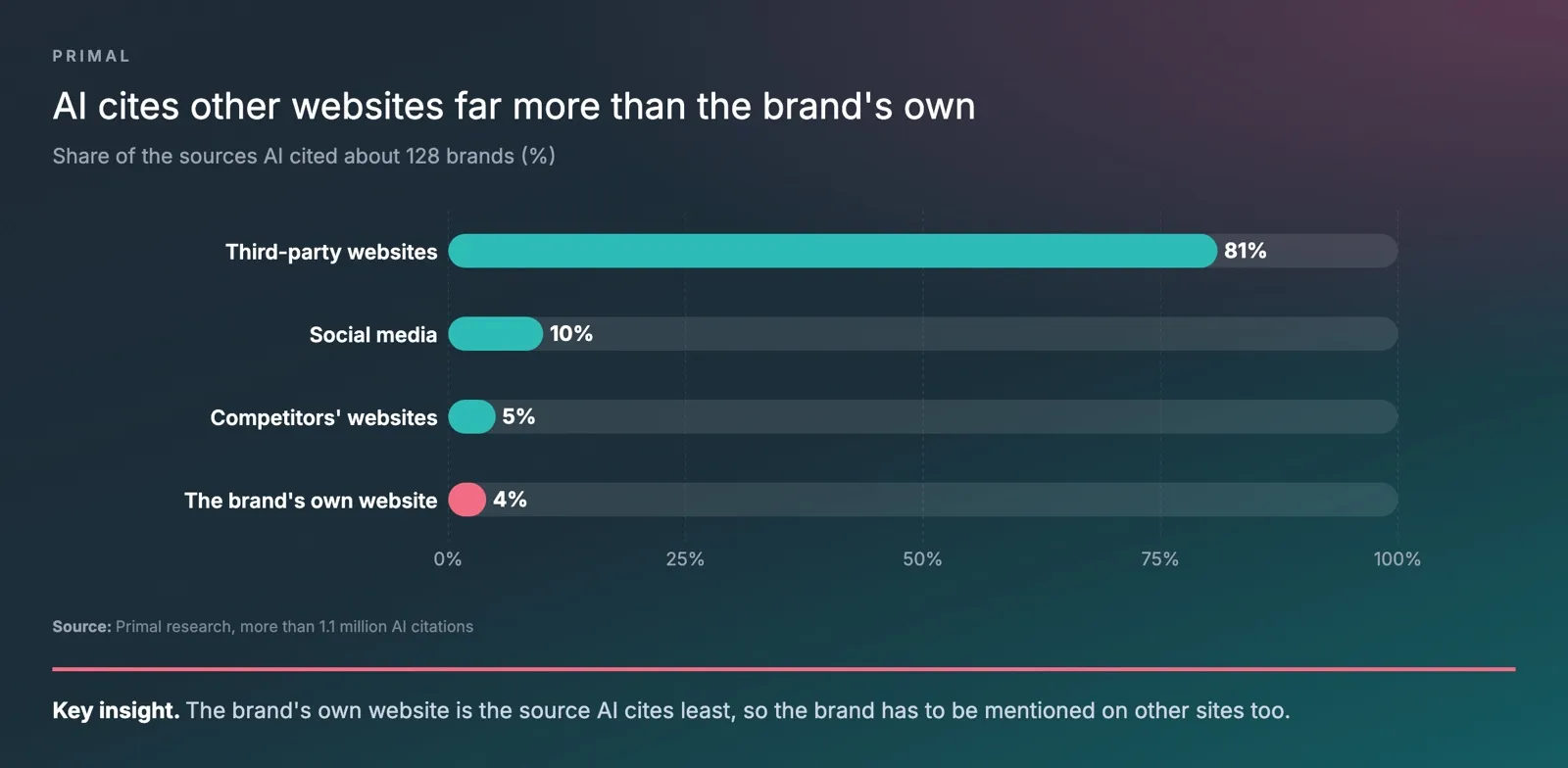
Social media made up about 1 in 10 of the sources, and competitors’ websites about 5 in 100.
The same study lists sources AI uses often, such as YouTube, Facebook, Reddit, Pantip, Wongnai and Wikipedia. So part of the work now is getting the brand mentioned on those sites. It also needs pages that answer the buyer’s question in their first sentence. That work is AI SEO, and our post on what AI search is explains how the answers are put together.
SEO is still the base of this work. Google Search Central says a page can appear as a link in AI Overviews if it is indexed. It must also be able to show a snippet in Google Search. In the video below, Primal’s founder and chief executive, Mark McDowell, looks at whether SEO still works when AI answers first.
A video from Mark McDowell’s YouTube channel on what the data says about SEO in 2026.
How Digital Marketing Is Paid For
Digital marketing has 2 costs. One is the media spend you pay the platforms. The other is the fee for the people who plan the work, make the content and run the campaigns. Keep them apart when you compare quotes.
Posting on your own page costs nothing. Reaching people beyond it means paying for ads, as offline marketing does. These are the common ways to pay.
- Cost per click (CPC). You pay when someone clicks the ad. Google Ads works mainly this way.
- Cost per thousand impressions (CPM). You pay each time the ad is shown 1,000 times. Social media and video ads are often bought this way.
- Cost per action (CPA). The platform charges when the result you chose happens, such as an app install.
- Commission. You pay an influencer or partner when a purchase comes through their link.
- Monthly fees. LINE OA packages, email tools and CRM systems charge by the month.
Click and view prices come from an auction. The more brands bid for the same audience, the higher the price. So prices vary widely by industry, season and audience. Work fees vary with the number of channels and the amount of content made each month.
How To Measure Digital Marketing
Measure each channel by the job it does. Likes show that people saw a post and liked it, and little more. The numbers that guide decisions tie back to the 4 jobs above.
| Job | Measures | What good looks like |
|---|---|---|
| Get found | Reach, impressions, CPM | More of the right people see the brand at a price you accept |
| Get chosen | Click-through rate (CTR), visits from search (organic traffic) | People click and keep reading |
| Leads and orders | Cost per lead (CPL), conversion rate, return on ad spend (ROAS) | Each lead or order costs less than the profit one customer brings |
| Bring customers back | Repeat purchase rate, spend per customer over time | Past customers spend more with no new ad spend |
Customers Often Ask Us How To Tell Whether The Budget Is Working
Compare each channel’s cost per result with the profit one customer brings. If a lead costs more than it earns you, that channel is losing money.
Industry averages are only a rough guide. Prices and close rates differ a lot from one business to the next. The figures to act on are the ones from your own ad accounts, checked every month.
Digital Marketing Terms You Will Meet
These terms come up in campaign reports and agency quotes.
- Search engine marketing (SEM). Marketing on search results pages, usually paid search ads. Some people include SEO in it.
- Pay-per-click (PPC). Ads you pay for only when someone clicks.
- Impressions. How many times an ad or post was shown on a screen.
- Reach. How many people saw an ad or post at least once.
- CTR. The share of people who clicked, out of those who saw the ad.
- Conversion. The action the business wants, such as a form sent, a chat started or an order placed.
- Conversion rate. The share of visitors who convert.
- CPL. Ad spend divided by the number of leads.
- ROAS. Revenue from ads divided by ad spend.
- Return on investment (ROI). Profit compared with everything spent, media and fees together.
- Organic. Results you did not pay for per click or view, such as visits from the normal search results.
- Key performance indicator (KPI). A number agreed in advance to judge success.
How To Start Digital Marketing In 5 Steps
Start with a goal you can measure, then pick the fewest channels that can reach it. These are the 5 steps.
- Set a goal in numbers. For example, leads a month or online orders, and the cost per lead or order the business can afford.
- Find where customers look. Check what they search on Google, what they ask in LINE chats and what AI tells them about products like yours.
- Get the website and tracking ready before you buy ads. Pages should load fast on a phone and answer questions clearly. Install GA4 and the Meta Pixel, and use forms that ask for consent under the PDPA.
- Start with 1 or 2 channels that fit the goal. Google Ads suits people who are already searching. TikTok suits a product that people need to see first.
- Review the numbers every month. Shift budget to the channels with the lower cost per result. Add the next channel once the first gives steady results.
For a luxury travel brand that started with us this year, I set the first goal as a few bookings, enough to show the client that the work does its job. Ranking on Google for its terms was going to be competitive and hard, while appearing in ChatGPT’s answers could come more easily. If I were looking for travel ideas, I would go to AI, so the plan measures the result as Google rankings or AI visibility.
To set the plan these steps sit in, read our guide to marketing strategy, which takes the decisions in order.
Primal is a marketing agency with about 150 people. We have 3 offices, in Bangkok, Kuala Lumpur and Singapore. Our digital marketing services plan SEO, AI search, Google Ads, Meta, TikTok and LINE together. One team runs them from our Bangkok office.
Frequently Asked Questions About Digital Marketing
What Is E-Marketing
E-marketing is short for electronic marketing. It means marketing through the internet and other electronic media. In practice, e-marketing, online marketing and internet marketing mean the same work.
Digital marketing is the widest term. It also covers digital media that run without the internet.
Customers Often Ask Us How Much Ad Spend To Set
Start from the result you need and work back. The number of leads you want each month, times the cost per lead you expect, gives the minimum media budget. Take that cost per lead from your past ad accounts, or from a test in the first 1 to 2 months. This media budget is separate from any agency fee.
Should You Run Digital Marketing In-House Or Hire An Agency
In-house works when a business uses 1 or 2 channels and has someone with time to check the numbers each week. An agency suits a business that runs several channels at once or needs a lot of content each month. It also brings people who see data from many brands in the same category.
Many businesses split the work. The in-house team runs the page and the chats, and the agency runs the ads and SEO.
What Does A Digital Marketer Do
A digital marketer plans the channels, buys the ads, looks after content and social media, and reports the results. In a company, digital marketing is both a team and a job title. Job titles you will see include SEO specialist, ads specialist and content creator.
How Long Digital Marketing Takes To Show Results
It depends on the channel. Paid ads bring clicks and leads from the day they run, though costs often swing in the first week while the platform learns who responds. SEO and content take several months, and their results do not stop the day you stop paying. Most plans use ads for results now and SEO for results later.
Founder and Chief Executive Officer
Mark McDowell is the Founder and Chief Executive Officer of Primal, which he started in Bangkok in 2015. He is on the Forbes 30 Under 30 Asia 2020 list and was Campaign Asia’s Southeast Asia Young Achiever of the Year in 2018. He writes about AI search and search engine optimisation.
About The Author