

By Pimlapat PhansuathongPosted: Updated: 14 min read
What Is Lead Generation And How To Measure Leads
Lead generation is marketing that gets people who are interested in a product or service to leave a way to reach them, such as a form, a LINE message or a phone call, so the business can follow up and win them as customers. Before you start, agree with the team that closes deals which actions are leads, and judge the work by the leads that team confirms as a fit.
Key Takeaways
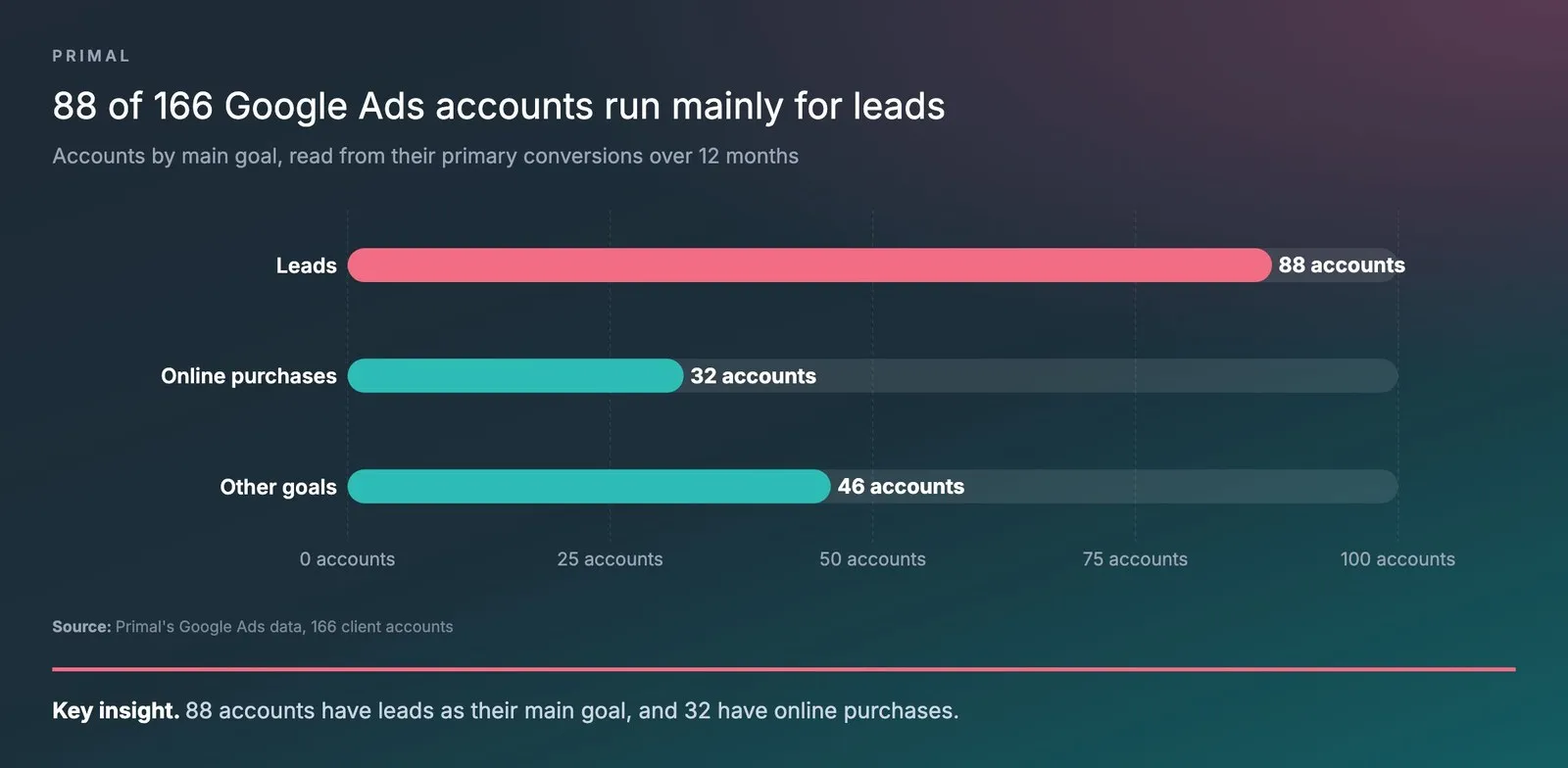
- Of the 166 Google Ads accounts Primal manages, 88 ran mainly for leads in the 12 months to 2026-09-30, against 32 that ran mainly for online purchases.
- In 54 of those 88 lead accounts, more than half of the recorded leads were contact actions, mostly presses on a chat or call button, and the ad account cannot see whether a conversation followed.
- In 39 accounts that record both forms and other contact actions, the total number of leads was about 5 times the number of forms on the middle account, so a cost per lead means little until you know what it includes.
- Meta no longer lets a new campaign use its qualified-lead goal without a Conversions API connection, and Google Ads takes back the leads that became customers through enhanced conversions for leads.
- Thailand's Personal Data Protection Act asks a lead form to state why it collects the data and to keep the consent request clearly apart from other text.
What Is Lead Generation
Lead generation is the marketing work that gets interested people to leave a way for a business to reach them. A person might send a form, message the business on LINE or call. The business then follows up until that person buys. Firms that sell homes, clinic care, courses or goods to other firms often rely on it.
Of the 166 Google Ads accounts Primal manages, 88 ran mainly for leads in the 12 months to 2026-09-30, against 32 that ran mainly for online purchases. In those lead accounts, most recorded leads were contact actions, such as a press on a chat or call button. A form with a name and a phone number was the smaller part. So lead generation starts by agreeing what a lead is for your business. Then judge the work by the leads your closing team confirms as a fit.
The chart below splits the 166 accounts by their main goal. The goal is read from the conversions each account set as primary over 12 months.
What Is A Lead
A lead is a person who has shown interest in a product or service and given the business a way to contact them. That can be a name, a phone number, an email address or a LINE account. Someone who likes a post but leaves no contact details is not a lead yet, because the business cannot reach them.
So every lead has two parts. The first is the interest they showed, such as asking for a price or a brochure. The second is the contact detail they left.
How A Lead Differs From A Prospect
A lead is anyone who got in touch or left their details. A prospect is a lead the business has checked and found to fit. A prospect has a budget, a real need and a say in the purchase. So not every lead is a prospect.
Many firms add a step between the two, called a marketing qualified lead (MQL). An MQL is a lead that passes the marketing team’s tests before it goes to the people who close deals. A common set of tests is budget, authority, need and timing (BANT). Write the tests with both teams, because the people who close deals know which leads turn into orders.
Lead Generation Versus Lead Nurturing
Lead generation gets the contact details of an interested person. Lead nurturing looks after the leads who are not ready to buy, until they are ready to talk. You can nurture leads with LINE messages, emails and articles that answer their questions. Ads shown again to past visitors help too.
A business with a long buying cycle needs both. A home buyer or a company choosing a supplier may get in touch months before they decide.
Which Actions Ad Platforms Record As Leads
An ad platform records as a lead whatever action the business tells it to. Google Ads has several lead categories, such as a form sent, an appointment booked, a quote requested and a contact. Google defines the contact category as a call, text message, email, chat or other contact with the business. So a press on a chat button can be recorded the same way as a form.
We looked at what the 88 lead accounts Primal manages record as a lead. On the middle account, about 8 in 10 recorded leads were contact actions. In 54 of the 88 accounts, contact actions made up more than half of all leads. The names the accounts give these actions show that most are presses on a LINE, Messenger or call button on the website. The chart below shows how many accounts record each kind of action.
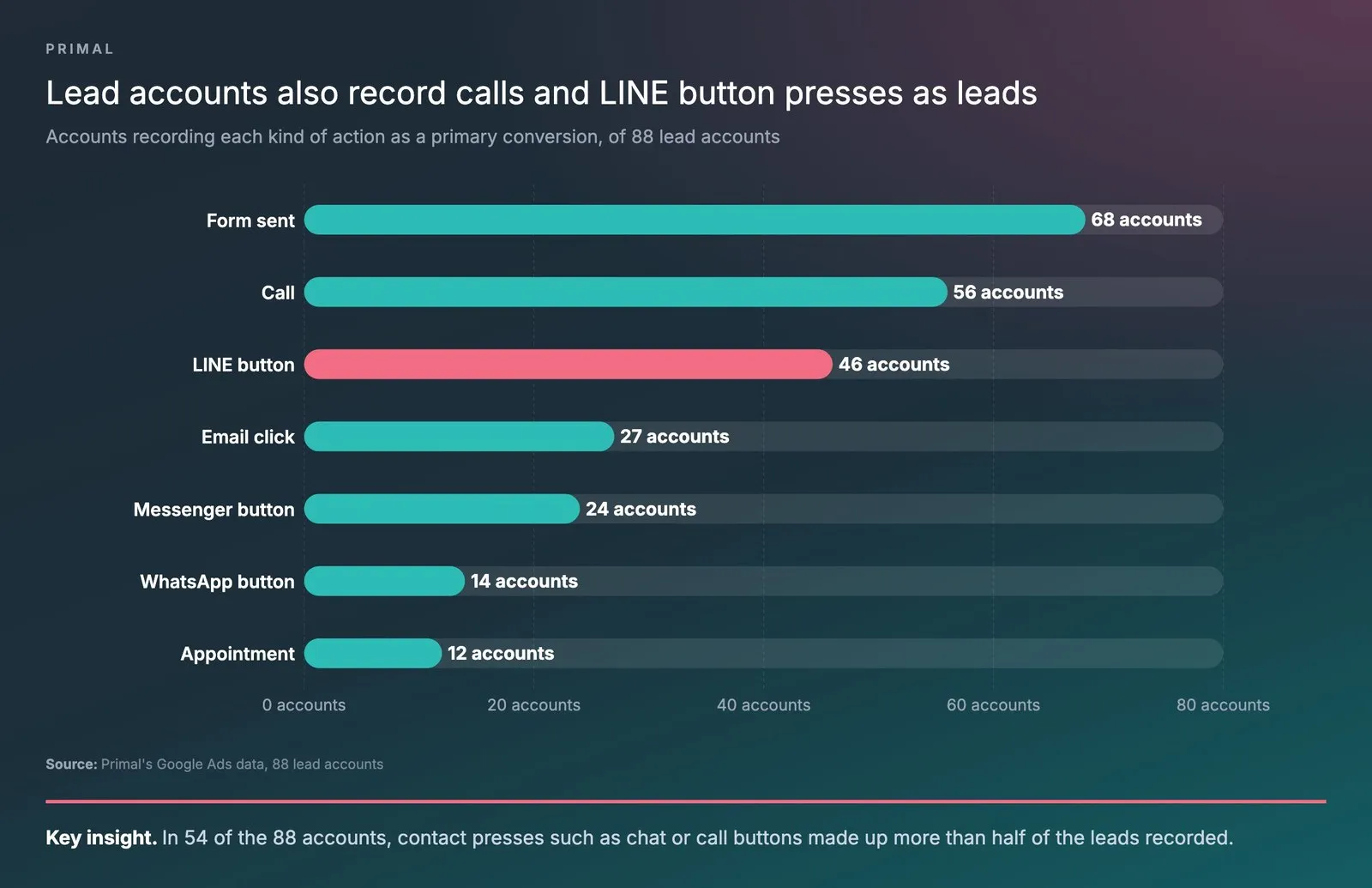
A press shows interest, but the ad account only sees the press. It cannot see whether the person added the business on LINE or sent a message. So the number of leads from presses is higher than the number of chats your team receives. Take the 39 accounts that record both forms and other lead actions. On the middle one, total leads came to about 5 times the number of forms.
This example uses made-up figures. A business spends 40,000 baht a month on ads. It gets 20 forms and 80 presses on its LINE or call buttons.
| What is recorded as a lead | Leads | Cost per lead |
|---|---|---|
| Forms only | 20 | 2,000 baht |
| Forms and contact button presses | 100 | 400 baht |
The same account and the same budget show two costs per lead, 5 times apart. So a cost per lead in a report needs to say what it includes. At Primal we agree what a qualified lead is with the client’s closing team before we add budget. Then we ask that team for the status of each lead, so we can see which channel brings leads they can close.
Mark McDowell, who founded Primal, found this gap in a software company’s Meta account this year. The account recorded sign-ups for a plan with no fee and requests for a paid demo as the same kind of lead, so its cost per lead looked low while the leads that could bring revenue cost far more. Our plan was to agree with the client’s team what a qualified lead is before setting targets, and to follow each lead from the ad click to the booked demo, beyond the form fill. Getting the most leads at the lowest cost per lead is only the first step. The aim is to see which ads bring paying customers, and that needs the client’s own customer data.
Which Channels Bring Leads In Thailand
Lead generation works on any channel where people find a business and can get in touch. In Thailand the main ones are Google ads, Meta ads on Facebook and Instagram, and LINE Official Account (LINE OA). Pages people find through search engine optimisation (SEO) bring leads too. Each channel brings a different kind of lead, and each platform records leads in its own way.
Two systems sit behind every channel. A customer relationship management (CRM) system holds each lead and where it stands. Google Analytics 4 (GA4) measures what people do on your website. Together they follow a lead from the first contact to the day it becomes an order.
| Channel | How people get in touch | What the platform records | What to set up |
|---|---|---|---|
| Google Search ads | A website form, a call or LINE button, or a form inside the ad | Forms sent and button presses set as conversions | Conversion tags and imports from the CRM |
| Meta ads | An instant form, a Messenger chat or a website form | Forms sent and chats started | The Meta Pixel and lead outcomes sent back from the CRM |
| LINE OA | A chat after someone adds the business as a friend | Friends added and chat messages | Chat tags and a note on each lead |
| SEO and articles | A form or contact button on the page | Key events in GA4 | A button or form on each article |
How Google’s Lead Form Works
Google’s lead form asset puts a form inside the ad. A person can send their email address or phone number without visiting your website. It works on Search and Performance Max campaigns, and you can turn on a one-time password (OTP) check.
Google keeps these leads for 60 days, and a download as a comma-separated values (CSV) file covers only the last 30 days. So send each lead to your CRM from the first day. Use an email alert, a webhook, Zapier or the Google Ads application programming interface (API). The form must also link to your privacy policy.
Few accounts use this form today. Lead forms in the ad brought leads in only 5 of the 166 accounts Primal manages in the 12 months to 2026-09-30. Most accounts send people to a page on the website and record the form or the button press there.
Facebook Lead Ads With An Instant Form Or A Website Form
An instant form suits a business that wants many leads from phones. A website form suits a business that wants people to read the details before they get in touch. Meta lead ads can send people to either one, from a campaign with the Leads objective.
Meta offers 3 instant form types. More volume is the default and is quick to fill in on a phone. Higher intent adds a line under the contact fields that says the business may follow up. It also adds a screen to check the details before sending. It shows only in the Facebook and Instagram feeds on phones. Rich creative lets you add images, brand colours and more text.
Primal sends a Leads campaign to a form on the website when the buyer needs details first, such as prices, the areas served or a product range. The Pixel then records each form on a page the business owns, and the closing team gets the same fields as from its other channels.
If you use an instant form, start with Higher intent and add the questions your closing team uses to sort leads. The steps to set up a campaign in Ads Manager are in our guide to Facebook ads.
How To Collect Leads On LINE
LINE OA collects leads through chat. A person presses a LINE button on your site or in an ad, adds the business as a friend, then types a question. LINE’s business site, which is in Thai, puts LINE at 56 million accounts in Thailand. Of the 88 lead accounts Primal manages, 46 record a LINE button press as a lead, against 14 for a WhatsApp button.
In LINE OA you can give each chat a tag, such as “new lead” or “quote sent”, and keep a note on each person. Notes need the OA Chat Package. Tags and notes let your team see how many chats were real leads.
We suggest you compare two numbers each week. The first is LINE button presses in the ad account. The second is new chats tagged as leads in LINE OA. If the gap is large, check the page and the greeting message before you add budget. LINE OA’s features and packages are in our guide to LINE Official Account.
How Long SEO And AI Search Take To Bring Leads
Leads from SEO and from artificial intelligence (AI) answers in search come later than leads from ads. A page has to rank, or be cited in the answer, before it brings anyone. For a term with many competing pages that often takes several months. Once a page ranks, the leads it brings carry no cost per click.
People who search with a question usually reach an article. Primal looked at 69 client sites for one week. On the middle site, article pages took about 9 in 10 of the impressions from question searches. For other searches that did not include the brand, articles took about 1 in 4. So each article needs a call to action or a form that fits its question.
In this video, Mark McDowell, Primal’s founder, explains how long it takes for AI search to bring a business leads.
What A Lead Generation Landing Page Needs
A lead generation landing page has one job, which is to get the visitor in touch. Its headline, offer and form all serve that job, and it leaves out links that take people away. The graphic below marks the 9 parts of such a page.
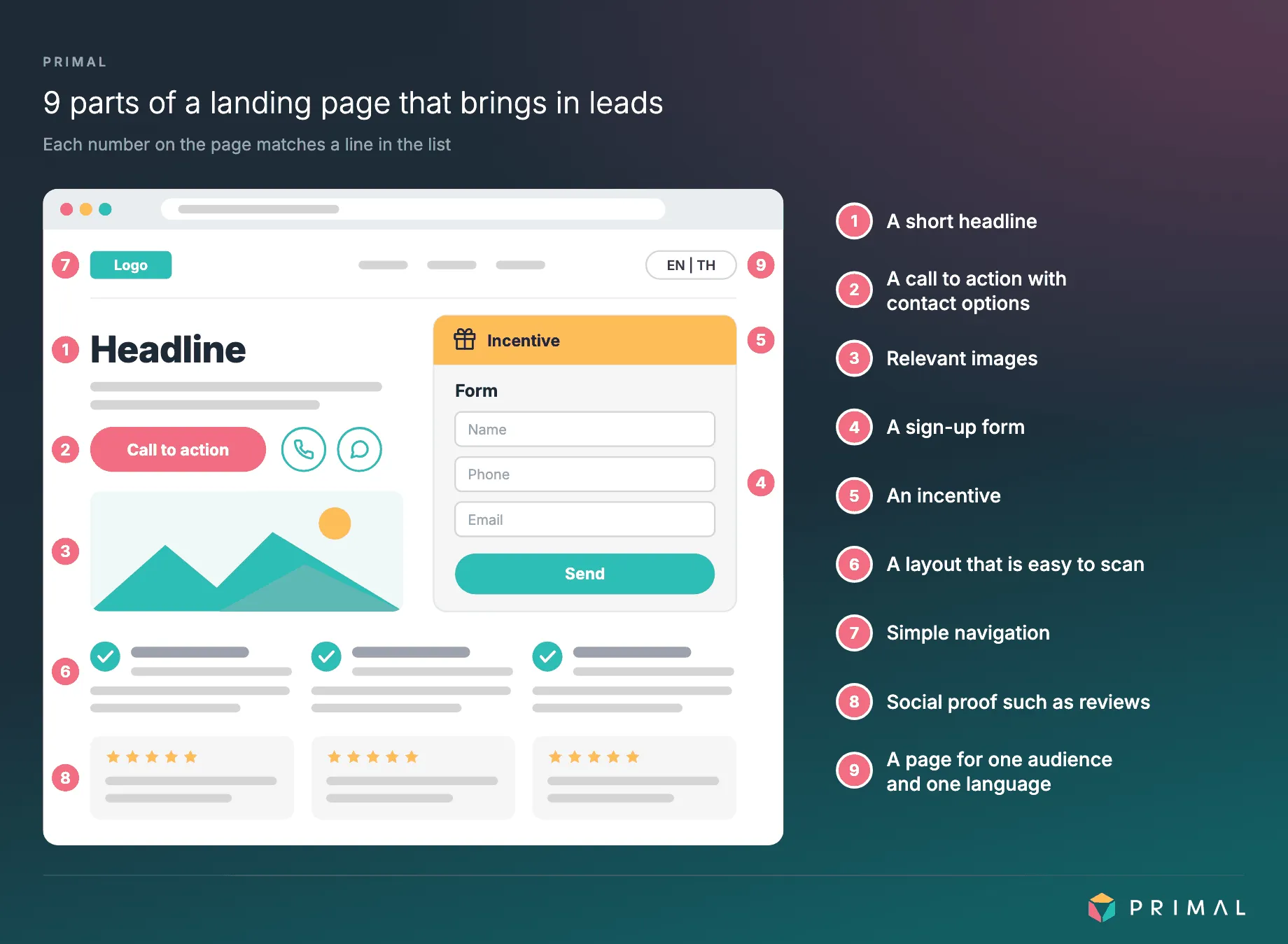
Ask only for the details your team will use to reply. Keep the phone number and the LINE button in view. Use the same words in the headline as in the ad that brought the visitor. An incentive such as a price list or a guide is called a lead magnet. Test one change at a time with an A/B test, which shows two versions of the page to two groups of visitors. Buyers in Thailand search in Thai and in English, so make one page for each language your buyers use.
Why You Get Many Leads But Few Customers
Many leads and few customers usually means the campaign is set to bring the largest number of leads. Meta explains that its goal for the number of leads shows ads to the people most likely to share their contact details. Its goal for qualified leads shows ads to the people most likely to become customers after they share them. So the goal you pick decides who sees the ad.
These are the 4 fixes we use.
- Add screening questions to the form. Ask about budget, area or when they plan to buy. People who do not fit often stop, and your team sees the answers before they call.
- Filter fake leads before they reach your team. Use the OTP check in Google’s form or Meta’s Higher intent form.
- Send lead outcomes back to the platforms. Google calls this enhanced conversions for leads. Your site sends Google a hashed copy of the email address or phone number from the form, a scrambled code that hides the real details. When a lead becomes a customer, you import the same hashed details from your CRM. Meta uses the Conversions API for CRM. A new campaign can no longer use Meta’s qualified-lead goal without it.
- Have your team record the status of every lead. For example, closed, not ready or not a fit. We use the list of closed leads to find people like them, and the not-ready list for ads shown again to past visitors.
Meta reports that instant-form lead ads using the Conversions API for CRM and the qualified-lead goal saw a 21% lower cost per quality lead. That is against ads set to get the most leads.
How To Measure Lead Generation
Measure lead generation with 4 numbers that follow on from each other. Start with the cost per lead, then the share of leads that fit, then the share that become customers. End with the cost per new customer, which is the number that decides the budget.
| Number | How to work it out | What it tells you |
|---|---|---|
| Cost per lead | Ad spend divided by leads | Which channel brings leads at a low cost |
| Share of leads that fit | Leads your team confirms, divided by all leads | The quality of the leads from each channel |
| Lead to customer rate | New customers divided by all leads | How well your team closes leads from each channel |
| Cost per new customer | Ad spend divided by new customers | Which channel should get more budget |
GA4 has a set of recommended events for leads that cover the whole path. Use generate_lead when someone sends a form or gives their details offline. Use qualify_lead when a lead passes your tests, and close_convert_lead when it becomes a customer. With the full set, you can see how far the leads from each channel get.
Lead numbers in Google Ads, Meta and GA4 rarely match, because each one gives credit in its own way. The reasons, and how to read them, are in our guide to conversion rate.
What Thailand’s PDPA Means For Lead Forms
A lead form collects personal data, so Thailand’s Personal Data Protection Act (PDPA) applies to it. Section 19 of the Act is in Thai. It says you need consent before or when you collect the data, unless a law says you may go ahead without it. The request has to state the purpose, stand clearly apart from other text and be easy to read.
In practice, a form should say what you will use the details for. It should link to your privacy policy. If you plan to send marketing messages, add a separate tick box for that. Google’s lead form already asks for that link. Have your own legal adviser check the wording before the form goes live.
How To Start Lead Generation
Start lead generation by agreeing what a lead is. Then pick the channels and set up the measurement. These are the 6 steps we use.
- Agree the definition with your closing team. Write down which actions are leads and which leads qualify, for example by budget, area, company size or when they plan to buy.
- Pick channels by how your buyers get in touch. If they search before they buy, start with Google Search. If they like to chat, add a LINE button and ads that open a chat.
- Make a landing page with a short form. Ask only for what your team uses, and state the purpose as the PDPA asks.
- Set up a separate conversion for each kind of lead. Keep forms, call presses and LINE presses apart. Then set the bidding to work on the kind your team can close.
- Send every lead to your CRM straight away. Ask your team to record the status of each one.
- Send outcomes back to Google and Meta, and review the budget each month. Shift budget to the channel with the lower cost per new customer.
For a team that plans this with you, from the lead definition to the cost of each new customer, see Primal’s lead generation services. About 150 people in our offices in Bangkok, Kuala Lumpur and Singapore plan search, advertising and AI search together.
Frequently Asked Questions About Lead Generation
What Does Lead Generation Mean
Lead generation means finding people who may buy and getting their contact details. A lead is a possible customer, and generation means creating more of them. People often shorten it to lead gen, which means the same thing.
Customers Often Ask Us What A Good Cost Per Lead Is
A good cost per lead depends on what one new customer is worth to you and how many leads your team closes. No single figure fits every business, because each account records leads in its own way. As a made-up example, say you can spend 10,000 baht to win one new customer and your team closes 1 in 10 leads. Then you can pay up to 1,000 baht per lead.
Customers Often Ask Us Whether Leads Arrive In The First Month
Google and Meta ads can bring leads in the first week, once the tracking and the landing page are ready. The cost per lead in the first month is not settled yet, because the bidding systems learn from campaign data first. So we set lead targets after about 4 weeks of real campaign data. Leads from SEO take several months.
Customers Often Ask Us How To Filter Out Fake Leads And Job Seekers
Add screening questions to the form, and turn on the OTP check or use Meta’s Higher intent form. In Search campaigns, add the Thai and English words for jobs and vacancies as negative keywords. Keep your careers page apart from your lead landing page. Then send the “not a fit” status back to the platform, so it stops looking for people like them.
How Lead Generation Differs From Demand Generation
Demand generation makes more people aware of a problem and of your brand before they look for a supplier. Lead generation collects contact details from people who already show interest. Demand work raises the number of people who know you, and lead generation asks some of them for a way to reach them.
What Is Lead Scoring
Lead scoring gives each lead points for its details and actions, so your team knows whom to call first. For example, a lead gets more points for a budget that fits or for asking for a quote. Start with the tests your closing team already uses, then adjust the points as you see which leads close.
Content Writer
Pimlapat Phansuathong is a Content Writer at Primal with over 6 years of writing experience. She writes search engine optimisation (SEO) content, from search intent and keyword research to the structure of each article. She joined Primal in 2022.
About The Author