

By Mark McDowellPosted: Updated: 12 min read
What Is Generative Engine Optimisation And How To Start
Generative engine optimisation (GEO) is the work of getting your brand mentioned, and your pages cited, in answers that artificial intelligence (AI) tools such as ChatGPT, Gemini and Google's AI Overviews write. It has two parts. One is a page with facts an AI can quote with their source, and the other is your brand on the other sites AI reads, which AI cites more often than the brand's own.
Key Takeaways
- The research paper that gave GEO its name tested 9 ways to rewrite a page and found that quotes, statistics and cited sources raised a page's share of AI answers most, while keyword stuffing did worse than no change.
- In 285, 098 AI answers about the categories of 171 brands, logged over the last month by Elevate, Primal's AI Visibility Tracker, a brand's own website was cited in only about 1 in 5.
- In the same data, the median brand owned just 1 of its 15 most-cited sources, so GEO includes reviews, articles, forums and profiles on other websites.
- Google's guide says that for Google Search, optimising for generative AI search is still search engine optimisation (SEO), because AI Overviews and AI Mode run on its core ranking systems and its Search index.
- Measure GEO on Google with the generative AI performance report in Search Console, and on ChatGPT and Gemini with the same set of questions asked every month.
What Is Generative Engine Optimisation
Generative engine optimisation (GEO) is the work of getting your brand mentioned, and your pages cited, in answers written by artificial intelligence (AI). ChatGPT, Gemini, Perplexity and Google’s AI Overviews all write answers this way. A generative engine searches several pages, then writes one new answer with links to some of them. A classic search engine gives you a list of links and lets you choose.
Data from Elevate, Primal’s AI Visibility Tracker, made me split this work in two. Over the last month, it logged 285,098 AI answers to questions in the categories of 171 brands. A brand’s own website was cited in only about 1 in 5 of them.
So the first job is a page with facts an AI can quote, along with their source. The second job is getting your brand onto the other sites AI reads in your category. Both jobs start from the questions your buyers really ask.
GEO overlaps with answer engine optimisation (AEO). AEO aims to have one page quoted as a short answer. GEO aims to put your brand inside an answer that AI writes from many pages.
What The Original GEO Research Found
The research that gave GEO its name found that quotes, statistics and cited sources made an AI use a page more. Keyword stuffing, a habit from old search engine optimisation (SEO), did worse than leaving the page alone. The term comes from a paper by Pranjal Aggarwal and 5 co-authors, including researchers at Princeton University and the Indian Institute of Technology Delhi. It was first posted in 2023.
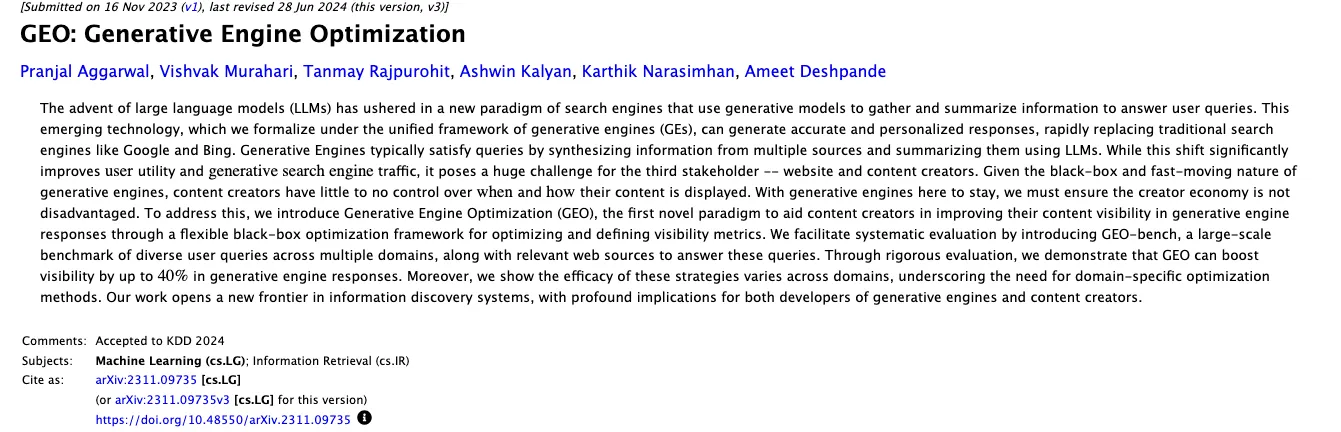
The paper’s page on arXiv, the open research archive, lists its authors and a summary of the work.
The team put together a set of 10,000 questions. For each one, they took the first 5 Google results and had a language model write an answer from those pages. Then they picked one of the pages at random and rewrote it in one of 9 ways. Last, they measured how much of the new answer came from that page, and how high up in the answer it sat.
These are the results that matter to a website owner.
- Quotes, statistics and cited sources gave the biggest lifts. Each raised the page’s share of the answer by about 30% to 40% on the paper’s main measure. Smoother wording also helped.
- A more persuasive, expert tone gave no clear gain.
- Keyword stuffing scored below the page with no edits at all.
- Pages lower down the results gained the most. When the page in 5th place cited its sources, its share of the answer more than doubled. The same edit cut the share of the page in 1st place.
- What worked depended on the topic. Statistics helped most on questions about law and government. Quotes helped most on questions about people, society and history.
- The team ran the test again on Perplexity, a live AI search tool. Quotes did best there too, and keyword stuffing again did worse than no change.
The table below turns the main methods into edits you can make to a business page.
| Method in the study | Result in the study | What to do on your page |
|---|---|---|
| Add quotes from credible sources | Among the biggest lifts | Quote your own director, doctor or engineer, with their real name and role |
| Add statistics | Among the biggest lifts | Use figures you measured, such as your average delivery time, with the period you measured |
| Cite sources | Among the biggest lifts | Link the government body, standard or maker’s document in the sentence that uses it |
| Smoother, easier wording | A smaller lift | Write short sentences, one idea each, and answer in the first sentence under each heading |
| A persuasive tone | No clear gain | Cut the promotional words and state the facts |
| Keyword stuffing | Worse than no change | Use a keyword only where the sentence needs it |
Every method in the study edits the text of one page. The other half of GEO happens on sites you do not own. AI answers cite those sites more often than the brand’s own.
Is GEO Different From SEO
For Google Search, GEO is SEO. Google’s guide to its generative AI features in Search has a short note on AEO and GEO. It says that from Google Search’s point of view, optimising for generative AI search is still SEO.
The note sits near the top of the guide, under its question on whether SEO still matters.

AI Overviews and AI Mode run on Google’s core ranking and quality systems, the guide explains. They pull pages from the Search index to write each answer. They also run several related searches at once, which Google calls query fan-out. So a page must be indexed and able to show a snippet before it can appear. The site must also be included in the generative AI setting in Search Console.
The guide also lists what Google Search does not need. You do not need an llms.txt file or special markup made for AI. You do not need to split pages into small chunks, or rewrite them just for AI. Seeking mentions that are not genuine does not help either. Structured data is not required, though Google still advises it for rich results. Our post on SEO vs AEO vs GEO sets that list against how Search works.
The guide and the paper agree on the main point. Google puts content that people find unique, compelling and useful first. The guide says it will likely do more for you in AI search than any other advice it gives. The paper found that quotes, statistics and sources worked best.
So GEO differs from SEO in what you measure and where you work. SEO measures rankings and clicks. GEO measures how often AI mentions and cites your brand, and it includes work on other websites. In Primal’s planning, about 80% of the work is SEO groundwork and about 20% is aimed at AI answers.
In this video on my YouTube channel, I go through what changes when people search with AI. I also cover which parts of the work are still plain SEO.
Which Sites AI Answers Cite About A Brand
AI answers cite other websites far more often than the brand’s own. In the same 285,098 answers, the single most-cited source was someone else’s site for 121 of the 171 brands. It was the brand’s own website for only 50.
I then looked at each brand’s 15 most-cited sources. For the median brand, 1 of the 15 was its own website, and the other 14 belonged to someone else. For 34 brands, their own site was not in the 15 at all.
The chart adds up those lists across all 171 brands and sorts each place by the type of site.
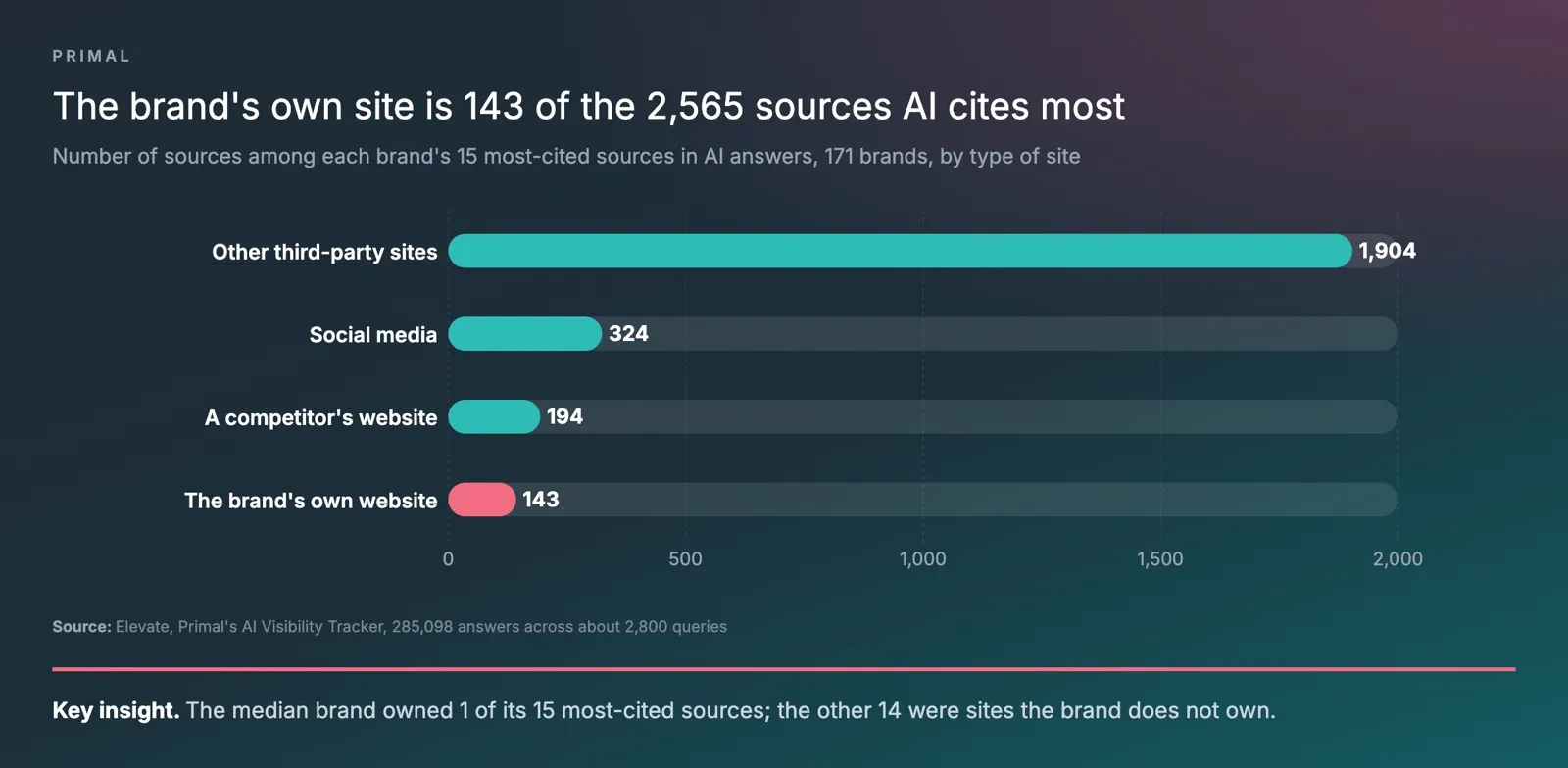
The third-party sites are publishers, review sites, forums such as Pantip, marketplaces and other businesses in the same category. The social sites cited most often were Facebook and YouTube. A competitor’s website was in the 15 for 103 brands.
So I never start GEO with the brand’s own site alone. If the answers in your category cite review sites and Pantip threads, your correct facts need to be there too.
How ChatGPT And Gemini Find Their Sources
ChatGPT and Gemini look for pages in different places. Gemini, AI Overviews and AI Mode use Google’s Search index. ChatGPT turns a question into search queries and sends them to the search providers it works with. OpenAI’s help page on ChatGPT search lists Microsoft among those providers.
OpenAI also reads sites with its own crawler, OAI-SearchBot. OpenAI’s crawler page says a site that blocks OAI-SearchBot will not be shown in ChatGPT search answers. So a high Google ranking helps more directly in Google’s AI than in ChatGPT.
The same brand can do well on one platform and poorly on another. I presented a study at Marketing Oops Summit 2026, and Marketing Oops reported what it found. A brand that stands out in Google’s AI can barely appear in ChatGPT. So I always check each platform on its own. Our posts on ChatGPT SEO and Gemini SEO cover how each one picks pages and which crawler settings matter.
How To Do GEO On Your Own Pages
GEO on your own pages has two parts. Search systems must be able to reach the page, and the page must hold facts an AI can quote with their source. The list below comes from the paper and Google’s guide.
- Check that your key pages are in Google’s index and that no setting blocks a snippet. OpenAI’s help page lists Microsoft, which runs Bing, among ChatGPT’s search providers, so check Bing’s index too.
- Answer the question in the first sentence under each heading. Keep sentences short, with one idea each.
- Add figures you measured yourself, with the period and the sample. Your average delivery time or the jobs you completed last year are good examples.
- Quote real people in your company with their name and role. Link each source in the sentence that uses it.
- Give your method or your dataset a name, and tie your brand to it. An AI may use what your page says without mentioning your brand. A method that carries your name gives the answer a reason to mention you.
- Add photos and videos of your products, premises or work. Google’s guide says its generative AI features can show relevant images and video.
Avoid making a separate page for every way a question can be asked. Google’s guide says doing that to manipulate its AI answers breaks its scaled content abuse spam policy.
What GEO Work Happens On Other Websites
GEO off your site means correct facts about your brand on the sites AI cites in your category. Google notes that its generative AI features can show what people say about products and services across the web, in blogs, videos and forum discussions.
Reviews And Business Listings
Google Business Profile and Merchant Center feeds help your products and services appear in AI answers and in other Search results, according to the same guide. Ask real customers for reviews on Google and on the review site for your category. That could be Wongnai for a restaurant or Tripadvisor for a hotel.
Articles On Other Websites
An article or news story about your brand puts your name on a page AI reads. If you pay for a placement, pick a site with real readers in your category. It should publish on your topic and have editors who choose what runs.
Forums And Communities
Pantip and Lemon8 were among the 15 most-cited sources for many brands in the same data. Answer questions there openly, as the brand, with facts a reader can check. Google warns that seeking mentions that are not genuine is not as helpful as it might seem.
Profiles On Other Platforms
Use the same name, address, phone number and services on your website, Facebook page, YouTube channel, marketplace shop and LinkedIn company page. When AI reads facts that clash, its answer about your opening hours or services can be wrong.
How To Start GEO In 6 Steps
Start with the questions buyers really ask, and see how AI answers them before you change a page.
- List 20 to 30 questions customers ask before they buy. Take them from the people who answer customer calls, your LINE chats and the People Also Ask box on Google.
- Ask each question in ChatGPT, Gemini and Google. Record the brands each answer mentions and the sites it cites.
- Sort the cited sites into the 4 types in the chart above. They are your own site, third-party sites, social media and competitors’ sites.
- Fix the pages that should answer those questions, using the list in the section on your own pages.
- Pick 3 to 5 third-party sites that are cited often but do not mention you. Correct your listing, ask for reviews or offer an article.
- Ask the same questions every month and compare the results with the month before.
The tracking sheet from step 2 needs these columns.
| Column | What to record |
|---|---|
| Question | The words a customer types, the same set every month |
| Platform and date | ChatGPT, Gemini, AI Overviews or AI Mode, and the day you asked |
| Your brand mentioned | Yes or no, and where it sits in the answer |
| Other brands mentioned | The competitors in the same answer |
| Sites cited | The domain of every link in the answer |
| Type of site | Yours, third-party, social media or competitor |
| Facts correct | Whether the prices, locations and services in the answer are true |
When we put an industrial label printer maker’s buyer questions through AI answers this year, YouTube was the site cited most. Resellers’ pages were cited more than most manufacturers’ own sites. So the brand’s product videos and its reseller listings became places to work on, because AI goes to those places for its citations. On the brand’s own site, the plan started with rewriting its industry pages for each buyer group, such as pharmaceutical, chemical and food firms, and then pages on how to choose, compare and print labels in-house.
How To Measure GEO
Measure GEO on Google with Search Console, and on the other platforms with a fixed set of questions asked again each month. Clicks alone are not enough, because AI can mention your brand without anyone visiting your site.
The generative AI performance report in Search Console shows how many times links to your site appeared in AI Overviews and AI Mode. You can split it by page, country, device and date. Use it to see which pages AI shows most, then compare them with the searches those pages rank for.
For ChatGPT, Gemini and Perplexity, use the tracking sheet from the steps above. I watch the share of answers that mention the brand and the sites they cite. I also watch which brands appear alongside it, and whether the facts are right.
AI answers change with the person, the day and the location. So one screenshot tells you little. Read the totals across many questions and many days. Keep the same question set too, or you cannot compare one month with the last.
Our team does this every day with Elevate, Primal’s AI Visibility Tracker. It asks each brand’s questions in ChatGPT, Gemini and Google AI Overviews. The team then plans the work on the site and off it from what the answers show. You can see the scope on our GEO service page.
Frequently Asked Questions About Generative Engine Optimisation
Customers Often Ask Us Whether GEO Is Different For Each AI Tool
The core work is the same for every tool. You need pages that answer questions with your own facts, and your brand on the sites AI reads. What differs is how each tool finds pages. Google’s AI features use Google’s index, while ChatGPT uses OpenAI’s search providers and its OAI-SearchBot crawler, so check each platform on its own.
Customers Often Ask Us Whether Reviews, Videos And Social Posts Change AI Answers
Yes, because AI cites them often. In the 285,098 answers logged by Elevate, Primal’s AI Visibility Tracker, Facebook was among the 15 most-cited sources for 161 of the 171 brands, and YouTube for 88. So the product names, prices and services in your posts, video descriptions and review replies should match your website.
Customers Often Ask Us Which Websites Should Carry Our Articles Or News
Start with the sites AI already cites when it answers questions in your category. Your tracking sheet shows them. A site that comes up across many questions should get your article or news first. Then check that it has real readers in your category and editors who choose what runs.
Can A Small Business Do GEO
Yes. The original GEO research found that pages lower in the search results gained more from its methods than the top result did. A small business can start with what it already has. That means figures from its own work, reviews from real customers and a Google Business Profile that matches its website.
Can You Use AI To Write Content For GEO
You can use AI to help with a draft, but the facts, figures and quotes must come from your business. Google’s guide says content made with the help of generative AI tools must meet its Search Essentials and spam policies. It also tells site owners not to recycle what a generative AI model could easily produce.
Founder and Chief Executive Officer
Mark McDowell is the Founder and Chief Executive Officer of Primal, which he started in Bangkok in 2015. He is on the Forbes 30 Under 30 Asia 2020 list and was Campaign Asia’s Southeast Asia Young Achiever of the Year in 2018. He writes about AI search and search engine optimisation.
About The Author