

By Panlert ChampakhomPosted: Updated: 10 min read
SEO Vs AEO Vs GEO, The Differences And Where To Start
Search engine optimisation (SEO) gets a page ranked in search results, answer engine optimisation (AEO) gets its words used as a short answer, and generative engine optimisation (GEO) gets a brand mentioned in answers that artificial intelligence (AI) writes from several pages. All three start with a page that search engines can reach and rank.
Key Takeaways
- SEO, AEO and GEO differ in where a brand appears, as a ranked link, a short answer quoted from one page, or an answer AI writes from several pages, and most of the work on the page is shared.
- Across 995 keywords in Primal's rank-tracking data for 17 client brands, Google showed an AI Overview on 859 results pages and People Also Ask on 646, so at least half carried both next to the ranked links.
- In 285, 098 AI answers about 171 brands logged over the last month by Elevate, Primal's AI Visibility Tracker, a brand's own website was cited in only about 1 in 5, so GEO includes work on other websites.
- Google's guide to its generative AI features says Google Search does not use llms.txt files and needs no special markup or chunked content, and Google no longer shows frequently asked question (FAQ) rich results.
- Search Console's generative AI performance report shows how often links to a site appear in AI Overviews and AI Mode, while ChatGPT, Gemini and Perplexity need a fixed set of buyer questions checked every month.
What SEO, AEO And GEO Mean
Search engine optimisation (SEO), answer engine optimisation (AEO) and generative engine optimisation (GEO) are three ways for your brand to be found when people search. SEO aims for a ranked link in the search results. AEO aims for a short answer quoted from your page, such as a featured snippet or a People Also Ask box. GEO aims for a mention or a citation in answers that artificial intelligence (AI) writes from several pages, such as AI Overviews and ChatGPT.
Primal’s data shows how closely the three sit together. Across 995 keywords in Primal’s rank-tracking data for 17 client brands, Google showed an AI Overview on 859 results pages and People Also Ask on 646. AI answers also cite many websites besides the brand’s own. Over the last month, Elevate, Primal’s AI Visibility Tracker, logged 285,098 AI answers about 171 brands. A brand’s own website was cited in only about 1 in 5 of them.
So we plan all three as one piece of work, with SEO first. Google’s AI features pick pages from the same index as its search results. AEO adds a clear answer at the top of each section. GEO adds facts only your brand can give, and looks after what other websites say about you.
SEO Vs AEO Vs GEO Side By Side
SEO, AEO and GEO differ in where your brand appears and in which system picks the page. Most of the work on the page is the same for all three. The table compares them on 6 points.
| SEO | AEO | GEO | |
|---|---|---|---|
| Where it shows | The list of links on Google and Bing | Featured snippets, People Also Ask and voice assistants | AI Overviews, AI Mode, ChatGPT, Gemini and Perplexity |
| What the searcher sees | A link to click | A short answer quoted from one page | An answer AI writes from several pages, with source links |
| Who picks the page | The search engine’s ranking systems | The search engine, quoting text from a page in its index | The AI tool, from the pages its own searches return |
| Work on your site | Technical health, one topic per page, internal links | Question headings, with the answer in the first 1 or 2 sentences | Facts only your brand has, such as your process, real photos and your own figures |
| Work on other sites | Links from relevant sites | The same as SEO | Reviews, listings on other platforms and mentions on other websites |
| How you measure it | Search Console’s Performance report and rankings | Featured snippet and People Also Ask positions | Search Console’s generative AI report and a fixed set of buyer questions each month |
The name GEO comes from a research paper by Pranjal Aggarwal and colleagues. They tested ways to raise a page’s chance of being used in answers that AI writes from several sources. What worked changed from one subject to the next. So no single GEO tip fits every business.
In this video on his YouTube channel, Mark McDowell, Primal’s Founder and Chief Executive Officer, explains what changes between SEO and GEO when people search with AI tools.
How AEO Differs From SEO
AEO differs from SEO in the result you aim for. SEO aims for a ranked link that someone clicks. AEO aims for your words shown as the answer, which people can read without a click.
That answer can sit in a featured snippet or be read out by a voice assistant. Both SEO and AEO need a page that Google has indexed and is allowed to show as a snippet. Our post on answer engine optimisation shows how to write an answer a search engine can quote.
How GEO Differs From SEO
GEO differs from SEO in who writes the answer. In SEO, the search engine lists pages and the reader picks one. In GEO, an AI tool reads several pages and writes one answer, with your brand as one source among others. So GEO also covers what other websites say about your brand.
AEO Vs GEO And Where AI Overviews Fit
AEO and GEO differ in how the answer is made. An AEO answer is quoted from one page, such as a featured snippet. A GEO answer is written by AI from several pages. AI Overviews sit in both.
That is why the pages that rank for this search file them in different places. An AI Overview appears on Google’s results page like an AEO answer, but AI writes it from several pages like a GEO answer.
Google’s guide to generative AI features in Search explains how AI Overviews and AI Mode find their pages. Google’s core ranking systems retrieve pages from the Search index. The AI also runs several related searches at once, which Google calls query fan-out. It then writes the answer with links to the pages that support it. The same guide says that, from Google Search’s point of view, optimising for generative AI search is still SEO.
The chart shows how often these places sit on one Google results page, across the same 995 keywords.
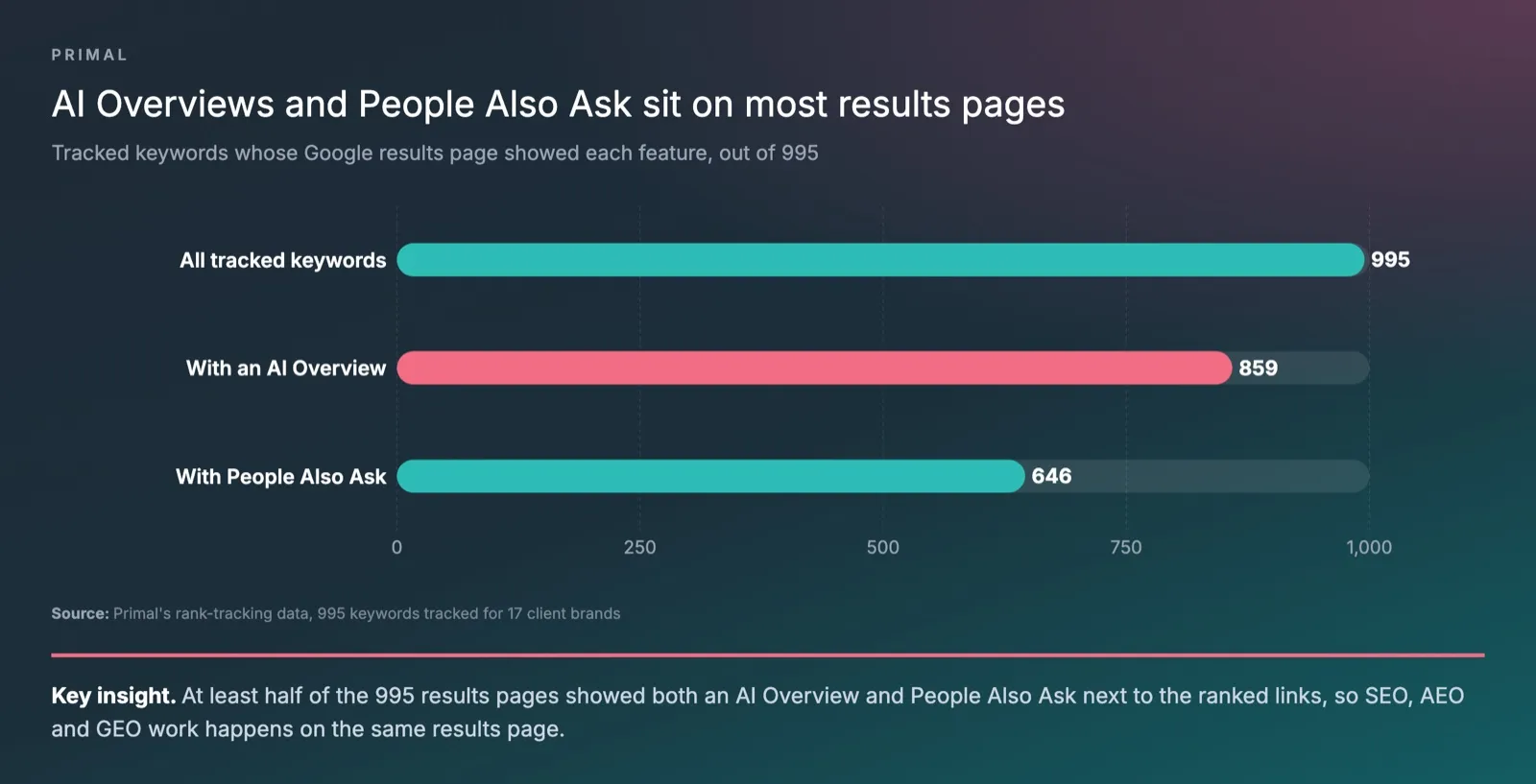
859 and 646 add up to 1,505, which is 510 more than the 995 keywords. So at least 510 results pages, at least half, showed an AI Overview and People Also Ask beside the ranked links. A single page can appear in all three places. It needs to rank, answer its question in its first sentence and carry facts of its own.
Why GEO Includes Work On Other Websites
GEO includes work on other websites because most AI answers do not cite the brand’s own site. In the 285,098 answers from the first section, a brand’s own website was cited in only about 1 in 5. Facebook, YouTube and the Thai forum Pantip were among the sites cited most often.
Google’s guide says its generative AI features show what people say about products and services. That includes blogs, videos and forum discussions. It also says inauthentic mentions are not as helpful as they might seem. Its ranking systems favour high-quality content, and other systems block spam. So the work starts with correct facts and real reviews.
AI tools read several sources before they write. When your brand facts differ from one site to the next, the answer can come out wrong. These are the jobs off your website that a brand can do itself.
- Keep your Google Business Profile and your Merchant Center product feed complete. Google’s guide says both help products and services appear in AI answers.
- Make your Facebook page, marketplace shops and review site listings match your website on name, services and location.
- Ask real customers for reviews, and give journalists and trade sites facts they can use.
Which AEO And GEO Advice Google Search Does Not Use
Google Search does not use llms.txt files, and it needs no special markup, chunked content or rewriting for its AI features. Google also no longer shows frequently asked question (FAQ) rich results. Some of the pages that rank for this search still advise FAQ schema or an llms.txt file for AEO and GEO.
Google’s guide mentions AEO and GEO and then lists the things you can ignore for Google Search. The capture below shows that part of the guide.
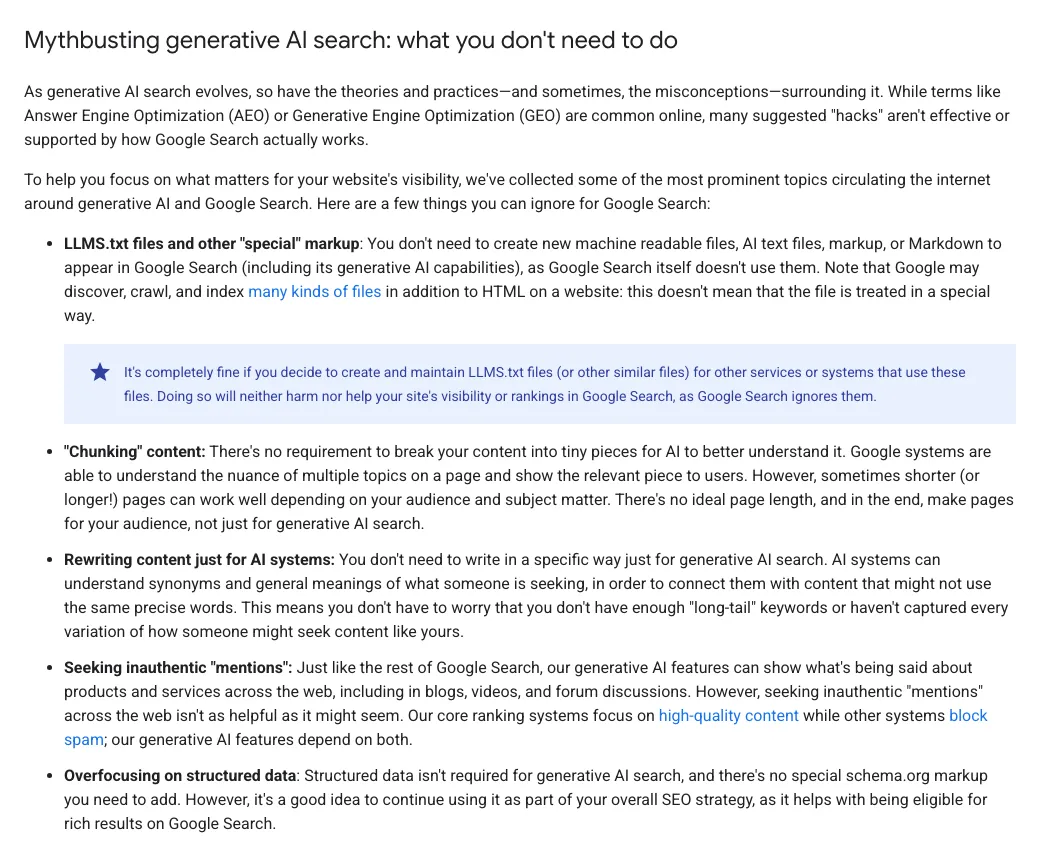
The table sets common advice against how Google Search works, and what we suggest instead.
| Common advice | How Google Search works | What to do instead |
|---|---|---|
| Add FAQ schema for AEO | FAQ rich results no longer show, and AI features need no special markup | Write an FAQ section for readers, and use structured data as part of normal SEO |
| Add an llms.txt file | Google Search ignores it, and it neither helps nor harms rankings | Keep one only if another service you use asks for it |
| Split content into small chunks for AI | Google’s systems understand several topics on one page, and there is no ideal page length | Split sections by your readers’ questions |
| Rewrite pages for AI | AI systems understand synonyms and the meaning behind a search | Write for people, and answer each question in the first sentence of its section |
| Get mentioned on other sites | AI features show what people say in blogs, videos and forums, but inauthentic mentions help less than they seem | Earn reviews and coverage from real customers and the media |
Google’s documentation updates log records that FAQ rich results no longer show in Google Search. The guide still recommends structured data for other rich results. It also says keeping an llms.txt file for other services is fine. The table covers Google Search only. Other AI tools may read files and markup in their own way.
Where To Start With SEO, AEO And GEO
Start with SEO, because AEO and GEO both need pages that search engines can reach and rank. Google’s guide says a page must be indexed and allowed to show a snippet to appear in its generative AI features. The site must also be included in those features in Search Console.
In Primal’s planning, about 80% of the work is SEO groundwork and about 20% is work aimed at AI answers. All of it happens on the same pages. This order suits most websites.
- Check in Search Console that your important pages are indexed and that nothing blocks their snippets.
- Open the Search generative AI control under Settings in Search Console. Check that your site is included, which is the default.
- Write headings that match the questions buyers ask, and answer each one in the first 1 or 2 sentences.
- Add facts only your brand has, such as your process, real photos and figures you measured yourself.
- Check that your Google Business Profile, Facebook page, marketplace shops and review listings match your website.
Mark McDowell, who founded Primal, saw this in 2026 with a business software company that asked for AEO and GEO. The company had published comparison pages for buyers weighing it against its rivals, so we checked whether Google had indexed them. When we checked, we could not see those pages in Google’s index, which means a buyer comparing providers in AI search might never see them. So the plan started with SEO work, such as submitting the sitemap and the new pages in Search Console and checking that no noindex tag blocks them.
How To Measure SEO, AEO And GEO
Measure each one with the platform’s own report, plus a fixed set of buyer questions you ask again every month. A click report on its own misses the AI answers that mention your brand when nobody clicks.
SEO is measured in Search Console’s Performance report and a rank tracker. The report shows clicks, impressions and average position. AEO is measured with a rank tracker that records featured snippets and People Also Ask. It shows whether a results page has one and whether your page is in it.
GEO on Google is measured in Search Console’s generative AI performance report. It shows how many times links to your site appeared in AI Overviews and AI Mode, by page, country, device and date. It does not show the text of the answers. It has no data from ChatGPT, Gemini or Perplexity either.
For those tools, ask the same buyer questions in each one every month. Note whether your brand is mentioned, which brands appear next to it and which websites the answer cites. Each month can then be set against the one before.
Primal runs SEO, AEO and GEO as one plan for each brand from our Bangkok office. We check the questions a brand’s buyers ask in ChatGPT, Gemini and Google AI Overviews with Elevate, Primal’s AI Visibility Tracker. You can read how that work runs on our GEO services page.
Frequently Asked Questions About SEO Vs AEO Vs GEO
Do You Still Need SEO If You Do AEO And GEO
Yes. Google’s guide says SEO best practices still apply, because its generative AI features rest on its core ranking and quality systems. A page that is not indexed, or not allowed to show a snippet, cannot appear in AI Overviews or AI Mode.
Can One Page Rank, Answer And Be Cited At Once
Yes. A page that ranks, answers its question in its first sentence and carries facts of its own can be listed, quoted and cited. Google’s guide says there is no need to write in a special way for AI.
Customers Often Ask Us How To Split SEO And AEO Work In The First 3 Months
Split it by order, on the same set of pages. Start with the SEO work that gets your important pages indexed and able to show a snippet. Then add question headings with the answer first, brand facts on other websites and a set of questions to measure. In Primal’s planning, about 80% of the work is SEO groundwork and about 20% is aimed at AI answers.
What Search Everywhere Optimisation And Omnichannel SEO Mean
Both names describe being found everywhere people search. That covers SEO, AEO and GEO, plus search inside social platforms such as YouTube and TikTok. Search Everywhere Optimisation stresses the number of platforms where a brand appears. Omnichannel SEO stresses keeping brand facts the same on every channel.
Senior SEO Specialist
Panlert Champakhom has worked in search engine optimisation (SEO) since 2018 and is a Senior SEO Specialist in Primal’s technical team. His work covers technical SEO, keyword research, on-page and content optimisation, and internal linking. His current focus is AI search, helping brands earn citations in Google AI Overviews, ChatGPT, Perplexity and Gemini.
About The Author