

By Mark McDowellPosted: Updated: 13 min read
First published by Nishananda Adityapadmavanch. Updated by Mark McDowell on 2026-10-20.
KOL Meaning And How A KOL Differs From An Influencer
KOL is short for key opinion leader, and its meaning in marketing is a person whose audience trusts their view on one subject, such as a skin doctor or a long-time car reviewer. An influencer is the wider word for anyone whose audience follows them for their personality and content. A KOC, or key opinion consumer, is a real customer who reviews products for a small audience.
Key Takeaways
- A KOL is trusted for knowledge of one subject, an influencer for personality and content, and a KOC is a real customer with a small audience, so one campaign can use all three.
- Tier ranges differ by source, with the Thai creator data Brand Buffet reported starting the Macro tier at 100,000 people and HypeAuditor starting it at 500,000.
- In 285, 098 artificial intelligence (AI) answers about 171 brands, logged by Elevate, Primal's AI Visibility Tracker, Facebook was among the 15 most-cited sites for 161 brands and TikTok for 9.
- Thailand's Food and Drug Administration (FDA) treats a review of a food's benefits for trade as advertising that needs approval first, and a false or exaggerated claim can bring up to 3 years in prison or a fine of up to 30,000 baht.
- No Thai law sets the wording for a paid post, but Facebook, Instagram, TikTok and YouTube each require creators to use their own disclosure tool.
KOL Meaning In Marketing
The platform a KOL posts on affects what AI assistants say about your brand. In Elevate, Primal’s AI Visibility Tracker, answers from ChatGPT or Gemini about a brand cite Facebook, YouTube and the web forum Pantip far more often than TikTok. So choose a KOL by their audience first. Then pick the platforms your customers read and AI assistants cite, and measure the KOL’s work apart from your other ads.
KOL stands for key opinion leader. In marketing, the meaning is a person whose audience trusts their view on one subject. A skin doctor who explains ingredients on YouTube is a KOL. So is a chef who teaches recipes, or a reviewer who has tested cars for years. Their trust comes from what they know, and the size of their audience matters less.
KOL marketing is a brand working with KOLs so they talk about its product on their own channels. The work can be a review video, a live stream or a how-to post. The brand pays with money or with products. Both sides agree on the message, the posting dates and whether the brand may reuse the content in its ads. The audience then hears about the product from someone they chose to follow, in a format they already watch.
In Ahrefs’ keyword data for Thailand, people look up what KOL means far more often than what influencer means. At Primal, the plan a brand receives for this work is called a KOL proposal.
How A KOL Differs From An Influencer And A KOC
A KOL can also be an influencer, and the difference is why people trust them. People trust a KOL for what they know about one subject. They follow an influencer for the person and the content. A KOC, or key opinion consumer, is a customer who reviews a product they have used for a small audience.
One person can be more than one of these. A doctor with several hundred thousand people following them is a KOL and an influencer at once. The table compares the words brands in Thailand use when they plan work with creators.
| Word | Who they are | Why people trust them | Work it suits |
|---|---|---|---|
| KOL | An expert in one subject, such as a doctor, a chef or a tech reviewer | Knowledge and experience in that subject | Products that need explaining or trust |
| Influencer | A person whose audience grew from their personality or lifestyle | People like the person and the content | Launches and wide awareness |
| KOC | A real user with a small audience | First-hand use, like advice from a friend | Many reviews before people buy |
| Brand ambassador | A person who represents the brand on a long contract | Seeing them with the brand over time | The brand’s image across a year |
| User-generated content (UGC) creator | A customer who posts about the brand without being paid | A real customer’s voice | Real reviews and photos on product pages |
What A KOC Is
A KOC is a key opinion consumer, an ordinary customer whose reviews reach a small group of people. Brands often book many KOCs at once, so a buyer who searches finds reviews from several real users. A KOC who receives a product or a fee is still doing paid work. The post needs the same disclosure as a KOL post.
How A Brand Ambassador Differs From A KOL
A brand ambassador represents a brand on a long contract, often for months or years. They appear across many campaigns. Most KOL work is booked per campaign or per post.
An ambassador can be a celebrity, an expert, a loyal customer or a member of the brand’s own staff. The contract should say whether the ambassador may work for a competitor while it runs.
What User-Generated Content Is
User-generated content is content customers make on their own without being paid. Examples are product photos, store reviews, unboxing clips and forum posts. A brand can use it on its website or in its ads once the owner of the content agrees.
Content a brand pays a creator to make in a customer style is paid work. It needs the same disclosure as a KOL post.
What Product Seeding Is
Product seeding is sending a product to dozens of KOLs, KOCs or users at the same time. Reviews then appear in many places in the same week. Brands use it for launches. Anyone who receives a product should tell their audience it came from the brand, even when no fee was paid.
KOL Tiers By Audience Size
KOLs and influencers are usually grouped into 5 tiers by audience size, called Nano, Micro, Mid-tier, Macro and Mega. Most sources end Nano at about 10,000 people and start Mega at 1 million. The middle tiers differ by source, so state the numbers whenever you talk about tiers with an agency or a KOL.
The table puts 2 sources side by side. The first is SCB EIC, the economic research centre of Siam Commercial Bank, as reported by Brand Buffet. It uses Thai creator data from Tellscore and FutureTales LAB. The second is the HypeAuditor help centre, from an influencer analytics platform.
| Tier | Audience size, SCB EIC | Audience size, HypeAuditor | Work it suits |
|---|---|---|---|
| Nano | 1,000 to 10,000 | 1,000 to 10,000 | Many reviews and product seeding |
| Micro | 10,000 to 50,000 | 10,000 to 50,000 | A group with one shared interest, such as runners or cat owners |
| Mid-tier | 50,000 to 100,000 | 50,000 to 500,000 | Trust within a product category |
| Macro | 100,000 to 1 million | 500,000 to 1 million | Wide reach |
| Mega | 1 million and up | 1 million and up | Awareness across the country |
SCB EIC puts the number of creators in Thailand at about 11 million. Nano creators number in the millions, while Mega creators number in the hundreds.
Smaller KOLs are closer to their audience and cost less each. But a brand has to manage many of them in one campaign. Larger KOLs reach more people with one post, but their audience is wider and more mixed. That is why the launch plans our team proposes usually mix tiers. They use 1 or 2 Mega KOLs for awareness and many Nano and Micro KOLs reviewing from real use.
What Micro And Nano Influencers Are
A micro influencer has an audience of about 10,000 to 50,000 people in both sources above. A nano influencer has about 1,000 to 10,000. Their audiences are small and often share one interest.
That suits product seeding and launches in one city. Ask for audience data before you book. A small audience can still be in the wrong city or the wrong age group.
Which Platforms Suit KOL Work In Thailand
Pick the platforms your customers use. Then pick the one where the KOL makes their best content. Most large platforms reach tens of millions of people in Thailand. So the difference lies in the format, and in what happens to the post afterwards.
DataReportal gathers the user numbers for TikTok, Facebook, YouTube and Instagram from each platform’s ad tools, and LINE’s number from LINE.
| Platform | Users in Thailand | KOL work it suits |
|---|---|---|
| LINE | About 56 million a month | Passing a KOL’s link or code to customers through the brand’s LINE Official Account |
| TikTok | About 57 million aged 18 and over | Short videos, live selling and TikTok Shop |
| About 52 million | Long reviews, live streams and groups | |
| YouTube | About 47 million | Long reviews and how-to videos |
| About 21 million | Photos, Reels and Stories |
The platform also affects what AI assistants say about a brand. Over 30 days, Elevate, Primal’s AI Visibility Tracker, logged 285,098 AI answers about 171 brands. Facebook was among the 15 sites those answers cited most for 161 of the brands. YouTube was on that list for 88 brands, Pantip for 48, Instagram for 38 and the review app Lemon8 for 33. TikTok was on it for 9. The chart shows the social and community platforms from the same data.
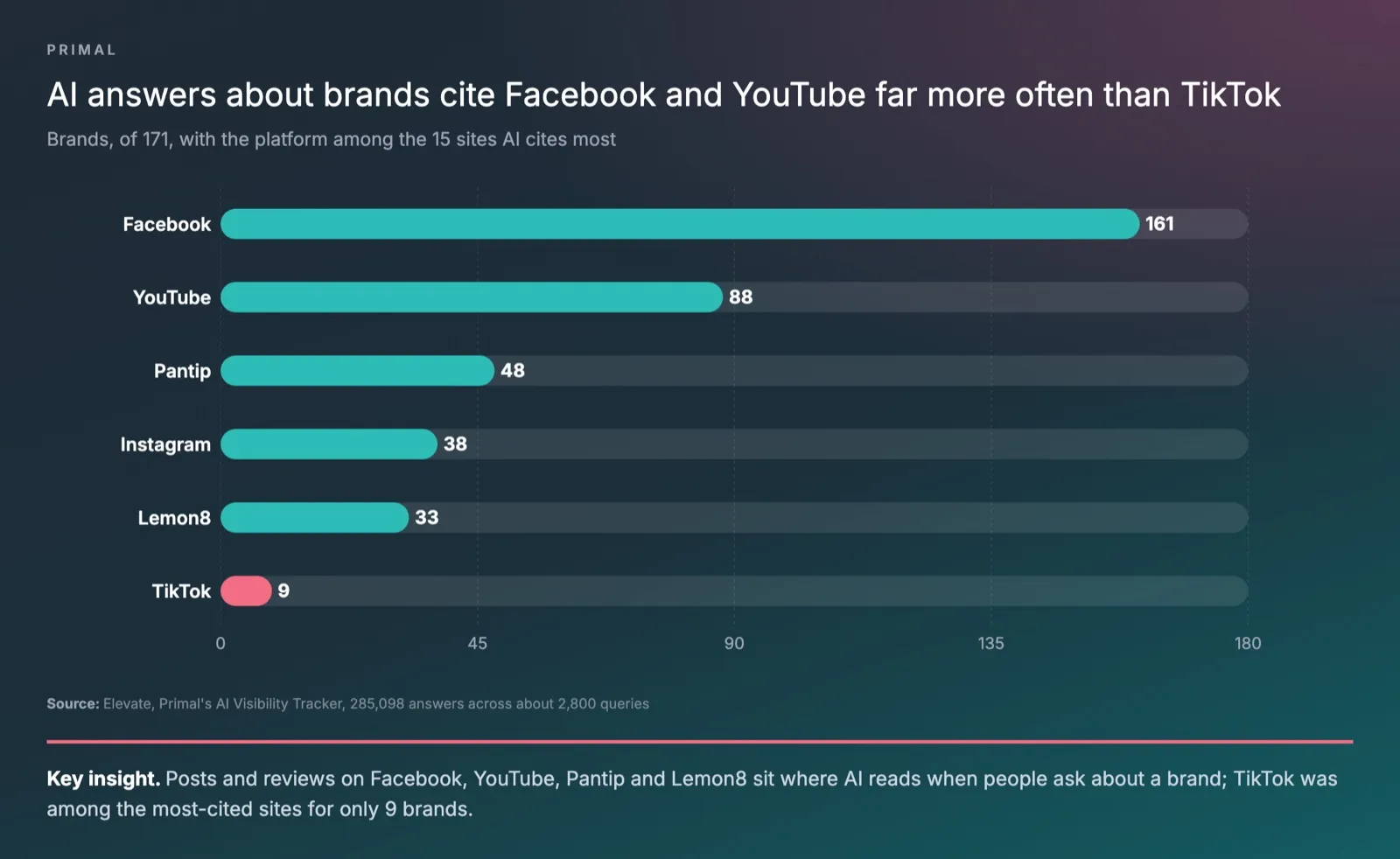
If your brand also wants a place in AI answers, put some KOL posts on YouTube, Facebook, Pantip or Lemon8. AI cites those far more often than TikTok. Our guide to what AI search is explains where AI answers take their sources from.
How KOLs Work On TikTok
A KOL on TikTok is a creator whose audience trusts their view on a subject. They speak through short videos or live streams.
Brands can find creators through TikTok One, TikTok’s platform for brands to find creators and run projects with them. When a creator tags the brand as a partner and gives it permission, the brand can run the video as a Spark Ads ad. Our TikTok marketing guide covers what to post and how to measure it.
How To Choose A KOL
Choose a KOL by audience first. Then check that their engagement is real, and look at their past brand work. Audience size is only useful for the first shortlist.
- Ask the KOL for the audience data on their platform’s insights page, such as age, gender and province. Compare it with your customers.
- Read the comments on several recent posts. People who ask real questions and talk with the KOL tell you more than the number of likes.
- Compare the views and engagement on the KOL’s paid posts with their own posts. If paid posts do much worse, the audience may not trust their reviews.
- Check whether the KOL has recently reviewed a competitor, and whether they disclose every paid post.
- Read their older posts and any news about them, to check that their past views sit well with your brand.
- If you sell food, drugs, cosmetics or health products, ask whether the KOL will keep to approved wording only.
At Primal, KOL work starts with an Influencer Brief that the brand fills in. Within 5 working days, our social team returns a KOL proposal. It sets out the approach, the main platforms, the KOL types, the list of KOLs and the budget split. The brand approves every KOL and every script before filming starts.
When AI answers keep citing a set of sites, those are the places I want a brand to appear, and that now includes the platforms its KOL posts go on. Over 30 days, Elevate, Primal’s AI Visibility Tracker, logged 285,098 AI answers about 171 brands, and Facebook was among the 15 sites cited most for 161 of them, against 9 for TikTok. So I look at a KOL’s audience first and the platform they post on next.
What Thai Law Says About Paid KOL Posts
A paid KOL post is advertising under Thai law, in the same way as a brand’s own ad. Food, drugs and medical devices need advertising approval from the Thai Food and Drug Administration (FDA) before the post goes up. Alcohol advertising is banned, and so is using fame to persuade people to drink. Each platform enforces disclosure of a paid post through its own tool.
Food, Drugs, Cosmetics And Health Products
The Thai FDA says that a review of a food’s benefits, quality or properties for trade is advertising. So it needs approval before it is posted. Posting without approval can bring a fine of up to 5,000 baht. A false or exaggerated claim can bring up to 3 years in prison, a fine of up to 30,000 baht, or both. A food registration number on the label is not advertising approval, so the brand applies for that separately.
The FDA’s warning to businesses and influencers bans reviews that claim to treat, ease or prevent a disease. It also bans lines such as “100% safe” or “recommended by doctors”, and before-and-after pictures. The FDA says it found accounts on Facebook, Instagram, YouTube, TikTok and LINE suspended or closed for exaggerated supplement reviews. The FDA also says it has never allowed doctors, pharmacists, nurses or other health staff to endorse a food or supplement in an ad. This applies to KOLs who are doctors.
Drugs and medical devices also need advertising approval first. Thailand’s Drug Act bans drug ads in which another person endorses the drug. So a drug brand should check with the FDA before it plans KOL work. Cosmetics do not need advertising approval, but false or exaggerated claims and claims to treat a disease are not allowed.
Alcohol
Thailand’s Alcoholic Beverage Control Act No. 2 bans alcohol advertising. Its section 32/2 bans anyone from using their fame for personal gain to show an alcohol brand’s name or mark. It covers content that aims to persuade others to drink. That covers a KOL review, and breaking the law can bring prison or a fine. An alcohol brand should not pay KOLs to post content that invites people to drink.
How To Label A Paid Post
No Thai law sets the words or hashtags a paid post must use. The Office of the Consumer Protection Board (OCPB) says influencer marketing in Thailand still lacks central guidance and standards on disclosing business ties. The Consumer Protection Act penalises anyone who advertises false or misleading claims about goods, their own or someone else’s.
The main platforms require disclosure through their own tools.
- Meta requires creators on Facebook and Instagram to tag the brand with its branded content tool when there is an exchange of value. Meta says gifted products can be part of that. The post then shows a Paid partnership label.
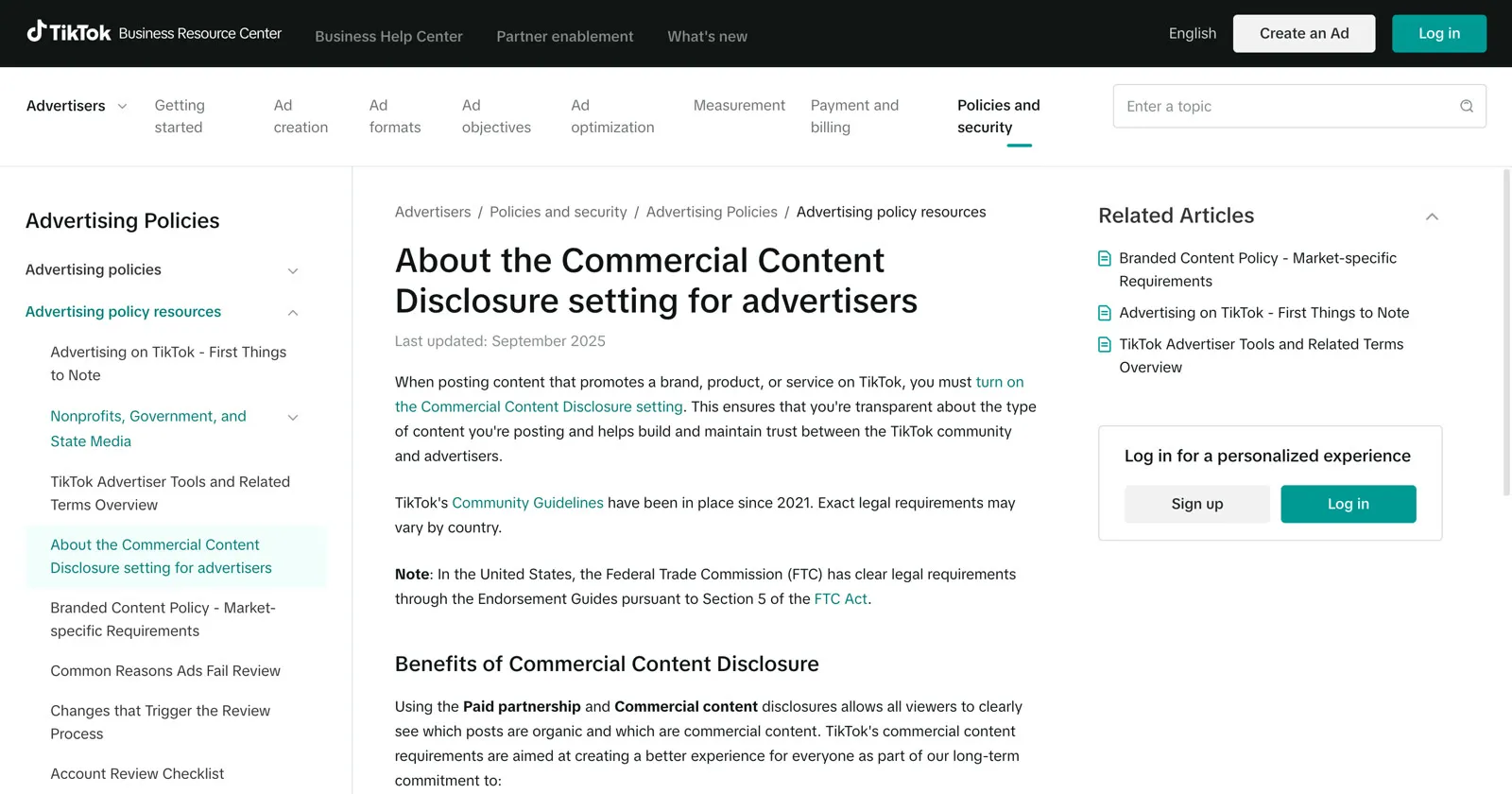
- TikTok requires the Commercial Content Disclosure setting to be on whenever a post promotes a brand, product or service. The post then carries a label such as Paid partnership.
- YouTube asks creators to tick a box in YouTube Studio when a video includes paid promotion. YouTube then shows a notice at the start of the video.
TikTok says the setting and the Paid partnership label do not change how it recommends a video. It bases that on its own study of nearly 2 million videos. It also says a video that is not disclosed may not be shown in the For You feed. The capture below shows the top of that TikTok help page.
Put each platform’s tool in the contract. Ask the KOL to write “ad” or “sponsored” at the start of the caption too.
What A KOL Brief And Contract Should Cover
A KOL collaboration runs on two documents. The brief tells the KOL what to say. The contract sets who does what, by when, and how long the brand may reuse the content. Both should be in writing before filming starts.
- One or two key messages, and what the KOL must not say, such as claims the FDA does not allow.
- The content format, the number of posts, the platforms and the posting dates.
- The approval steps. The KOL sends an idea or a script, the brand approves it, and then filming starts.
- How the KOL will disclose the paid post, and which platform tool they must turn on.
- The usage rights, meaning whether the brand may run the content as ads, on which platforms and for how many days.
- The data the KOL sends after posting, such as screenshots of the post’s insights 7 days after it goes up.
- Payment, and what happens if a post does not follow the brief or misses its date.
How To Measure KOL Marketing
Measure each KOL against the job you gave them. For awareness, look at reach and views. For education, look at watch time, saves and shares. For purchases, measure clicks, discount code use and orders you can trace back to that KOL.
Use the same formulas for every KOL in a campaign, so the numbers compare.
- Engagement rate is likes, comments, shares and saves added together, divided by views or reach, times 100.
- Cost per engagement is the KOL’s fee divided by the number of engagements.
- Cost per click or per order is the fee divided by the clicks or orders from that KOL’s link and code.
Give each KOL their own link with Urchin Tracking Module (UTM) tags and their own discount code. Google Analytics then splits visits and orders by link. The code covers orders made in an app or in a shop.
If you run a KOL’s video as an ad, keep it in its own test campaign for at least 2 weeks. In one campaign with your other ads, the ad system shifts budget to whichever ad works fastest. The KOL’s results then mix with the rest, and you cannot tell them apart.
Primal’s social team at our Bangkok office has an Influencer Specialist who runs KOL work from selection and briefing to reporting. The team plans with our ads team to reuse the videos that work. Our influencer marketing service page explains how we work with brands.
Frequently Asked Questions About KOLs
What Does A KOL Specialist Do
A KOL specialist runs a brand’s KOL work from start to finish. That covers finding KOLs, checking their audiences, agreeing fees, writing briefs, checking content before it goes live and reporting results. The role exists in brand marketing teams and in agencies. At Primal it is the Influencer Specialist in the social team.
Customers Often Ask Us How Long A KOL Campaign Takes
In our work, it takes about 6 weeks from the brief to the first post. Contacting and confirming KOLs takes about 2 weeks. Making the content takes about a month after the brand approves the ideas. If the ad needs FDA approval first, add time for that.
Customers Often Ask Us Whether KOLs Work For B2B Brands
Yes. For business-to-business (B2B) brands, the KOL is often an industry expert, a university lecturer or a senior executive. People in the trade follow them on LinkedIn, YouTube or Facebook.
Formats that fit include an expert interview and a live stream from a trade show booth. Measure clicks and enquiries rather than impressions.
What Is A Virtual Influencer
A virtual influencer is a computer-made character with its own social media accounts. The brand controls every image and every line, and the character has no private life that can cause problems for the brand. The character has never used the product, though. So it suits brand image work more than reviews of products used on the body, such as skincare.
Founder and Chief Executive Officer
Mark McDowell is the Founder and Chief Executive Officer of Primal, which he started in Bangkok in 2015. He is on the Forbes 30 Under 30 Asia 2020 list and was Campaign Asia’s Southeast Asia Young Achiever of the Year in 2018. He writes about AI search and search engine optimisation.
About The Author