

By Maris MortelPosted: Updated: 12 min read
What Is E-E-A-T And How To Show It On Your Website
E-E-A-T (often typed EEAT) stands for experience, expertise, authoritativeness and trust, the qualities Google's search quality raters look for in a page. Trust matters most. Google says E-E-A-T itself is not a specific ranking factor, but its systems use a mix of factors to find content that shows it, with more weight on topics that affect health, money or safety.
Key Takeaways
- Trust sits at the centre of E-E-A-T. Google's rater guidelines say an untrustworthy page has low E-E-A-T, however experienced or expert it seems.
- There is no E-E-A-T score. Google says E-E-A-T itself is not a specific ranking factor, and its rater guidelines say no single rating can change how a page appears in Search.
- Artificial intelligence (AI) answers about a brand lean on other sites. In 285,098 AI answers about the categories of 171 brands, logged over the last month by Elevate, Primal's AI Visibility Tracker, a brand's own website was cited in only about 1 in 5.
- Your Money or Your Life (YMYL) pages need the most trust. These topics can affect health, money, safety or society, and Google says its systems give strong E-E-A-T even more weight on them.
- Google strongly encourages accurate bylines. It asks whether bylines lead to more about the author, and calls made-up author profiles, such as AI-generated headshots or false credentials, a form of deception.
What Is E-E-A-T
E-E-A-T is Google’s name for what makes a page worth trusting. It stands for experience, expertise, authoritativeness and trust. The term comes from Google’s Search Quality Rater Guidelines, the handbook for the people who rate Google’s search results. Google’s page on creating helpful, reliable, people-first content says trust matters most of the four.
E-E-A-T describes the kind of page Google’s systems try to reward. There is no E-E-A-T score you can look up. Raters judge it from what a site says about itself, what others say about it and what the page shows.
Our data shows that artificial intelligence (AI) answers also lean on what others say. Over the last month, Elevate, Primal’s AI Visibility Tracker, logged 285,098 AI answers. They answered questions in the categories of 171 brands. A brand’s own website was cited in only about 1 in 5 of them.
So E-E-A-T work has two parts. On your own site, show who runs the business and who wrote each page. Off your site, the reviews and posts others write about you need to exist where search engines and AI read.
What Each Letter In E-E-A-T Means
Each letter is a question a rater asks about a page and the person or business behind it. The rater guidelines give an example for each one.
- Experience asks if the writer has done the thing or lived it. Google compares a product review from someone who used the product with a “review” from someone who has not.
- Expertise asks if the writer has the knowledge or skill the topic needs. Wiring advice from a skilled electrician is the example, against advice from an old-house fan who knows nothing about wiring.
- Authoritativeness asks if the writer or site is a go-to source for the topic. One example is the official government page for passports. Another is a local shop’s page on social media. It may be the trusted source for what is on sale now.
- Trust asks if the page is accurate, honest, safe and reliable. An online store needs safe payment and good customer service. A social media post made for fun needs less trust.
The table turns the four questions into what a reader looks for on a business website.
| Letter | The question | What answers it on a business website |
|---|---|---|
| Experience | Has the writer done or used this? | Your own photos, results and steps from real jobs |
| Expertise | Does the writer know the subject? | The writer’s name, qualifications and any licence the topic needs |
| Authoritativeness | Do others treat you as a source? | Reviews, press coverage, industry profiles and links from sites in your field |
| Trust | Is the page accurate and safe? | Company name, address, contact details, secure payment and a source for every figure |
The guidelines draw the first three as circles that overlap, with trust in the middle. They say a page that cannot be trusted has low E-E-A-T, however expert it seems. Their example is a scam run by a skilled scammer.
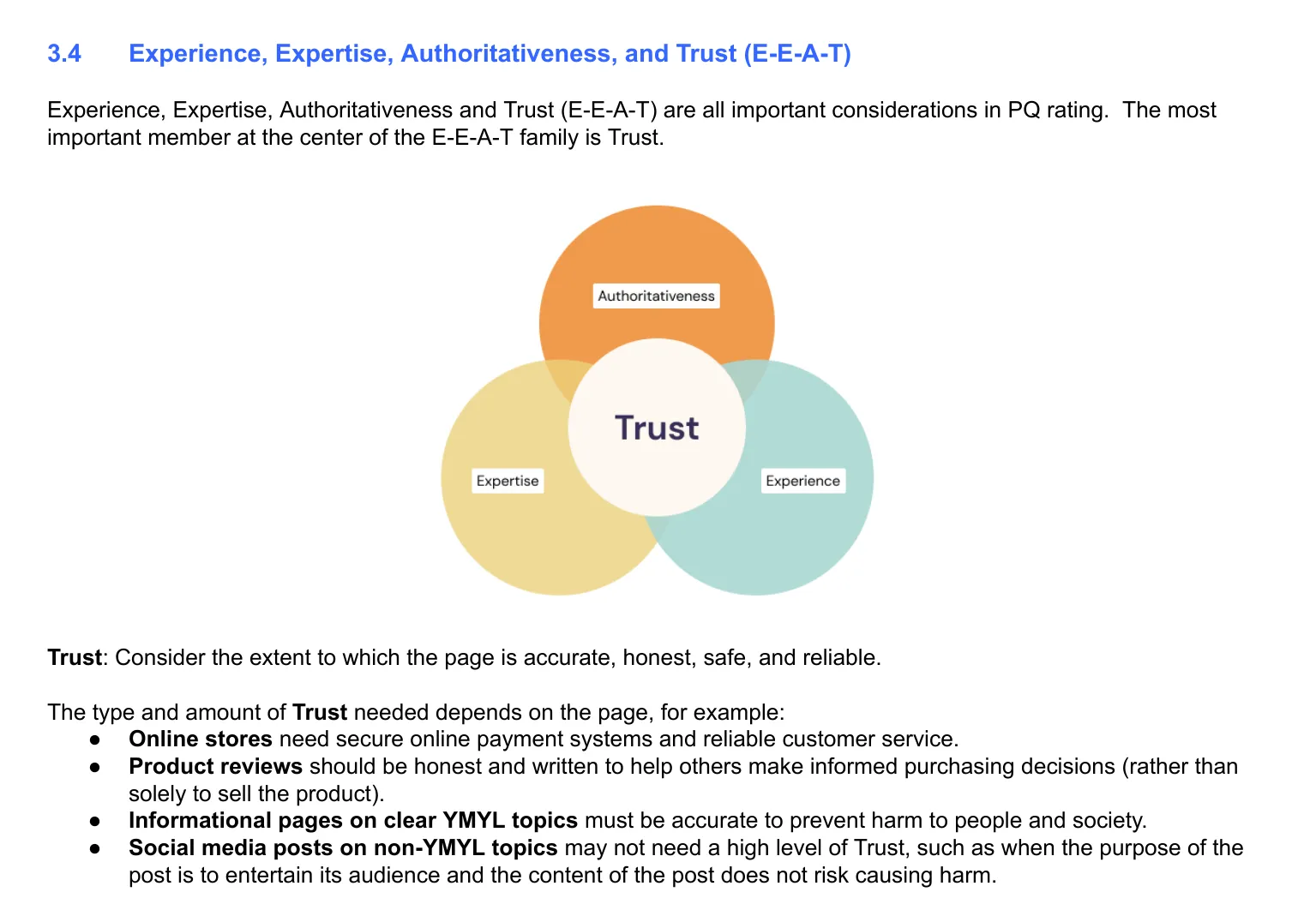
A page does not need to show all four. Google says some content helps because of the experience it shows. Other content helps because of the expertise it shares.
Is E-E-A-T A Google Ranking Factor
Not on its own. Google’s helpful content page says E-E-A-T itself isn’t a specific ranking factor. Its systems use a mix of factors that can spot content with good E-E-A-T.
Google’s page on how it ranks results explains the next step. First its systems find relevant content. Then they look for signs of expertise, authority and trust, to put the most helpful pages first. One factor is whether other well-known sites link to the content or refer to it.
The raters do not set rankings either. The guidelines say no single rating can directly change how a page shows in Google Search. Google uses the ratings to check how well its search works. It also uses them as examples of good and bad results.
Google publishes no E-E-A-T score and no weight for any signal. So we use E-E-A-T as a list of questions. We check each page the way a customer would.
Where Google’s Raters Look For E-E-A-T
Raters look in three places. The guidelines list them in this order.
- What the site or writer says about itself. The About page and the writer’s profile come first.
- What others say about it. That means reviews, news stories and other sources the site does not own.
- What the page itself shows, including reviews and comments. Google’s example is a hair stylist’s video. You can see the skill in the work.
The guidelines also warn about a conflict of interest. Reviews from people who bought and used a product can be very useful. “Reviews” from the maker are less trustworthy. So are reviews from an influencer paid to promote it. Raters are told to doubt both good and bad customer reviews. They should read what the reviews say, because the content matters as well as the stars.
Raters find what others say with a search the guidelines spell out. They look up a brand’s name with its own site left out, as in yourbrand -site:yourbrand.com. You can run the same search on your own business.
AI answers lean on that second place too. In the same 285,098 answers, the site cited most often was someone else’s for 121 of the 171 brands. The brand’s own website came first for only 50.
What YMYL Means And Which Pages Need More Trust
YMYL stands for Your Money or Your Life. It covers topics that could do real harm to people’s health, money or safety, or to society. Google says its systems give strong E-E-A-T even more weight on these topics.
The guidelines sort the harm into 4 types. They are health or safety, money, government and society (such as voting), and other harm. When to go to the emergency room is a YMYL topic. How often to replace a toothbrush is not. The guidelines add that many or most topics are not YMYL.
We read that test this way for business sites. The service pages of a clinic, hospital, insurer, bank or law firm are YMYL pages. A restaurant menu is not.
YMYL topics do not always need an expert. The guidelines split life experience people can share from advice that should come from experts. Here are three of their examples.
| Topic | Experience worth sharing | Best left to experts |
|---|---|---|
| Sleep problems in pregnancy | Safe pillow tips from people who went through it | Which sleep medicines are safe in pregnancy |
| Filling in tax forms | A funny video about the pain of doing taxes | How to fill in the forms |
| Saving for retirement | Reviews of retirement savings services from people who used them | How much to save and what to invest in |
On a YMYL page for your business, have a qualified person write or check it. Show their name, role and qualifications on the page. Our own addition is to show any licence or registration number a product needs. Then a buyer can check it.
How E-E-A-T Relates To AI Overviews And AI Search
Google’s AI Overviews and AI Mode rest on the same core ranking and quality systems as Search. Google’s guide to its generative AI features says they use those systems to fetch pages. They then write an answer with links to the pages that support it. Google’s helpful content page says those systems look for a mix of factors that show E-E-A-T.
The same guide asks for content that goes beyond common knowledge. It compares a page called “7 Tips for First-Time Homebuyers” with one buyer’s own story of why they skipped a home inspection. Google says the first is often based on common knowledge and adds little, while the second gives an expert or experienced view that goes beyond it. The guide also says seeking inauthentic “mentions” across the web isn’t as helpful as it might seem. Google’s AI features rely on its quality systems and its spam systems.
The chart below comes from our data. It shows how many of the 171 brands had each review or community site among the 15 sources AI cited most about them.
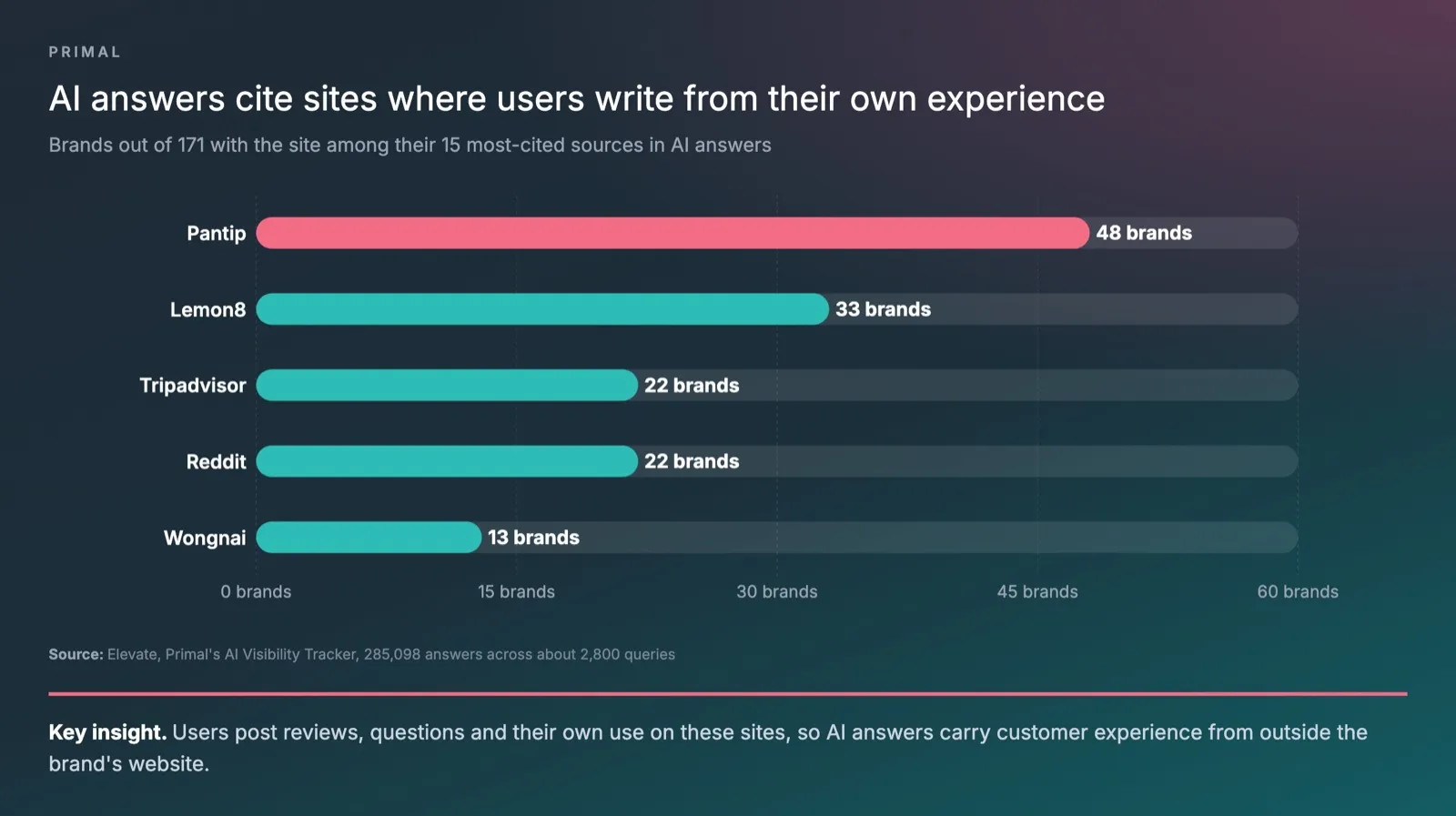
Pantip was on that list for 48 brands and Lemon8 for 33. Tripadvisor and Reddit were on it for 22 brands each, and Wongnai for 13. People use these sites to ask questions and review what they bought or visited. So AI answers about a brand carry customer experience from outside its own website. Our post on what AI search is explains how AI picks its sources.
What People-First Content And The Helpful Content System Are
People-first content is content made mainly to help people. Google sets it against search engine-first content, made mainly to rank. Its helpful content page gives questions to check your own pages. Here are three of them in our words.
- Does the page give facts, research or analysis of your own?
- If it uses other sources, does it add value instead of just rewording them?
- After reading, will someone know enough to reach their goal?
Google Search Essentials lists helpful, reliable, people-first content first. It is one of a few practices Google says can have the most impact on ranking.
Google announced the helpful content system in 2022. It aimed to show more content written by people, for people. Google’s ranking systems guide now lists it as a retired system. In 2024 it became part of the core ranking systems.
How To Show E-E-A-T On Your Website
Show readers who runs the site, who wrote each page, how it was made and where the facts come from. Google’s helpful content page puts this as three questions, who, how and why. It says “why” may matter most. The answer should be to help people.
- Say who runs the business. Put the company’s registered name, address, phone, email and LINE account on an About or Contact page. Add the company registration number to the footer. If the site takes payments, make customer service easy to find.
- Put a byline on every article. Link it to an author page. That page should list the writer’s role, work history, education, credentials and public profiles a reader can check.
- Show first-hand work and say how the page was made. Use your own photos, results and steps from real jobs. In a review, say how many products you tested and what you found. If AI helped, say how.
- Give a source for every figure. Link to the original, such as a regulator, a platform’s own help pages or a study. Change a page’s date only when its content changes.
- Put bylines on the pages that answer questions. Question searches go mostly to articles. We looked at 69 of Primal’s client websites over one week. On the median site, article pages took about 9 in 10 of the impressions from question searches. Home pages and product or service pages took under 1 in 100. Our guide to answer engine optimisation has the detail.
- Look after what others say about you. Ask real customers for reviews on your Google Business Profile. Keep your profiles on industry sites complete. Earn mentions and links from sites in your field. Our guide to backlinks covers which links help.
- Have a qualified person write or check YMYL pages. Show their name, role and qualifications on the page.
Steps 2 and 3 come from Google’s “who” and “how” questions. This is the “who” part of Google’s helpful content page.
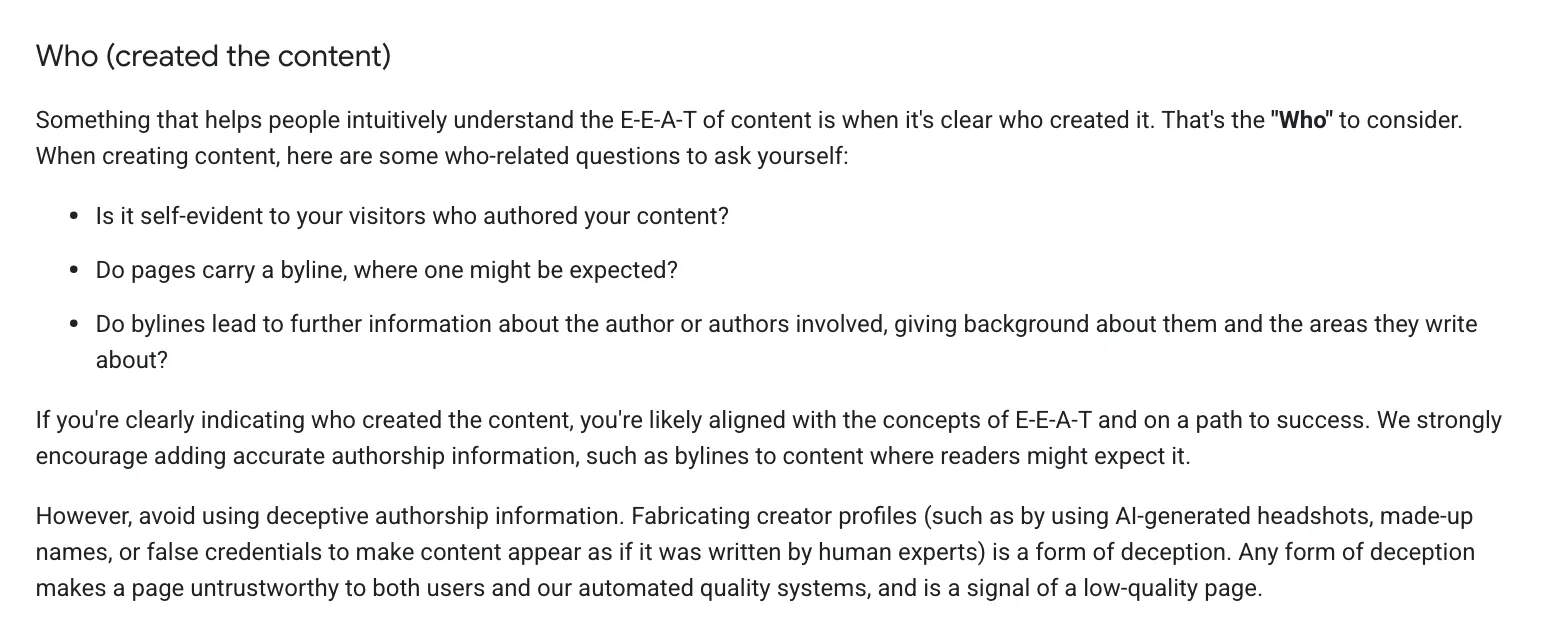
This site follows steps 2 and 4 on every article. Each article has a byline that links to the writer’s page. That page lists their skills, work history, education, credentials and LinkedIn profile. It also sends the same facts to search engines as Person structured data. The footer shows our company registration number. Every Primal figure in a post gives its sample and time window in the sentence.
Mark McDowell, who founded Primal, has seen proof of trust change results for a client. An international school came to us with a site that looked untrustworthy to Google and carried links from low-quality websites. We added proof of the experience, expertise and authority of the real people behind its content and removed the bad links, and the school’s enquiries from search rose sharply within the year. On a business site I reviewed this year, some posts had no author on the page, and adding one is a small fix that helps.
What Lowers E-E-A-T
Content that misleads readers or adds nothing new lowers E-E-A-T. Google’s guidelines and its helpful content page give these examples.
- Fake author profiles, such as AI-made headshots, made-up names or false credentials. Google calls this deception. It says any deception makes a page untrustworthy.
- Articles that mostly sum up what others said and add little.
- Changing a page’s date to look fresh when the content has not really changed.
- Lots of text made with generative AI and no human check. Google calls that little to no effort.
- Reviews with a conflict of interest, such as reviews the maker wrote.
- Errors on YMYL topics. There, Google wants content to be highly accurate and to agree with expert consensus.
These points are part of search engine optimisation (SEO). Our SEO services cover a site’s technical health, content and links, and how often AI answers cite it. The work runs from our Bangkok office, with our teams in Kuala Lumpur and Singapore.
Frequently Asked Questions About E-E-A-T
What Is The Difference Between E-E-A-T And E-A-T
E-A-T is the older name, for expertise, authoritativeness and trustworthiness. Google added experience as a fourth part in 2022, in a Search Central blog post. EAT and EEAT, as many people type them, mean the same thing.
Google’s example in that post is a tax return. There you want an accountant. For reviews of tax software, a forum of people who used it may help more.
Customers Often Ask Us Whether An SEO Tool’s Trust Score Is An E-E-A-T Score
No. Google publishes no E-E-A-T score, and says E-E-A-T itself isn’t a specific ranking factor. A trust or authority score in an SEO tool is that tool’s own estimate.
The rater guidelines even tell raters to ignore traffic data from sites like Similarweb. Traffic says nothing about reputation. So find out what the tool measures. Then fix what a customer would notice, such as missing company details, thin author pages or few real reviews.
Customers Often Ask Us Why AI Recommends Other Brands When Their Site Says More
Your own site is only part of what AI reads. In our data, a brand’s own website was cited in about 1 in 5 AI answers about it. A brand with reviews, forum posts and articles on other sites gives AI more to cite. Adding pages to your own site does not change what other sites say about you.
Does AI-Written Content Lower E-E-A-T
Not because AI was used. The rater guidelines say generative AI can help make content, and like any tool it can be misused. Using it does not decide a page’s rating on its own.
The problem is lots of text with no human check. Have a real writer add first-hand detail and check every fact. Tell readers how AI was used where they would expect to know.
Can A Small Business Without Press Coverage Show E-E-A-T
Yes. The guidelines say small websites may have little or no reputation information. They add that this is not a sign of high or low quality.
Many small local businesses rely on word of mouth. Raters then pay more attention to other things, such as the page itself. Start with the About page, contact details, bylines and reviews on your Google Business Profile.
Content Writer
Maris Mortel is a Content Writer at Primal with more than 15 years of experience in media and e-commerce, as a writer and editor for print and online publications. She writes search engine optimisation (SEO) copy for content marketing and digital marketing campaigns.
About The Author