

By Mark McDowellPosted: Updated: 12 min read
First published by Sitvisut Anantnakarakul, 2021-06-10. Updated by Mark McDowell on 2026-10-20.
What Are Backlinks And Which Ones Help SEO And AI Search
Backlinks are links on other websites that point to a page on your site. Google reads them with systems such as PageRank to judge what a page is about and how often other sites refer to it. The links worth having sit in the main text of sites your buyers read, such as news and industry sites, which are also among the sources artificial intelligence (AI) assistants cite most.
Key Takeaways
- Google says PageRank, a system that reads how pages link to each other, is still part of its core ranking systems, so links from other sites still affect where a page ranks.
- In 10, 083 AI answers logged over the last month by Elevate, Primal's AI Visibility Tracker, 8 of the 10 most-cited sites outside marketing service providers were review directories or news sites.
- When we checked the same sites in Ahrefs, 9 of 12 news sites gave a dofollow link to almost every site they linked to, while 3 of 4 review directories marked almost every outgoing link nofollow.
- The Links report in Google Search Console shows which sites link to you at no cost, and Google says most sites will never need its disavow tool.
What Are Backlinks
Backlinks are links on other websites that point to a page on your site. When a reader clicks one, they arrive on your page. Some people call them inbound links.
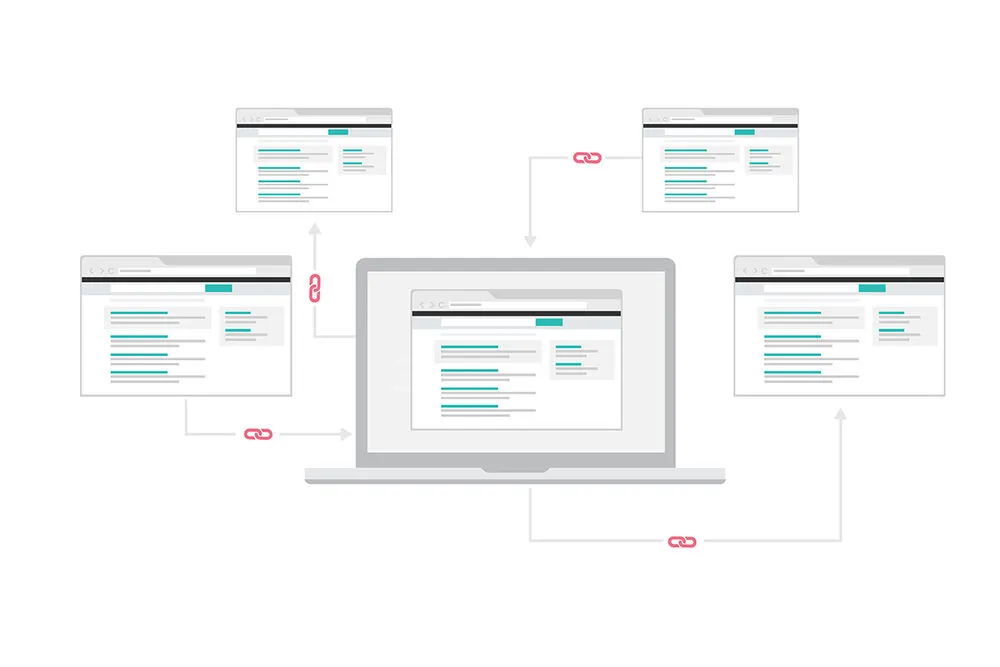
Three kinds of link get mixed up. An internal link joins two pages on the same website. An outbound link points from your site to someone else’s. A backlink is the reverse, a link from someone else’s site to yours. So one link is an outbound link for the site that places it and a backlink for the site it points to.
Primal’s diagram from the old version of this guide shows both directions. The two arrows pointing into the site on the laptop are its backlinks, and the two pointing out are its outbound links.
Google still uses links to rank pages. And the sites whose links matter most are often the sites artificial intelligence (AI) assistants read before they answer. We see this in data from Elevate, Primal’s AI Visibility Tracker. Apart from the companies’ own websites, the sites AI cited most were review directories and news sites. So start your link work on the sites your buyers already read. Then add the sites AI uses to answer questions in your category.
How Backlinks Help A Page Rank On Google
Backlinks help Google judge which pages other sites refer to and what those pages are about. Google’s guide to its ranking systems describes systems that read how pages link to each other. One of them is PageRank, which Google says is still part of its core ranking systems.
Links do two more jobs. First, they help Google find new pages. Its guide to how Search works says Google discovers many pages by following a link from a page it already knows. Second, links send real readers. You can see those visits as referral traffic in Google Analytics.
Links are one part of search engine optimisation (SEO). A page still has to answer the searcher’s question, load properly and be indexed by Google.
The Types Of Backlinks
Backlinks are sorted in two ways, by the code on the link and by where the link comes from.
The code is the rel attribute on a link in HTML (HyperText Markup Language), the language web pages are written in. Google’s page on qualifying outbound links sets out three values. A link with rel=“sponsored” is an advert or a paid placement. A link with rel=“ugc” sits in user-generated content (UGC), such as comments and forum posts. A link with rel=“nofollow” is any other link the site owner would rather Google did not connect with their site. SEO specialists call a link with none of these values a dofollow link.
<a href="https://example.com/">a normal, or dofollow, link</a>
<a href="https://example.com/" rel="nofollow">a nofollow link</a>
<a href="https://example.com/" rel="sponsored">a paid link</a>
<a href="https://example.com/" rel="ugc">a link in a comment or forum post</a>
By where they come from, most backlinks fall into four groups. Editorial links are placed by a writer or editor in an article or news story. Guest post links sit in an article you wrote for another site. Listing links come from directories and review sites where a business has a profile. Comment and forum links are posted by users. Our team gives editorial links the most weight, because someone else chose to place them.
Dofollow And Nofollow Links
A dofollow link is a normal link with no special rel value, so Google reads it as a plain reference to the page. A nofollow link tells Google that the linking site does not want to be associated with the page it links to.
Most sites have both kinds pointing to them. News sites, review sites and social networks each decide how they link out. The owner of each site sets its rel values, so put your effort into choosing which sites to pitch.
What Makes A Good Backlink
A good backlink comes from a site related to your business, sits in the main text of a page, and is on a page people read. Check these 6 points before you ask for a link or log one as a result.
- The site writes about your industry, and your buyers read it.
- The page with the link shows up in Google when you search for its address.
- The link sits inside the article, not in a footer or sidebar that repeats on every page.
- The link text says what your page is about.
- The page does not link out to dozens of unrelated sites.
- The rel value is true, so a link someone paid for carries rel=“sponsored”.
What Anchor Text Is
Anchor text is the clickable text of a link. Good anchor text tells the reader what they will find, such as a brand name, a service or the title of a guide.
There are 4 common kinds. Branded anchors use your brand name. Exact-match anchors repeat a search term word for word. Generic anchors say “read more” or “this guide”, and naked links show the web address itself. Links that people give on their own mix all four kinds. If almost every link uses the same search term word for word, someone probably placed those links on purpose.
What Domain Rating Measures
Domain Rating (DR) is Ahrefs’ score for the strength of a whole website’s backlink profile. The Ahrefs help page on DR says it compares a site with the others in Ahrefs’ database on a 100-point scale.
DR is one tool’s score. Google does not show or publish it, and other tools have their own versions, such as Moz’s Domain Authority (DA). Our team uses DR to sort a long list of sites, then a person checks each site’s topic and readers.
How Backlinks Connect To AI Search
Backlinks and AI search draw on the same sources. ChatGPT, Gemini and Google’s AI Overviews search the web, read the pages they find and cite the ones they use. So a news site or review directory that mentions your brand can give you a backlink and a place in the sources AI reads.
Over the last month, Elevate, Primal’s AI Visibility Tracker, logged 10,083 AI answers across 86 queries. The questions were about choosing an agency, SEO and AI search. We left out the websites of marketing service providers. Of the 10 sites cited most after that, 8 were review directories or news sites. Clutch, a directory of service providers, was cited in about 1 in 5 answers.
The chart shows those 10 sites in order of how often AI cited them.
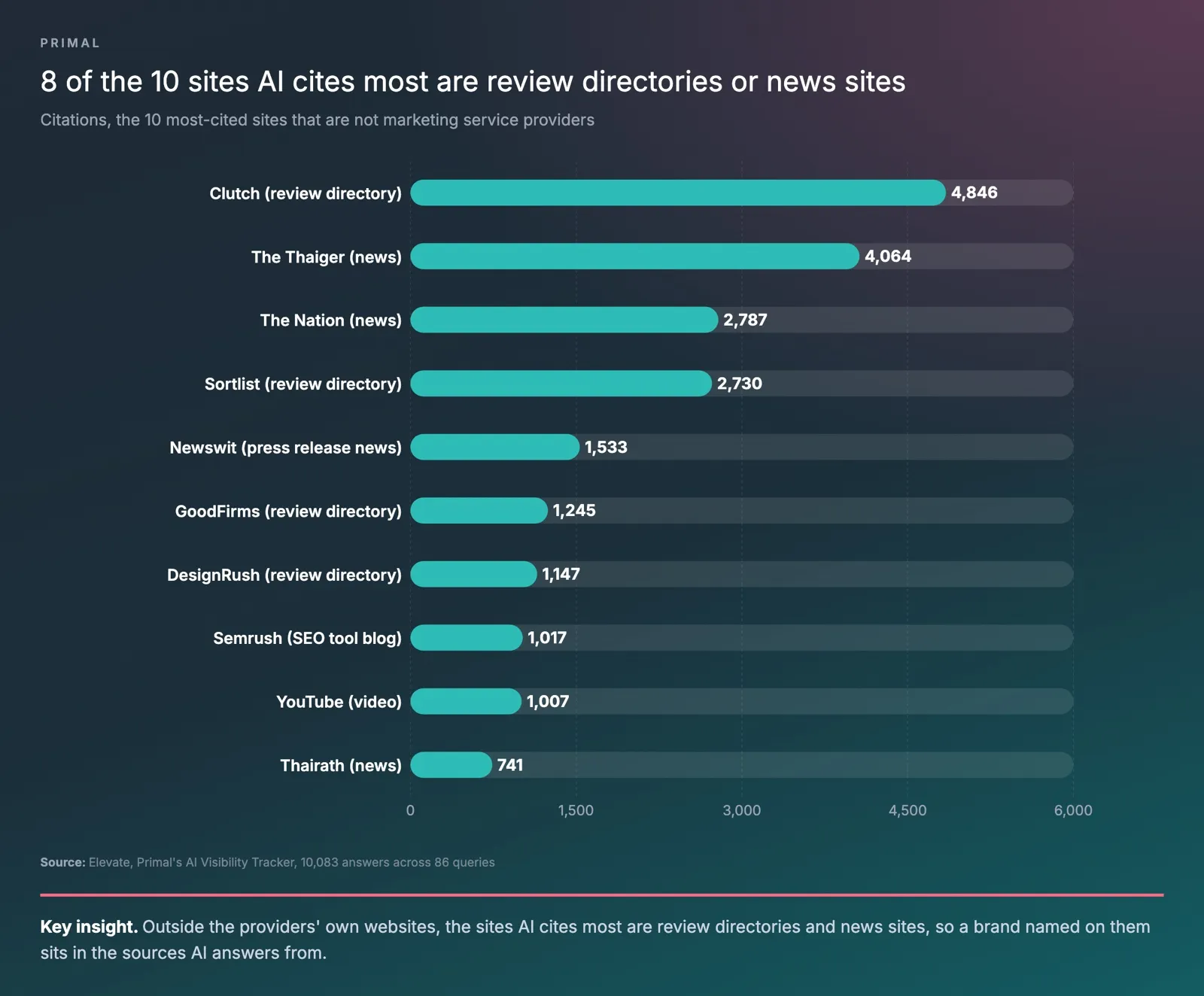
Then we checked in Ahrefs how those sites link out. Of the 12 news sites on the list, 9 gave a dofollow link to almost every site they linked to. Of the 4 review directories, 3 marked almost every outgoing link nofollow.
So a story on a news site usually gives you a link Google uses and a mention AI reads. A directory listing mostly gives you the mention.
This matches Primal’s research, which Marketing Oops reported from Mark McDowell’s talk at its 2026 summit. Across 128 brands, a brand’s own website made up only about 4 in 100 of the citations in AI answers.
In this video, Mark McDowell, Primal’s founder, gives 6 ways to get a brand into ChatGPT answers. One of them is a place on the outside sources AI trusts.
How To Get Backlinks
You get good backlinks by having something worth citing and putting it in front of the people who write about your topic. The 6 methods below all do that.
- Publish something worth citing, such as your own data, a complete guide or a calculator. Writers link to the original source. Our guide to content marketing covers how to plan it.
- Run Digital PR, which means pitching your brand’s stories and data to journalists and online media.
- Write guest posts for sites your buyers read.
- List your business in the directories and review sites for your category.
- Fix broken links. Find pages on other sites that link to a page that no longer exists, and offer your page on the same topic in its place.
- See who links to your competitors. Compare their backlinks with yours in a tool such as Ahrefs, then contact the most relevant sites first.
For Digital PR, I look for angles in news a brand already has. On a call with a health technology company this year, I pointed to an industry award it had won the year before, because that kind of story is newsworthy and gets more placements. We also check which websites AI answers cite when they recommend a brand’s competitors, and go after those sites, which are often list articles and business directories. The aim is links back to the website and mentions in the places AI looks.
What Digital PR Is
Digital PR (public relations) means pitching a brand’s stories, data or expert views to journalists and online media. The aim is coverage that carries the brand’s name and a link to its site. Traditional PR is judged by coverage in print, on television and on radio. Digital PR is judged by the links, the mentions and the visits the coverage sends.
What we pitch to the media is usually new data or an expert view from the brand. In our Digital PR work, the team writes the story in 3 days, and it goes out to the media within 3 weeks of the client’s approval.
Guest Posts And Paid Placements
A guest post is an article you write for another site, with a link back to your site in the text or the author bio. It works when the site’s readers are your buyers and the article teaches them something they can use.
Some sites charge to publish a guest post or a sponsored article. A link in a paid placement carries rel=“sponsored”, as Google’s page on outbound links sets out.
Whether Web Directories Still Help
A web directory is a list of businesses or websites, sorted by type. A local business guide is one kind, and a review site for service providers is another. Most of the review directories in our data mark their outgoing links nofollow.
So a listing is worth having for the buyers who search the directory, and because AI reads the brand names on it. List only in directories that fit your business and that people use. Keep your name, address and services the same on every one.
How To Check Your Backlinks
The simplest way to check your backlinks is the Links report in Google Search Console, which costs nothing and uses Google’s own data. Search Console Help explains each table. To open it, follow these steps.
- Sign in to Search Console and pick your site’s property.
- Open Links in the menu on the left.
- Under External links, open Top linked pages to see which of your pages have the most backlinks.
- Open Top linking sites to see which websites link to you most.
- Open Top linking text to check that the anchor text describes your business correctly.
- Export the lists so you can compare them next month.
The report groups sites by their root domain, so www.example.com and blog.example.com show as one site. It does not say whether a link is nofollow, so use another tool when you need to know how each site links to you.
How To Find A Competitor’s Backlinks
Search Console only shows links to your own site. To see a competitor’s backlinks, use a tool that crawls the whole web for links, such as Ahrefs or Semrush. Enter the competitor’s domain and open its list of referring domains, the sites that link to it. The totals differ from tool to tool, because each tool crawls the web on its own.
Which Backlinks Carry Risk
The risky backlinks are the ones made only to change rankings. One example is a large number of links from sites nobody reads. Comment links posted by software are another, and so are links from a network of sites that one owner set up for linking.
Google can take a manual action against a site with unnatural links pointing to it. It reports the action in Search Console.
What A PBN Is
A private blog network (PBN) is a group of websites that one person or company sets up to link to a target site. Many are made on expired domains bought for the links they already had. The sites usually have thin content and no real readers, and they link out to many unrelated sites. PBN links are one kind of unnatural link that can lead to a manual action.
When To Disavow Links
Disavowing means sending Google a file of links through Search Console and asking it to ignore them. Google’s help page on disavowing links says most sites will not need the tool.
Google says to use it only when two things are true. The site has a large number of spam or fake links pointing to it. And those links have caused a manual action, or are likely to. A spam warning from an SEO tool on its own is not a reason to send a disavow file.
Where To Start With Backlinks
Start with the links you already have, then add new ones from the sites your buyers and AI both read.
- Open the Links report in Search Console, and note which pages have links and which sites send them.
- Ask ChatGPT, Gemini and Google the questions your buyers ask, and note the news sites, review sites and trade media the answers cite.
- Pick a few target pages, such as your main service pages, and make data or a guide those outlets have a reason to cite.
- Pitch editors and journalists at those outlets, then check new links in the Links report each month.
If you want a team to do this work, see our link building service. Primal earns links through editorial outreach and Digital PR, on Thai and English sites that fit each client’s business. It is part of the same SEO work that covers a site’s technical set-up and content. We check each client’s links every month.
Frequently Asked Questions About Backlinks
Customers Often Ask Us Why A Tool Shows Thousands Of Backlinks
A tool’s backlink total usually includes every single link, not every site. A site that links to you from its footer creates one link on each of its pages, so thousands of links can come from a handful of sites. Look at referring domains instead, the number of sites that link to you. The Top linking sites table in Search Console lists them.
Customers Often Ask Us Whether Link Building And Backlinks Are The Same
Backlinks are the links themselves. Link building is the work done to earn them, such as content, outreach to editors and Digital PR. When an agency reports on link building, ask how many new sites linked to you. Then ask how close those sites are to your business.
Customers Often Ask Us Whether Nofollow Links Help
They help in two ways. A nofollow link on a site people read still sends visitors, and your brand name on that page is still text that AI can read. Many of the review directories AI cites most mark almost every outgoing link nofollow.
Can A Page Rank Without Backlinks
Yes, on many searches where people want to learn something. On those searches, a page that answers the question well can rank with few links.
Take Ahrefs’ record of Google’s results in Thailand for “backlinks”. The page in position 2 had links from 3 websites. Four pages below it had links from more than 1,500 websites each.
Customers Often Ask Us How Long Backlinks Take To Work
Google has to find the page that carries the link first. Only then does the link appear in Search Console’s Links report and affect your page. In our SEO work, we measure rankings and visits at 3, 6 and 12 months after the work on the site is done, and we check new links every month.
Founder and Chief Executive Officer
Mark McDowell is the Founder and Chief Executive Officer of Primal, which he started in Bangkok in 2015. He is on the Forbes 30 Under 30 Asia 2020 list and was Campaign Asia’s Southeast Asia Young Achiever of the Year in 2018. He writes about AI search and search engine optimisation.
About The Author