

By Panlert ChampakhomPosted: Updated: 11 min read
What Is Query Fan-Out And How AI Picks The Pages It Cites
Query fan-out is how Google's AI Overviews and AI Mode answer one question with many searches. The AI splits the question into smaller related searches, runs them at the same time, and writes one answer with links to the pages it used. So a page can be cited for one of those smaller searches even when it does not rank for the question the person typed.
Key Takeaways
- Google's guide to its generative AI features describes query fan-out as a set of related searches the model runs at the same time to find more results for one question.
- ChatGPT works in a similar way. OpenAI's help page says ChatGPT search usually rewrites a question into one or more targeted searches and sends them to its search partners.
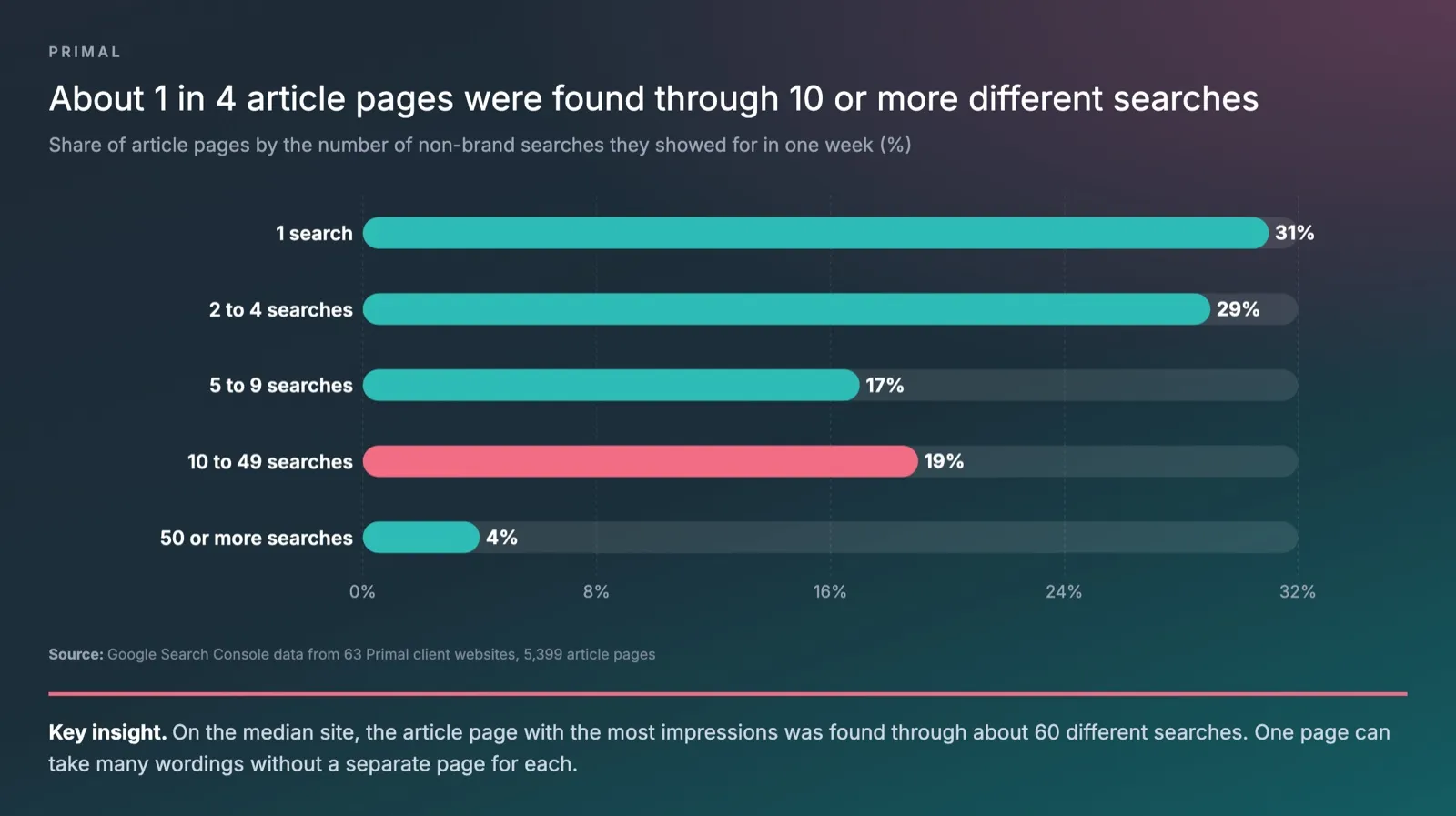
- In one week of Search Console data from 63 of Primal's client websites, about 1 in 4 article pages were found through 10 or more different searches, so one page can answer many wordings.
- In 285, 098 AI answers logged over the last month by Elevate, Primal's AI Visibility Tracker, a brand's own website was cited in only about 1 in 5.
- Search Console treats a follow-up question in AI Mode as a new query, and its generative AI report shows pages, countries, dates and devices, with no view of the queries.
What Is Query Fan-Out
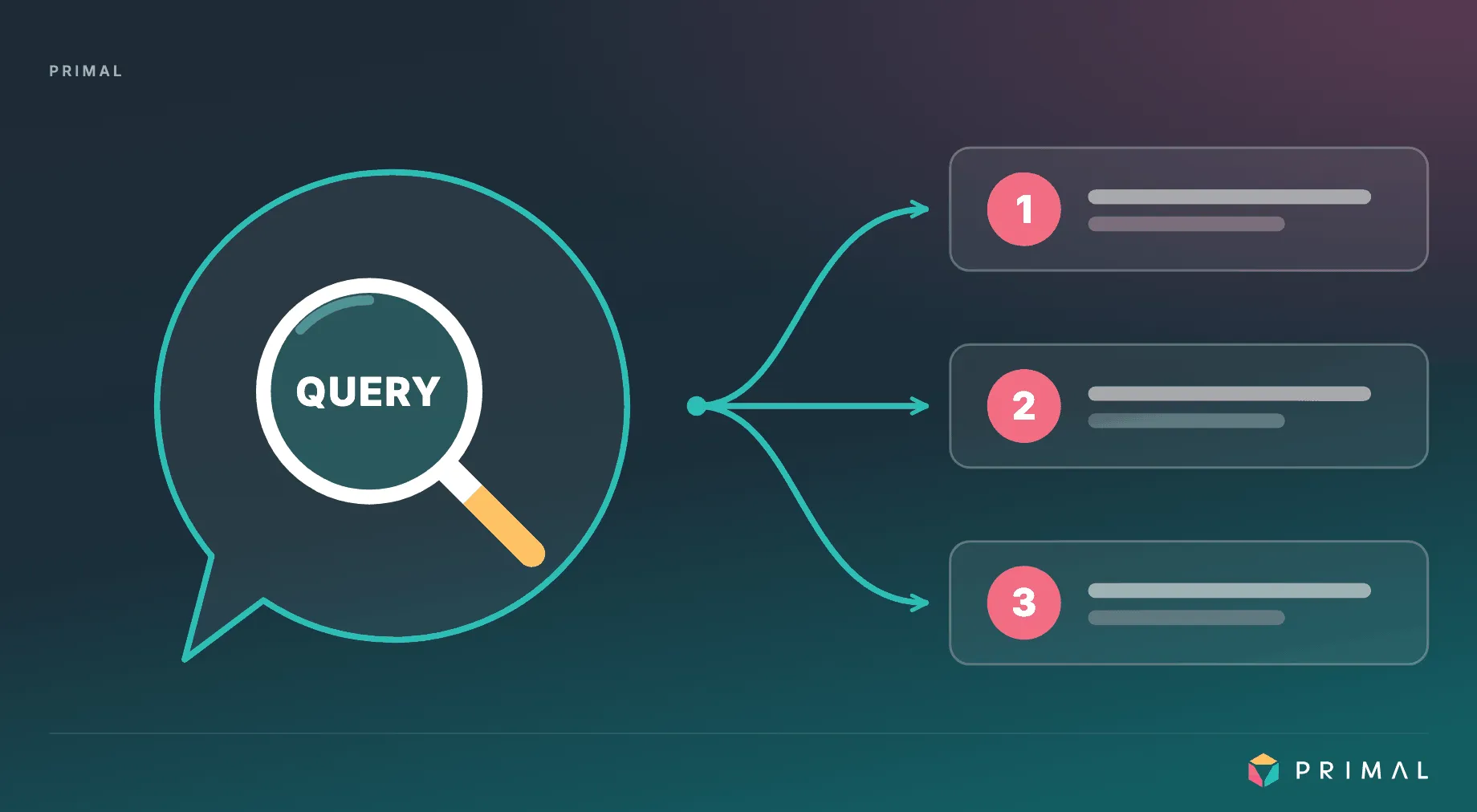
Query fan-out is the way Google’s artificial intelligence (AI) features answer one question with several searches. AI Overviews and AI Mode take the question and split it into smaller related searches. They run those searches at the same time and read the pages that come back. Then they write one answer and link the pages they used.
Google’s guide to generative AI features describes query fan-out as a set of related queries the model runs at once. The aim is to find more results for the person’s question. The guide lists it next to retrieval-augmented generation (RAG), the step that pulls pages from Google’s Search index. Both sit under a heading that asks whether search engine optimisation (SEO) still matters for AI search. The capture shows that section, with Google’s own example about a lawn full of weeds.
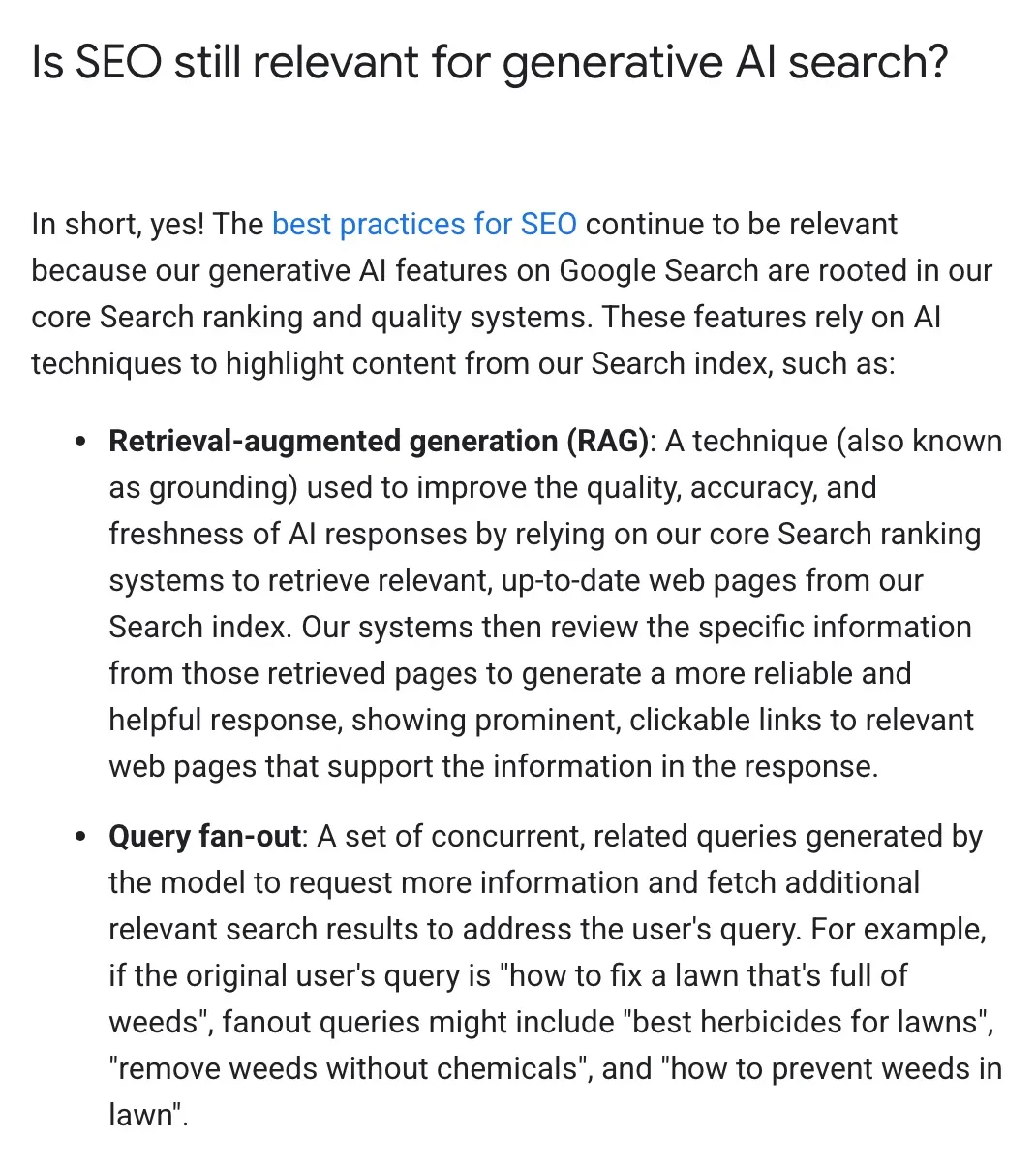
AI Overviews already show on most of the searches tracked for our clients. Of the 995 keywords in Primal’s rank-tracking data for 17 client brands, 859 showed an AI Overview on Google. Google’s page on AI features says AI Overviews and AI Mode may both use query fan-out.
The page an AI cites may answer just one of the smaller searches, and it does not need to rank for the question the person typed. One page also takes many searches already. In Search Console data from Primal’s client websites, the busiest article page on a site is often found through dozens of different searches. Plan one page for each customer question, and answer each smaller question in its own section.
How Query Fan-Out Differs From A Normal Search
A normal search runs once for the words a person types, and the person opens the pages. With query fan-out, the system runs many searches for the person. It reads the pages and sums them up in one answer. Google’s page on AI features says this lets it show a wider and more varied set of links than a classic web search.
Google’s post on AI Mode says AI Mode breaks a question into subtopics. It then sends a large number of searches at once for the person. Deep Search in AI Mode uses the same method and can run hundreds of searches. The table compares the 2 ways of searching on the points that matter for a website.
| Point | Normal search | Query fan-out |
|---|---|---|
| Searches for one question | One for the words typed | Many, written by the system |
| Who reads the pages | The person, one page at a time | The system, which sums them up |
| What the person sees | A list of links | One answer with source links |
| Pages that can appear | Pages that rank for the words typed | Pages that answer any one of the smaller searches |
| The next question | The person types a new search | A follow-up in AI Mode, which Search Console treats as a new query |
Primal’s diagram shows the first step, where one query splits into smaller searches that run side by side.
Do AI Overviews And AI Mode Split Questions The Same Way
Both may use query fan-out, but they do not always give the same answer or links. Google says the 2 features may use different models and techniques. Their answers and links can differ as a result.
Google also says AI Overviews appear only when they add something to the classic results, and that they often do not appear. On the client keywords above, they appeared on most results pages. AI Mode is made for longer questions that once took several searches, such as comparing options. One page can be cited in AI Mode and still be missing from the AI Overview for the same search, so check your pages in both.
Does ChatGPT Use Query Fan-Out
Yes, in a similar way, though OpenAI calls it rewriting the query. OpenAI’s help page on searching the web with ChatGPT says ChatGPT search sometimes works with outside search providers. When it does, it usually rewrites the question into one or more targeted searches and sends them to those providers. After it reads the first results, it may send more specific searches.
The rewritten search can depend on the person. OpenAI says ChatGPT may add a general location taken from the internet protocol (IP) address. If memory is on, it may also use saved memories when it rewrites the search. Two people who ask the same question can set off different searches.
The 2 systems also search in different places. Google’s AI features take pages from Google’s Search index. ChatGPT sends its rewritten searches to outside providers, and OpenAI’s page lists Microsoft among them. Our post on ChatGPT SEO explains how to let ChatGPT reach your site.
Which Pages Get Cited When A Question Is Split
A page that clearly answers one of the smaller searches can be cited, even if it does not rank for the question the person typed. The pages still come from Google’s index, chosen by its core ranking systems. A page must therefore be indexed and able to show a snippet in Google Search. Google says its AI features have no extra technical requirements.
Many of the cited pages belong to other websites. Over the last month, Elevate, Primal’s AI Visibility Tracker, logged 285,098 AI answers to questions in the categories of 171 brands. For the median brand, its own website was cited in about 1 in 5 of them.
The work has 2 parts. Your own pages should answer the smaller questions you know best, such as price and steps. Your brand’s name should also appear on the sites that answer the rest, such as review sites and forums.
How To Plan Content For Query Fan-Out
Start with one real customer question. List the smaller questions a buyer needs answered before they decide. Then give each one a heading on the same page, with the answer in the first 1 to 3 sentences. Link to a separate page only when a smaller question needs a page of its own, such as prices.
Google’s guide says there is no need to cut content into tiny chunks for AI. Its systems can find the right part of a longer page that covers several topics.
This is how Primal plans pages with clients. We ask the customer’s question in AI Mode and ChatGPT. We note which pages are cited and which subtopics the answer covers. Then we group those subtopics into a topic cluster. Each main topic gets one main page with a frequently asked questions (FAQ) section, plus supporting articles that link to each other. The steps are below.
- Pick the main question from real customers. Use the questions your team hears most often, or long question searches in Search Console.
- List the smaller questions around it. Price, comparisons, steps, limits and reviews are common ones.
- Check them against real AI answers. Ask the main question in AI Mode and ChatGPT a few times. Note the topics that repeat and the pages that are cited.
- Match each smaller question to a section. Give each one its own heading and put the answer at the top.
- Mark the questions other sites answer. Reviews are the usual one. Plan for your brand to appear on those sites.
Mark McDowell, who founded Primal, plans the question list for AI search around query fan-out. An AI tool that gets a question breaks it into smaller questions and runs a search for each one. So the list we plan pages from has to cover the whole cluster of smaller questions, with the main question as only one line on it.
One page can already take many searches. We looked at one week of Search Console data from 63 of Primal’s client websites, with searches for the brand’s own name removed. About 1 in 4 of their 5,399 article pages were found through 10 or more different searches. About 3 in 10 were found through only one. On the median site, the article page with the most impressions was found through about 60 different searches. Here, found means the page showed in Google’s results for that search. The chart shows how the article pages split.
Pages that answer questions are mostly article pages. On the median site among 69 of Primal’s client websites, over the same week, article pages took about 9 in 10 of the impressions from question searches. Home pages and product pages hardly showed for questions. Our post on answer engine optimisation shows the full split. Put the answers to the smaller questions on article or guide pages that link to your service pages.
A Made-Up Example For One International School Question
This example is made up to show the method. It does not come from a real AI answer or from client data. Say a parent asks AI Mode, “Which international school in Bangkok suits a 6-year-old, and how much are the fees?” The system might split it into the searches below. A school could answer each one on its own site like this.
| Smaller search the system might run | Page that answers it | Section on the page |
|---|---|---|
| Primary school fees at international schools in Bangkok | Fees page | A table of fees by year group, and the costs on top of fees |
| How British, American and International Baccalaureate (IB) programmes differ | Curriculum page | A comparison section that answers in its first 2 sentences |
| Which year group a 6-year-old joins | Admissions page | A table of ages and year groups |
| Documents needed to apply, and whether there is an entry test | Admissions page | Numbered steps to apply |
| International schools near Sukhumvit or Bang Na | Contact page | Location, travel and school bus |
| Reviews of the school from parents | Other websites, such as forums and parent groups | Not on the school’s own site, so the school needs to be mentioned on those sites |
The main question gets one main page with a short answer. It links to the fees, curriculum and admissions pages. The school can answer the first 5 smaller searches on its own site. The last one depends on other websites.
Should You Make A Page For Every Fan-Out Query
No, not in most cases. Our data above shows that one page already takes many different searches. A separate page makes sense when a smaller question needs a page of its own for the reader, such as the fees page in the example.
Google’s guide also warns against separate content for every variation of a search, fan-out queries included. When such content is made mainly to manipulate rankings or AI answers, the guide says it goes against Google’s scaled content abuse spam policy. It adds that a high number of pages does not make a site more relevant to people.
How To See Query Fan-Out In Search Console
Search Console does not show the smaller searches an AI runs. It does show which pages appear in AI Overviews and AI Mode, and what people typed before they saw those pages. Google reports AI features inside the Performance report, under the Web search type, with the rest of the results.
The generative AI performance report shows impressions of your links in AI Overviews and AI Mode. You can view it by page, country, date or device. It has no view of the queries. It shows which pages AI answers used, but not which smaller search each page answered.
Search Console’s help page on impressions, position and clicks explains how AI features are recorded.
- A follow-up question in AI Mode is a new query. One conversation can appear as several rows in the queries report.
- An AI Overview takes one position on the results page. Every link inside it gets that same position.
- A click on a link to an outside page from an AI Overview or AI Mode is a click.
To find pages that are cited because of the smaller searches, follow these steps.
- Open the generative AI performance report. Note which pages get impressions from AI Overviews and AI Mode.
- Look those pages up in the Performance report. Filter by page and open the Queries tab. Look for long question searches without the page’s main keyword. The page is found for these questions, though it was not written for them.
- Filter the queries with a regular expression (regex). A filter like the one below keeps the question searches. Add the common ones as headings or FAQ entries in your next update.
^(what|how|why|which|can|does|is)\sPrimal plans pages around customers’ real questions and the smaller questions around them. We then check the results in Search Console and in AI answers. Our AI SEO service page explains how our Bangkok office does this work.
Frequently Asked Questions About Query Fan-Out
Customers Often Ask Us Where Fan-Out Queries Come From And Whether They Have Search Volume
They come from the AI model, which writes them each time it answers a question. Google and OpenAI do not publish the list, and fan-out queries have no monthly search volume to look up the way keywords do. So we start from the questions customers really ask, long searches in Search Console and the topics that repeat in AI answers. Keyword volume still helps you choose the main question.
How Many Searches AI Runs For One Question
There is no fixed number. Google’s post on AI Mode speaks of a large number of searches, and says Deep Search can run hundreds. OpenAI’s help page says ChatGPT rewrites a question into one or more searches. The number depends on the question and on the feature the person uses.
Can You See The Fan-Out Queries An AI Used
Not in full. Search Console does not show them, and in ChatGPT they can change with the person’s location and saved memories.
You can still ask the same question in AI Mode or ChatGPT several times. Note the topics in the answers and the pages cited. Each run can differ, so look for the topics that repeat rather than single searches.
How Fan-Out Queries Differ From Long-Tail Keywords
A long-tail keyword is a longer search that a person types, and you can see it in Search Console. A fan-out query is a search the system writes and runs for the person. Long-tail keywords show what people ask. Fan-out queries show what the system needs to find before it answers.
Both help with planning. Google’s guide adds that you do not need to cover every long-tail variation, because its systems understand synonyms and general meaning.
Customers Often Ask Us Whether A Frequently Asked Questions Section Helps
It helps when the questions in it are ones readers really ask, and each answer is complete in 2 or 3 sentences. The section holds smaller questions that are not big enough for a heading of their own. Google’s guide says structured data is not required for its generative AI features. You do not need special markup for this.
Senior SEO Specialist
Panlert Champakhom has worked in search engine optimisation (SEO) since 2018 and is a Senior SEO Specialist in Primal’s technical team. His work covers technical SEO, keyword research, on-page and content optimisation, and internal linking. His current focus is AI search, helping brands earn citations in Google AI Overviews, ChatGPT, Perplexity and Gemini.
About The Author