

By Mark McDowellPosted: Updated: 8 min read
First published by Sitvisut Anantnakarakul, 2022-04-22. Updated by Mark McDowell on 2026-10-20.
Facebook Ad Sizes And Specs 2026 For Each Placement
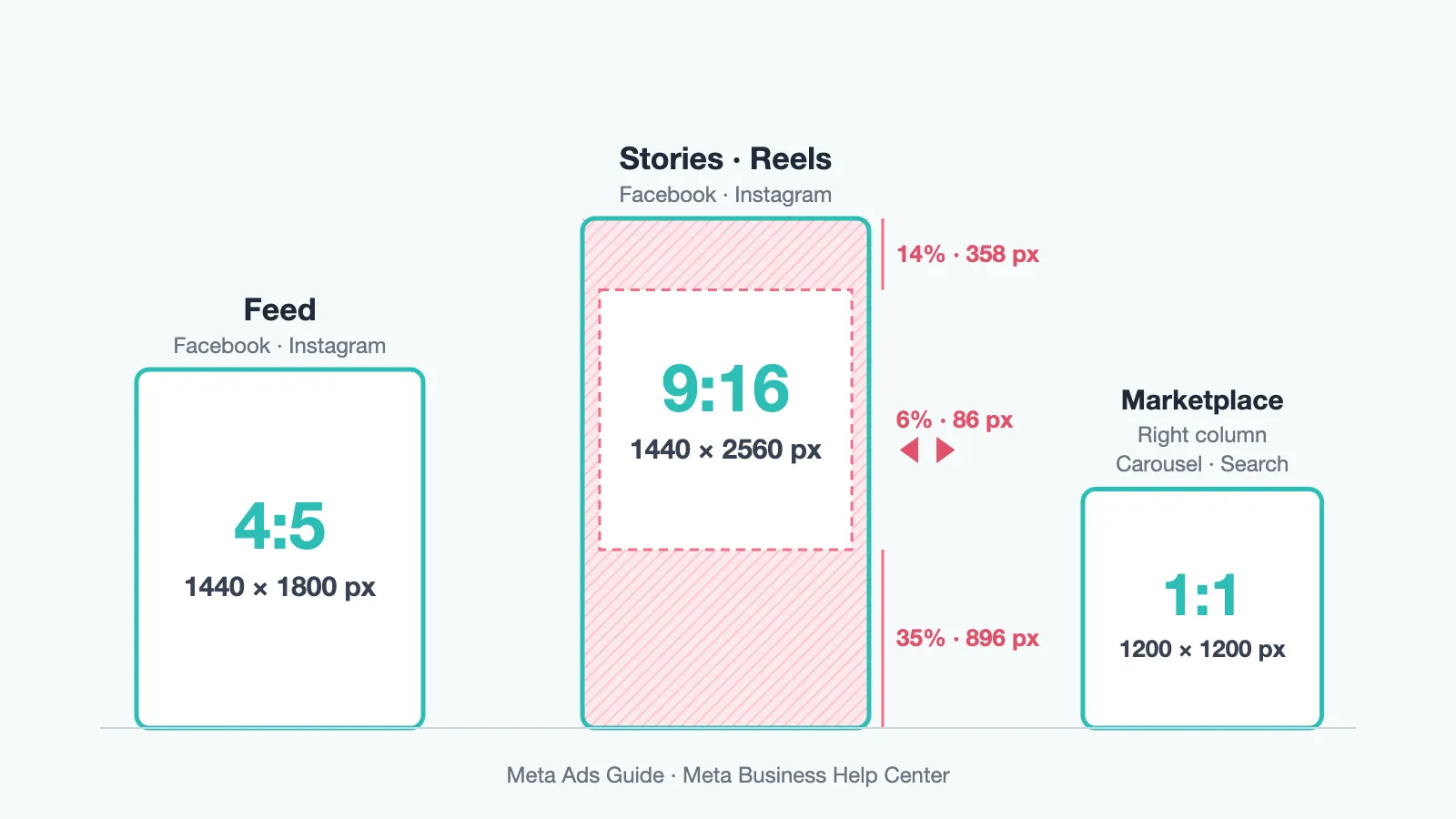
The Facebook ad sizes Meta recommends are 1440 x 1800 pixels (4:5) for the feed and 1440 x 2560 pixels (9:16) for Stories and Reels. Make the 1:1 square for Marketplace, the right column, search and carousel cards at 1200 x 1200 pixels, which clears the minimum on both of Meta's pages. In a 9:16 file, keep text and logos out of the top 14%, the bottom 35% and 6% on each side.
Key Takeaways
- Meta's Ads Guide recommends a 4: 5 image at 1440 x 1800 pixels for the Facebook feed and a 9:16 image at 1440 x 2560 pixels for Stories and Reels.
- Make the 4: 5 feed file and the 9:16 Stories and Reels file first, because those placements usually take most of the spend and each uses its own ratio.
- On a 1440 x 2560 file, keep 358 pixels clear at the top, 896 at the bottom and 86 on each side, which leaves a box of about 1268 x 1306 pixels in the middle for text.
- When an ad lacks one of the four ratios, Meta fills the gap by padding, expanding or cropping the image, so check every crop in the aspect ratios view in Ads Manager.
- A 1200 x 1200 square clears the minimum Meta lists for Marketplace and the right column, which is higher than the 1080 x 1080 in the Ads Guide.
What Size Should A Facebook Ad Be
Three files cover the Facebook ad sizes most campaigns need. The first is a 4:5 file at 1440 x 1800 pixels for the feed. The second is a full-screen 9:16 file at 1440 x 2560 pixels for Stories and Reels. The third is a 1:1 square at 1200 x 1200 pixels for Marketplace, the right column, search results and carousel cards.
Most of the spend usually goes to the placements those first two files serve, the feeds and Stories and Reels. Each uses its own ratio, and Meta crops or pads a file to fill a ratio it lacks.
So make the feed file and the full-screen file first, and the square after them. Then keep the text inside the safe zone and check every crop before an ad goes live.
Every size here comes from Meta’s own pages, the Meta Ads Guide and the Meta Business Help Center. The diagram below draws the three files to scale, with the bands to keep clear on the full-screen file.
Which Placements Take The Ad Spend
The feeds usually take the largest share of the spend, with Stories and Reels second, so the feed file and the full-screen file serve the placements where most of the budget goes. The reports in Ads Manager show the split for your ad account when you break the results down by placement.
When we plan Meta ads for a brand, a creative package starts with a few unique designs. We then make variations and adaptations of each one, because every ad placement needs its own size. So a proposal can list many files while holding only a few designs, and the rest are the same designs resized for each placement.
Facebook Image Ad Sizes By Placement
A single-image ad on Facebook uses 4:5 in the feed, 9:16 in Stories and Reels, and 1:1 in Marketplace, the right column and search results. In the feed and in Stories, an image is a JPG or PNG file of up to 30 megabytes (MB).
Meta publishes two sets of numbers. The Ads Guide gives the size to make. A second page, Meta’s recommended minimum image sizes, gives the smallest size Meta recommends for good quality. The table puts them side by side.
| Placement | Ratio | Ads Guide size (pixels) | Meta’s recommended minimum (pixels) |
|---|---|---|---|
| Facebook feed | 4:5 | 1440 x 1800 | 1440 x 1800 (4:5) or 1080 x 1080 (1:1) |
| Facebook Stories | 9:16 | 1440 x 2560 | 1080 x 1080 |
| Facebook Reels | 9:16 | 1440 x 2560 | 1080 x 1080 |
| Facebook Marketplace | 1:1 | at least 1080 x 1080 | 1200 x 1200 |
| Facebook right column | 1:1 | at least 1080 x 1080 | 1200 x 1200 |
| Facebook search results | 1.91:1 to 1:1 | at least 1080 x 1080 | not listed |
| Instagram feed | 4:5 | 1440 x 1800 | 1080 x 1080 |
| Instagram Stories and Reels | 9:16 | 1440 x 2560 | 1080 x 1080 |
The two pages give different figures for the square. A 1200 x 1200 square meets both, so that is the size to make.
Meta also sets technical minimums well below these sizes. A feed image must be at least 600 pixels wide, a Stories image 500 pixels wide, and a right column image 254 x 133 pixels. The right column shows the picture small, and Meta advises no text on it.
The text beside the image has suggested lengths too. In the feed, Meta suggests 50 to 150 characters of primary text and a 27 character headline. Stories take 125 and 40. Reels ads take the shortest primary text, at 40 characters.
Carousel Ad Sizes
A carousel in the Facebook feed holds 2 to 10 cards. Each card is a 1:1 image or video of at least 1080 x 1080 pixels. An image card can be up to 30 MB and a video card up to 4 gigabytes (GB).
Keep every card at the same ratio. Meta’s guide to aspect ratios says matching ratios stop automated adjustments. It allows 4:5 cards only in Advantage+ ads that pull product images from a product catalogue. Carousel text is short, with 80 characters of primary text, a 20 character headline and an 18 character description.
Facebook Video Ad Sizes
Video ads use the same ratio and pixel size as images in each placement. The feed takes 4:5 at 1440 x 1800 pixels, and Stories and Reels take 9:16 at 1440 x 2560 pixels. Files can be MP4, MOV or GIF, up to 4 GB.
The length limits differ by placement.
- Feed video runs from 1 second to 241 minutes.
- Stories video runs from 1 second to 3 minutes.
- Reels video has no upper limit.
Meta suggests sound and captions for Stories video, though neither is required. For in-stream video, the ads that play inside other people’s videos, Meta recommends a wide 16:9 file to match the video around it. A full-screen video needs the same safe zone as a full-screen image.
The Stories And Reels Safe Zone In Pixels
In a 9:16 file, keep text, logos and the product out of the top 14%, the bottom 35% and 6% on each side. The Stories page of the Meta Ads Guide gives these figures because the profile picture and the call to action button sit over those edges. Meta’s safe zone page applies the same guidance to full-screen ads in Stories, Reels, the feed and in-stream reels.
Worked out in pixels, the space for text is a near-square box in the middle of the frame.
| File size (pixels) | Top 14% | Bottom 35% | Each side 6% | Box for text |
|---|---|---|---|---|
| 1440 x 2560 | 358 | 896 | 86 | 1268 x 1306 |
| 1080 x 1920 | 269 | 672 | 65 | 950 x 979 |
Put the whole message inside that box. The bands above and below still carry the picture, because people see them, but nothing there needs to be read.
Ads Manager can mark the box for you. Turn on the safe zone guardrail and a yellow overlay shows it on the creative. Meta’s safe zone page also says that on screens taller than the ad, Meta may zoom it, which crops anything outside the safe zone, or show it on a black background. A Reels ad with a disclaimer should keep the bottom 40% clear.
What Meta Does When You Upload One Size
When an ad lacks some of the four ratio versions, Meta fills the gaps itself. Its aspect ratio guide lists padding, media expansion, cropping and features that use artificial intelligence (AI). The result can crop out a logo or a line of text.
Ads Manager has an aspect ratios view for each ad. It shows every version, lets you turn off any adjustment you do not want, and takes up to 10 images or videos per ad. The safest course is to upload the feed file and the full-screen file yourself, then check each crop before you publish.
Each placement accepts more ratios than it recommends. The Facebook feed takes several, yet Meta’s list of ratios by placement recommends 4:5 there for both images and video. Stories and Reels also take several, with 9:16 recommended.
Facebook Profile Picture And Cover Photo Sizes
A Facebook Page profile picture should be 320 x 320 pixels, and Facebook crops it to a circle. The cover photo must be at least 400 x 150 pixels. It loads fastest as a JPG of 851 x 315 pixels under 100 kilobytes, according to Facebook’s Help Center.
On phones, the profile picture overlaps the cover by about 40 pixels. Leave room for it when you place words on the cover. These two sizes are for the Page itself, and ads use the sizes above.
How To Hand Ad Files From Design To The Ad Team
A design team saves the ad team time when every ratio arrives in one set and the text already sits in the safe zone. Then nobody has to let Meta crop a file on its own. Before each hand-off, check these five things.
- One folder per ad, holding the feed file, the full-screen file and the square.
- The ratio at the end of each file name, such as summer-promo_4x5.jpg and summer-promo_9x16.jpg.
- Text, logo and product inside the centre box of the full-screen file, using the safe zone table.
- A version with no words on the image for the right column.
- A note of the placements the ad will run in, so the ad team knows which files matter most.
Once the files are in Ads Manager, the ad team opens the aspect ratios view and looks at every placement before launch. If your team is new to Meta campaigns, start with how to run Facebook ads. The creative team in our Bangkok office cuts each idea into the sizes Meta uses, and our Facebook advertising team plans the placements around leads and online orders.
Frequently Asked Questions About Facebook Ad Sizes
Is 1:1 Or 4:5 Better For Facebook Feed Ads
Meta recommends 4:5 for single-image ads in the Facebook feed. Its aspect ratio guide recommends 1:1 for single-image ads in the Instagram feed. Both ratios run in both feeds, so making both files covers each case.
Can Instagram Ads Use The Same Sizes
Yes, in most cases. The Ads Guide lists 4:5 at 1440 x 1800 pixels for the Instagram feed and 9:16 at 1440 x 2560 pixels for Instagram Stories and Reels, the same as on Facebook. The safe zone figures match too. Our Instagram advertising page covers how those campaigns are planned.
What Is The Largest File A Facebook Ad Can Use
An image can be up to 30 MB, as a JPG or PNG file. A video can be up to 4 GB, as an MP4, MOV or GIF file. The size limits are the same in the feed, Stories and Reels.
Is 1080 x 1920 Still Fine For Stories Ads
Yes. A 1080 x 1920 file is 9:16 and well above the 500 pixel minimum width for Stories. The Ads Guide recommends 1440 x 2560 pixels. At 1080 x 1920, keep 269 pixels clear at the top, 672 at the bottom and 65 on each side.
How Much Text Can Go On A Facebook Ad Image
The Meta spec pages read for this guide set no share of the image for text. Meta’s safe zone page asks for a large, clean font in a contrasting colour and one message per ad. It also asks that the text does not hide the picture and stays inside the safe zone.
Founder and Chief Executive Officer
Mark McDowell is the Founder and Chief Executive Officer of Primal, which he started in Bangkok in 2015. He is on the Forbes 30 Under 30 Asia 2020 list and was Campaign Asia’s Southeast Asia Young Achiever of the Year in 2018. He writes about AI search and search engine optimisation.
About The Author