
How MCP Connects AI To Your Own Systems And Data
Summarise this blog



Key Takeaways
- Model Context Protocol is an open standard that works as a common language, letting an AI model connect safely to external data and tools.
- Where an ordinary API moves raw data, MCP was designed around what an AI model needs, so context travels with the information.
- Pulling live data in is what lets a model analyse current conditions and operate as an AI agent rather than a static assistant.
- Understanding how the plumbing works helps a brand structure its data so an AI system can actually reach it.
- Preparing for AI search now matters, because the way people look for information is already shifting.
MCP answers a problem most people have run into without naming it. Some AI models handle general questions brilliantly, then fail the moment you ask them to pull this month’s revenue figures out of your own system. Early AI models knew only what they were trained on. They could not reach into a company database or read a document updated an hour ago.
That is the gap Model Context Protocol was built to close, opening a route for an AI model to talk to your databases, your code and your applications directly, in an era increasingly shaped by AI Search.
Table of Contents
What Is MCP And Why AI Needed It
MCP, or Model Context Protocol, is an open standard protocol developed by Anthropic, the company behind Claude AI, to set a consistent way for AI models to communicate with external data sources.
The goal is a universal standard, a shared language that lets any AI model connect to any tool without a developer writing fresh integration code every time. Think of it as a USB port for AI, where devices from different makers plug in and work immediately. Because it is open source, developers can build an MCP server for their own tools independently, connecting to Slack, GitHub, Google Drive or a company database.
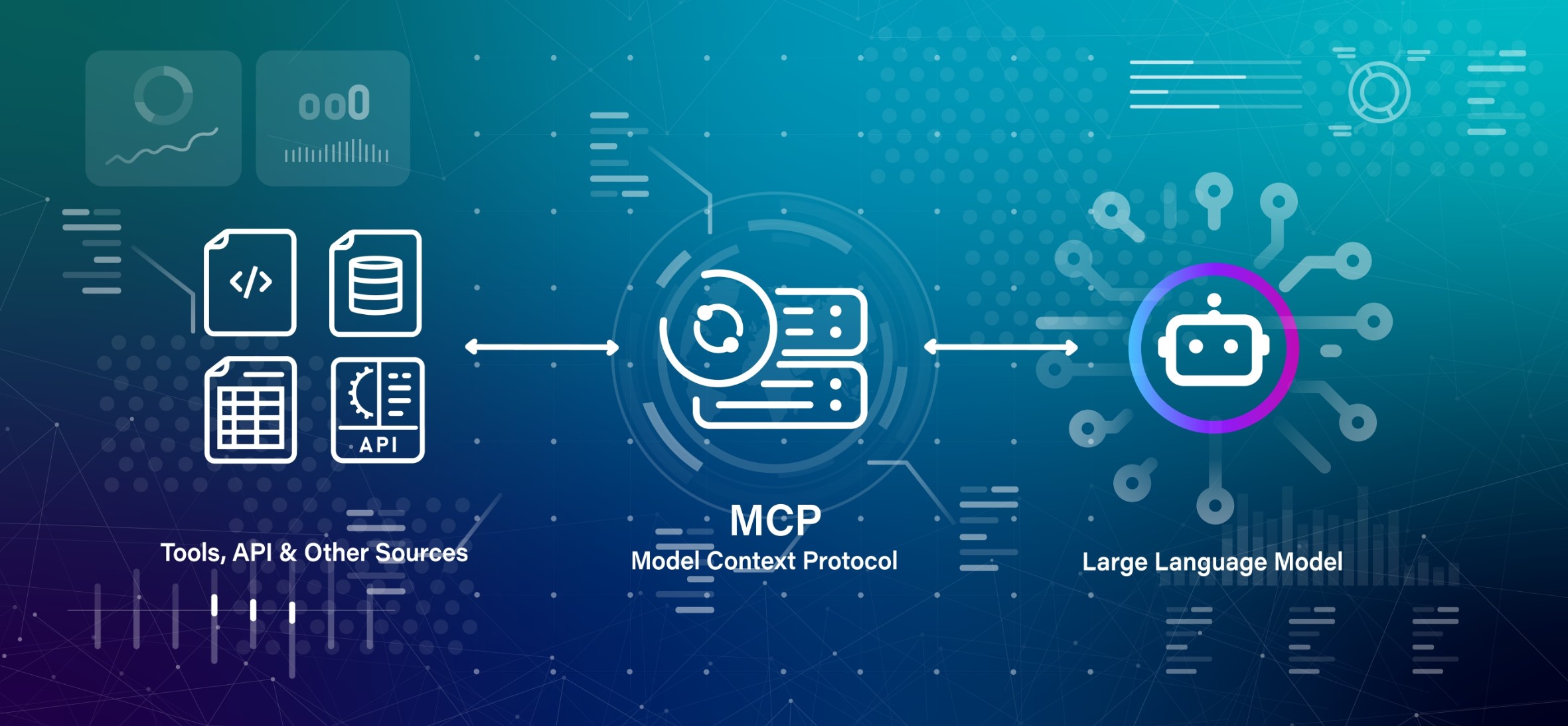
The idea behind Model Context Protocol, sitting between external data sources and APIs on one side and a large language model on the other
How MCP Connects Your AI To Another System
Anyone new to this asks the same thing first. What is actually happening between the AI model and the database. The answer is a client-server architecture with three clearly separated parts.
- Host: the AI application the user interacts with, such as Claude Desktop or Cursor IDE.
- MCP client:the intermediary sitting inside the host, taking the user’s instruction, sending the request, and receiving the result back from the server.
- MCP server: a server programme with one specific job, such as pulling records from a database or finding a document in cloud storage.
How it runs:you ask the AI for “a summary of this month’s revenue”. The host sends the request through the MCP client to the MCP server. The server retrieves the revenue data and sends it back. The AI processes the raw figures and returns a summary you can read.
Where MCP Goes Further Than A Traditional API
Both connect systems together. MCP was built specifically for the AI model reasons.
| Difference | MCP (Model Context Protocol) | Traditional API (REST/GraphQL) |
|---|---|---|
| Standard | One standard, works with any AI model that supports it | New integration code for every system, every time |
| Connection | Two-way exchange, so the AI can ask, answer and decide with more depth | Mostly one-way (request and response) |
| Context | Sends data with context attached, so the AI understands the situation | Sends raw data only, with nothing around it |
| Security | Permissions set through the client, giving precise control over what the AI can reach | Depends on how each developer writes it |
What MCP AI Integrations Look Like In Practice
- Customer service: connect the AI to a CRM through MCP so a chatbot can pull customer history and delivery status and answer in real time.
- Marketing and data analytics: have the AI pull from Google Analytics and Facebook Ads at once, and identify the campaign returning the most value, in a single instruction.
- Software development: connect an IDE to GitHub and a database through MCP so the AI can trace bugs, run SQL, or explain complex code.
- Content and search: connect a CMS to the AI to assess content quality, research in real time, and help keep published articles current.
Why An AI Agent Needs MCP To Do Real Work
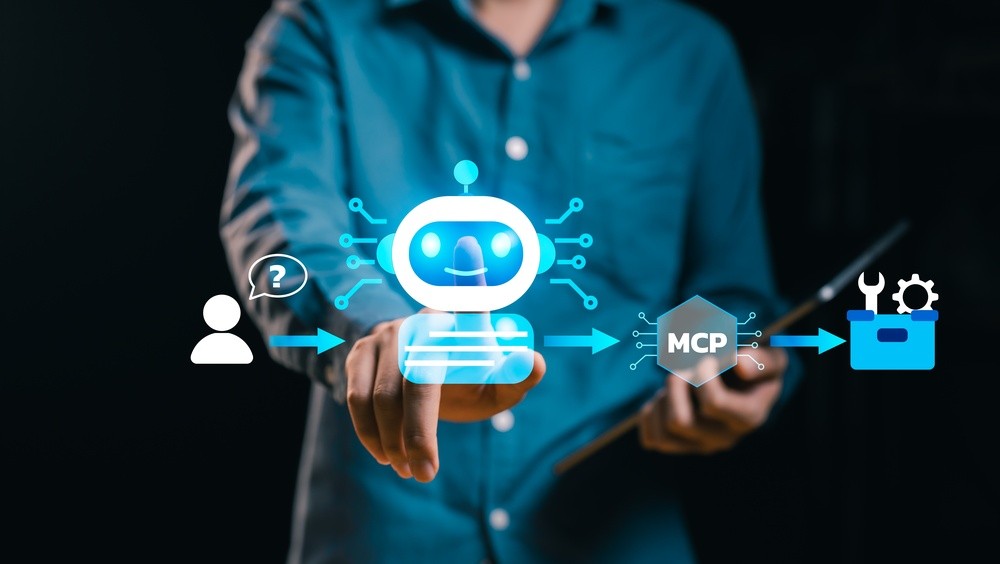
To move an AI model from answering questions to operating as an AI Agent, a programme that reasons through and executes several steps on its own, MCP is the piece that makes it possible. An AI agent cannot work in the real world without the right tools in reach.
MCP acts as the nervous system, linking the agent’s reasoning to the data systems around it, so it knows where to pull information from and where to send results back, in an orderly and secure way. That is the same structural thinking an AI search agency brings to a brand’s content: make the information reachable, and make its context obvious.
What MCP Means For Marketers In The AI Search Era
How people look for information is changing. Google AI Overviews, Perplexity and ChatGPT Search now summarise information from across sites and answer the user directly. MCP is part of the technology underneath that, letting these systems connect several sources together with context intact.
Brands that prepare their data structure so AI systems can reach it easily, which is AI-ready data, stand a better chance of being cited in the answer than their competitors. The approach has to move past the old frame and take in the wider picture of how AI now sits between a brand and its audience.
For organisations that would rather not miss the shift, the AI search agency capability at Primal covers the approach, the content structure and the platform work needed for an era where AI is the first stop in a search, so the brand stands out and the information is straightforward for an AI system to draw on.
Frequently asked questions about MCP, Model Context Protocol (FAQs)
| Question | Answer |
|---|---|
| What is the model context protocol MCP built to do, and does it cost anything? | MCP is an open standard that lets an AI model connect to external data and tools through one consistent interface. It is open source, so you can adopt it and build on it with no licence fee. The only costs are your own server infrastructure and the API charges for whichever AI model you use. |
| Who developed the Model Context Protocol? | Anthropic, the company behind Claude AI, developed MCP and released it as an open standard so any AI model or tool can adopt it. |
| If we already have APIs, do we have to rebuild everything to use MCP? | No. You can build an MCP server that acts as a wrapper around the API you already have, converting its output into a form an AI model can read with context, to the MCP standard. |
| Beyond Claude, do other AI providers support MCP? | Anthropic started it, and because it is an open standard, other tools and ecosystems have adopted it widely. That includes developer tools such as Cursor, Windsurf and GitHub Copilot, along with a growing set of enterprise AI applications. |
| Does giving an AI access to company databases through MCP risk a data leak? | MCP was designed with security as a priority. You can set least-privilege permissions, which means the AI reaches only what you allow it to reach in the MCP client, and nothing beyond that. |
| Can you connect MCP without a coding background? | Setting up an MCP server still takes some developer skill at this stage. No-code and low-code platforms are arriving steadily, and connecting systems to AI through MCP is heading towards being as simple as installing an app on a phone. |



















Join the discussion - 0 Comment